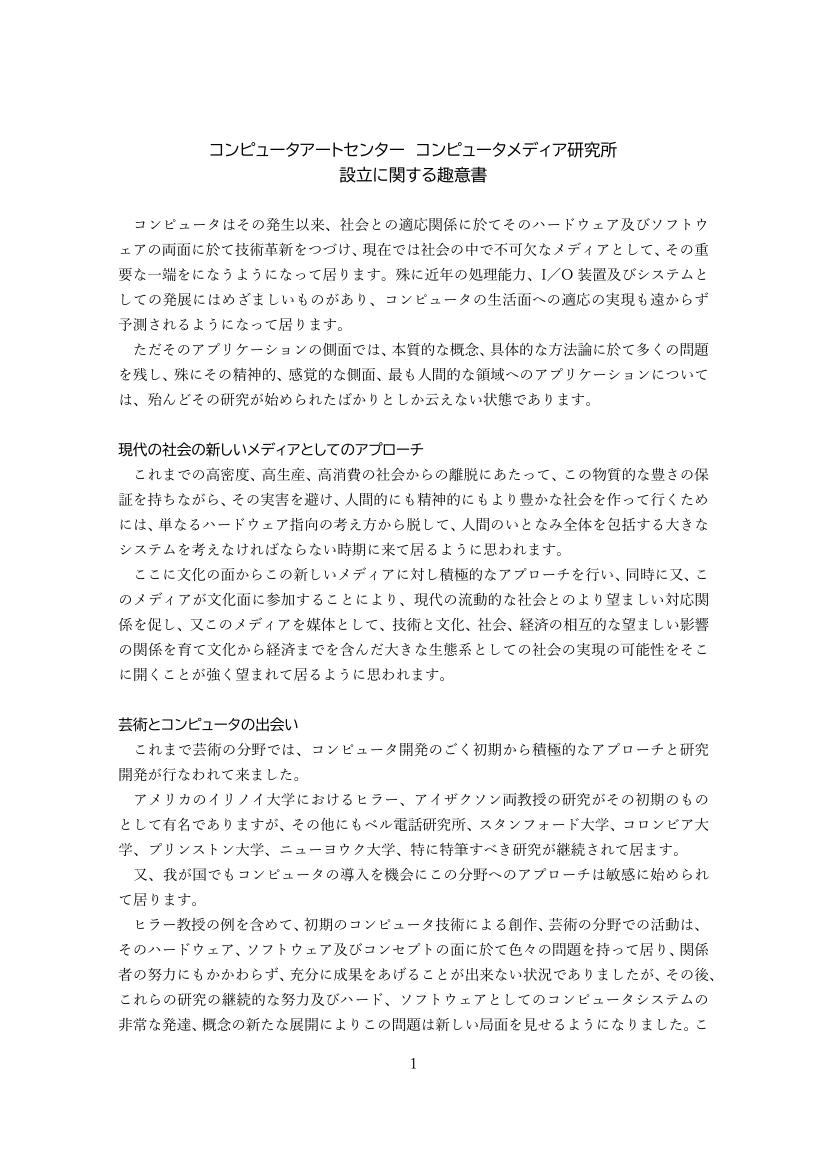
コンピュータアートセンター コンピュータメディア研究所設立に関する趣意書 (Prospectus for the Founding of the Computer Art Center / Computer Media Research Institute)
- Author
- Komei Hayama
- Year
- 1972
- Tags
- japan · hayama archive · computer art history · media art · pioneers
Notes
From the 端山貢明アーカイブ (Hayama Kōmei Archive), item 9864 in the コンピュータアート (computer art) category, registered 2022-10-01: https://d-commons.net/hayama/?c=&p=9864. Published by the 端山貢明アーカイブプロジェクト (Hayama Kōmei Archive Project), directed by 前川道博 (Michihiro Maekawa) of Nagano University, on the D-Commons platform, and licensed CC BY (表示). The source documents come from the 端山文庫, the papers kept in Hayama's laboratory at Tohoku University of Art and Design, digitised by the project with the agreement of his family; his autograph scores were given to the University History Archives of the Tokyo University of the Arts in 2026. A fundraising prospectus of 1972, surviving as a four-page typed text and as the ten-page handwritten original. The computer, it argues, has become an indispensable medium through continuous hardware and software innovation, and gains in processing power and I/O devices make its adaptation to everyday life foreseeable — yet application to the spiritual and sensory side, the most human domain, has barely begun. Leaving the high-density, high-consumption society behind without losing material security means moving past hardware-oriented thinking toward a system encompassing all human activity. Hayama then surveys who is already doing this: Hiller and Isaacson at the University of Illinois as the earliest case, with work continuing at Bell Telephone Laboratories, Stanford, Columbia, Princeton and New York University. On a recent American trip he found computer media close to domestic use and noted that Xerox and Bell Telephone invest heavily in returning culture to society. In Europe he cites the Computer Arts Society in London, which held an exhibition with events and demonstrations in Edinburgh the previous August; Barbaud and Xenakis in France, Franke and Nees in Germany. A turning point, he says, now allows one to speak of 「コンピュータアートの第二期」 ("the second period of computer art"). The institute's purpose is research into functioning as a medium linking culture with society and the economy through computer media. His complaint is structural: in Japan creators and hardware engineers almost never meet, and when they do it is by accident. The later sections are frankly commercial, listing returns to industry — new consumer markets, new peripherals, NC machining of metal and acrylic, space and industrial design, simulation-based amusement, CAI approached from the human side, computer-generated sound for living space. Industry and culture can no longer develop apart: culture must drive technical development, which in turn transforms culture. Contents as the document gives them: (無題序説) (untitled opening on the computer as an indispensable medium) · 現代の社会の新しいメディアとしてのアプローチ (An approach to this new medium of contemporary society) · 芸術とコンピュータの出会い (The encounter of art and the computer) · 諸外国に於ける研究・開発 (Research and development abroad) · コンピュータアートセンター コンピュータメディア研究所の意義 (The significance of the Computer Art Center / Computer Media Research Institute) · 社会への波及効果と企業へのメリット (Ripple effects on society and benefits to industry) · むすび (Conclusion). People named: ヒラー (Lejaren Hiller), アイザクソン (Leonard Isaacson), バルボー (Pierre Barbaud), クセナキス (Iannis Xenakis), フランケ (Herbert W. Franke), ネエス (Georg Nees). Two files are held here: the download above is the text version keyed by Maekawa's laboratory (4 pp.); attached alongside it is the scan of Hayama's handwritten original (10 pp.), at https://auzflodykqpwhwkadtpq.supabase.co/storage/v1/object/public/library-files/hayama-computer-art-center-founding-prospectus/scan-2.pdf. Noted: Neither file carries a date, a signature or an author's name; the attribution to Hayama and the year 1972 come from the archive, not from the document. The handwritten original (9864_cp000549_002.pdf, 10 numbered pages) is legible throughout and matches the typed text; it ends with the appeal for support and has no colophon. The Edinburgh C.A.S. exhibition is dated only as 「昨年8月」 (last August), i.e. August 1971 if the document is from 1972; it is not named. Romanisations of the transliterated Western names (Hiller, Isaacson, Barbaud, Xenakis, Franke, Nees) are inferred from katakana plus context; the document gives katakana only. The typed text contains transcription slips (「ニューヨウク大学」 for New York University; 「既存の危機」 for 既存の機器).