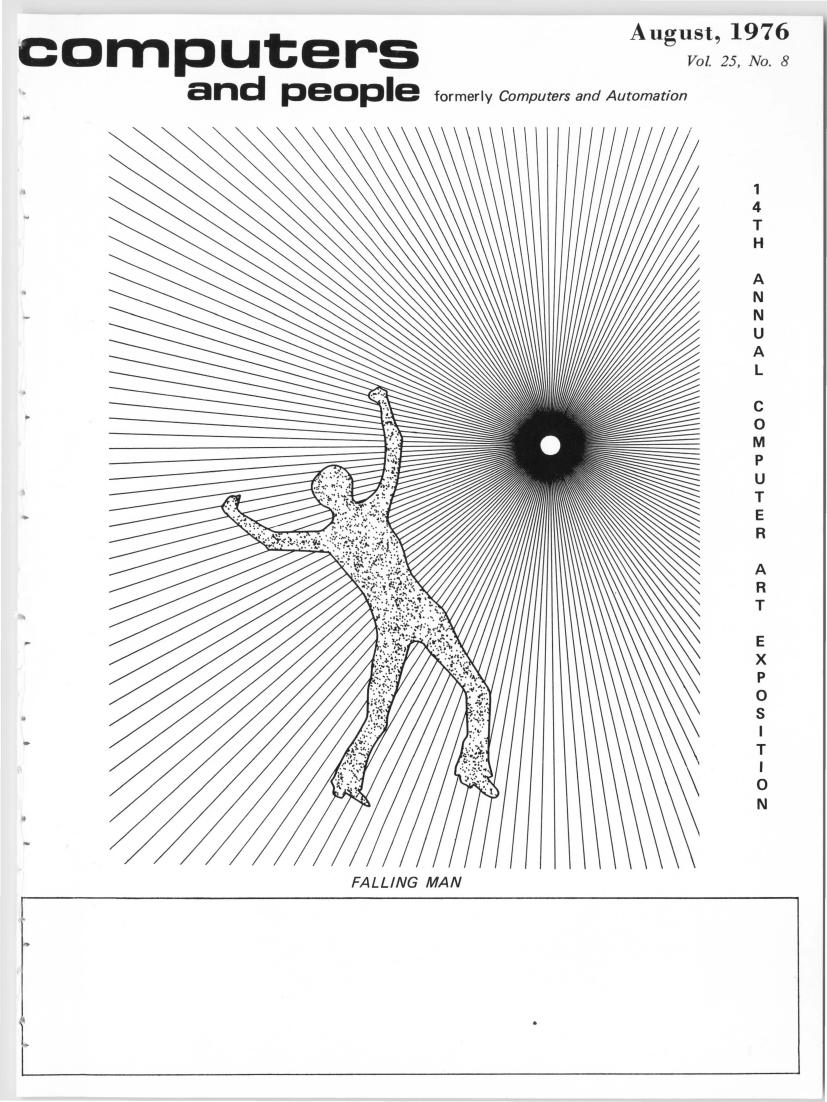
Computers and People, Vol. 25 No. 8 (August 1976) — Fourteenth Annual Computer Art Exposition
- Author
- Edmund C. Berkeley (ed.), Grace C. Hertlein (art ed.)
- Year
- 1976
- Published in
- Computers and People
- Publisher
- Berkeley Enterprises
- Subjects
- Duane M. Palyka, Edward Zajec, Herbert W Franke, Kerry Jones, Manuel Barbadillo, Mutsuko K. Sasaki, Sozo Hashimoto, Vera Molnar, Vilko Žiljak
- Tags
- magazine · computer art history · computers and people · exhibition catalog · digital-scan
Notes
Berkeley Enterprises, Newtonville MA, August 1976. 36 pp., OCR'd scan (text-searchable). The Fourteenth Annual Computer Art Exposition, edited by Grace C. Hertlein, Art Editor (California State University, Chico): more than 70 works by 24 artists from Brazil, England, France, Germany, Italy, Japan, Spain, the United States and Yugoslavia on pp. 8–31, each with an artist's statement, and a roster with cities on p. 31. Cover: Falling Man by Kerry Jones, a stippled figure tumbling across a radiating starburst. The artists: Manuel Barbadillo, Gregory R. Bass, Jean Bevis (Princely Potential, the symbol of the NCC '76 Art Exhibition), John Chudy, Analivia Cordeiro (M3X3), Michael Davis (Horse, Dancer and Document from his ARTRAN art-language system at San Francisco State), Barbara Dwyer, Herbert W. Franke (Bavaria), Sharon Gospich, Groupe Couleur de Belfort (industrial murals), Sozo Hashimoto (Mandala 4–6), Grace C. Hertlein (Leaf and Shell series, textile designs), Kerry Jones, Phil Lloyd (EnigMA, Rocky Coast, The Vortex), Jean-Claude Marquette (Vois-voie-voix-voyelles), Tony Martin, Tomislav Mikulić, Vera Molnár (Transformations), Joseph Ovadia (Math Functions), Duane M. Palyka (Burning Figure, Two Figures, Strange Bird on the Evans & Sutherland frame buffer), Mutsuko Kunii Sasaki, James C. Ver Hague Jr. (tapestries), Edward Zajec (Diagonal White) and Vilko Žiljak. Sasaki's Nemophila (p. 23) is the earliest appearance of her ART-3 system in this library, and she is credited here as Mutsuko Kunii Sasaki of Tokyo. A nemophila plant, divided into parts with differently textured leaves and flowers, glows out of a dark interference field; it was produced on a FACOM 230-75 computer and a Calcomp plotter at the Institute of Physical and Chemical Research (RIKEN). Her statement: "Nature created many beautiful things, and human beings found artificial beauty in mathematics. In order to combine the beauties of nature and mathematics, a system named ART-3 has been constructed." Hertlein adds that her work "generally has a representational basis, and most of her forms are derived from nature". Her later papers in this library (Computers and People, November–December 1981; IPSJ reports of 1992 and 1993) develop the same system. Hertlein's editorial, "NCC '76 Art Review, Directions and Questions: The Role of the Computer in Computer Art" (pp. 6–7), reviews the NCC '76 Art Exhibition at the New York Hilton, 7–10 June 1976, 361 works gathered by Jackie Potts of the Social Security Administration and the largest computer-art show yet held in the United States. Her findings: computer artists are no longer an elitist group of mathematicians and scientists; mixed media now dominates professional work (of 216 invited works only 20 were on white industrial plotter paper, against 91 of the 145 juried, mostly student works), because plotter and CRT output should be treated as intermediate rather than final forms; software is freely shared, so a capable artist can read a graphic and reproduce it; and Evans & Sutherland's solid-appearing graphics and frame buffer (Palyka's work, the Henry Christiansen collection of shaded finite-element images, E. T. Manning's scanchrome portraits of Washington and Lincoln that "literally stole the show") will bring a genuine revolution. A full-page chart lays out the alternatives of input, processing, output and final form, and she predicts "a fully developed, accepted art form made possible by computers" by 1980. Page 30 carries an open invitation to The Varied Computer Arts, a touring exhibition for US science and technology museums in early 1977. The rest of the issue: computers at the Montreal Olympics drug tests, a program describing exploding stars, the European Computer Chess Championship, and Neil Macdonald's puzzles. The magazine's other Annual Computer Art Contest / Exposition issues, August 1963 to 1973, August 1975 and September–October 1980 (plus the July–August 1980 rules and the July–August 1981 announcement ending the series), are also in this library.