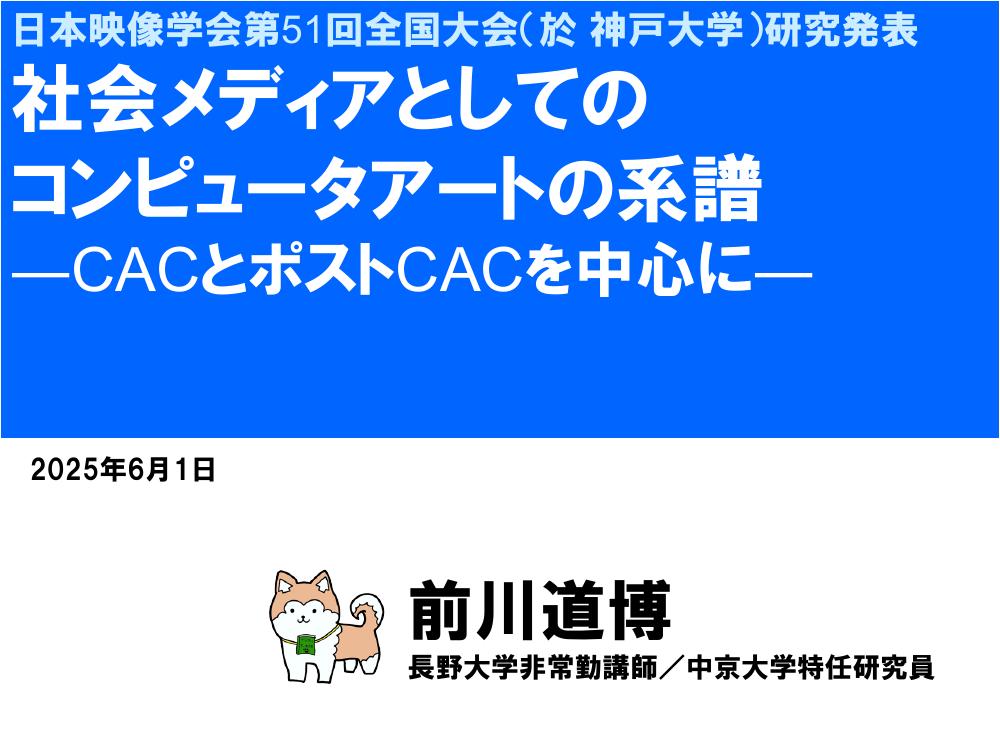
社会メディアとしてのコンピュータアートの系譜―CACとポストCACを中心に― (A Genealogy of Computer Art as Social Media: Centring on CAC and Post-CAC)
- Author
- Michihiro Maekawa
- Year
- 2025
- Published in
- 日本映像学会第51回全国大会研究発表(於 神戸大学), 1 June 2025; presenter 前川道博, 長野大学非常勤講師/中京大学特任研究員; video https://youtu.be/vTHyHvgnjqw
- Tags
- japan · hayama archive · computer art history · research
Notes
From the 端山貢明アーカイブ (Hayama Kōmei Archive), item 133434 in the アーカイブプロジェクト (archive project) category, registered 2026-05-13: https://d-commons.net/hayama/?c=&p=133434. Published by the 端山貢明アーカイブプロジェクト (Hayama Kōmei Archive Project), directed by 前川道博 (Michihiro Maekawa) of Nagano University, on the D-Commons platform, and licensed CC BY (表示). The source documents come from the 端山文庫, the papers kept in Hayama's laboratory at Tohoku University of Art and Design, digitised by the project with the agreement of his family; his autograph scores were given to the University History Archives of the Tokyo University of the Arts in 2026. Source: 日本映像学会第51回全国大会研究発表(於 神戸大学), 1 June 2025; presenter 前川道博, 長野大学非常勤講師/中京大学特任研究員; video https://youtu.be/vTHyHvgnjqw. Dated: 2025年6月1日 (presented 1 June 2025). A 32-slide paper given to the 51st annual conference of the Japan Society of Image Arts and Sciences at Kobe University on 1 June 2025, reporting an exploratory step toward a "post-CAC" digital archive. Its aims: to trace how computer art turned into social media during and after CAC, to give CAC the historical placement it never received, and to assess Hayama and Komura Masao. The 2020–24 survey found 81 boxes at the Yamagata cable station (now Diversity Media) plus 13 at Maekawa's house; Komura was interviewed at Nagano University on 29 July 2023. The history begins with Kawano Hiroshi and then CTG, the Computer Technique Group formed in 1966 by Komura Masao (Tama Art University), Tsuchiya Haruki (University of Tokyo, mechanical engineering), Yamanaka Kunio and Kakizaki Jun'ichirō, later ten members. Its second manifesto (1967) called for collaboration between artists, scientists and other creative people to look coolly at the relation of human and machine; the symposium "Electronic Computers and Art" at Tama Art University on 9 October 1967 declared computer art a new art. Works cited are Random Walk Kennedy (1967), Running Cola is Africa (1968) and Return to Square (b) (1968), made from formal grammars plus parameters. Komura showed in Cybernetic Serendipity at the ICA, London, in 1968; Hayama's CAC, founded October 1972, then ran Cybernetic ARTRIP from 1973. Maekawa reads Hayama's turn from composition as Copernican, prompted by Messiaen — who showed him the depth of Western civilisation and the limits of music as a medium answering social demand — and above all by Cage's 4'33", which moved him from determinate to indeterminate music and so to the agency of the access side. In 1974 Hayama founded the Social Dynamics Institute, pitched against statistics as a knowledge that sees society only statically, and proposed INFORUM in a MITI-commissioned project. The schema is CTG (60s) → CAC (70s) → post-CAC, computer art shifting from art to social media. Contents as the document gives them: CAC(コンピュータ・アート・センター)の視座/それ以前とそれ以後 (The CAC viewpoint: before and after) · CAC/ポストCACに関わる事前調査 2020~2024年 (Preliminary survey 2020–24) · 本研究のねらい (Aims of this research) · コンピュータ・アート・センター(CAC) (The Computer Art Center, founded October 1972) · 「端山貢明アーカイブ」 (The Hayama Kōmei Archive, opened 20 September 2022) · コンピュータアートの源流:CTG (The source of computer art: CTG) · 「コンピュータ・アートは新しい芸術である」/シンポジウム「電子計算機と芸術」 (Computer art is a new art; the symposium Electronic Computers and Art) · 幸村真佐男の作品 (Komura's works: Random Walk Kennedy 1967, Running Cola is Africa 1968, Return to Square (b) 1968, 非語辞典 1980s) · 端山貢明/ヴィオラ協奏曲(1955)、メシアンに師事、電子音楽、ケージからの啓示 (Hayama: Viola Concerto, Messiaen, electronic music, the revelation of Cage) · CAC設立に関する趣意(1972) (The 1972 CAC prospectus) · 国際コンピュータ・アート展 Cybernetic ARTRIP 1973~1978 · インフォーラム INFORUM (1974, MITI-commissioned) · 社会メディアとしてのコンピュータアートの軌跡:CTG(60s)→CAC(70s)→CAC以後 · ポストCAC俯瞰図 (Overview chart of pre- and post-CAC) · ソシアルダイナミクスへの展開 (The turn to social dynamics) · 創造性を育む教育のイノベーション (Innovation in education for creativity) · 端山貢明による社会メディアの視点 (Hayama's view of social media) · 「アート」の問い直し (Rethinking 'art') · 探究的試行・まとめ (Exploratory trial: conclusions). People named: 前川道博 (Maekawa Michihiro) — presenter, 端山貢明 (Hayama Kōmei, 1932–2021), 幸村真佐男 (Komura Masao, b. 1943), 川野洋 (Kawano Hiroshi), 槌屋治紀 (Tsuchiya Haruki), 山中邦夫 (Yamanaka Kunio), 柿崎純一郎 (Kakizaki Jun'ichirō), 大泉和文 (Ōizumi Kazufumi) — cited for 『コンピュータ・アートの創生 CTGの軌跡と思考 1966-1969』, ジョン・ケージ (John Cage), オリヴィエ・メシアン (Olivier Messiaen), 大岡信 (Ōoka Makoto) — text of the 1965 symphony 「象形」. Noted: The slides date the international exhibition series inconsistently: 'Cybernetic ARTRIP 1973-1978' on one slide and 'ARTRIP 1973-75' on the chronology chart; Komura's own CV slide gives '1973 国際コンピューターアート展「Cybernetic ARTRIP」東京(~1975)'. Several slides are images (the CAC function diagram, the ARTRIP'73 venue plan, the committee and secretariat list, the FACOM U-200 price slide) whose content is not in the PDF's text layer and could not be read. The CTG second manifesto is quoted without a source citation beyond the year 1967. Komura's works are reproduced as images; dates and titles are taken from the slide captions. The site migration to 'CA-DA' is announced as a plan, not a fact.