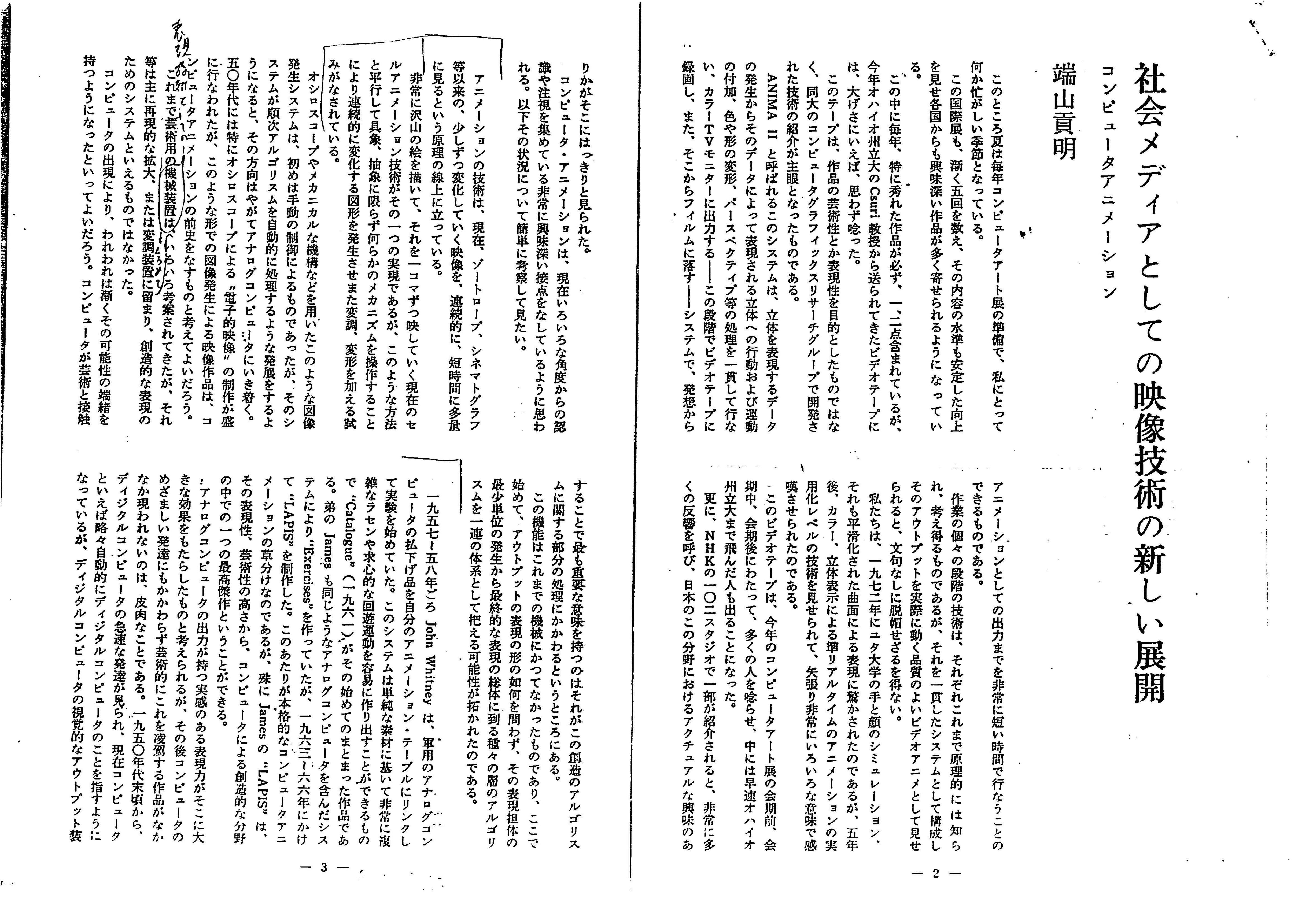
社会メディアとしての映像技術の新しい展開―コンピュータアニメーション (A New Development in Image Technology as a Social Medium: Computer Animation)
- Author
- Komei Hayama
- Year
- 1978
- Subjects
- Charles Csuri, Computer Technique Group, Daniel J. Sandin, James Whitney, John Whitney, Kenneth Knowlton, Komei Hayama, Stan VanDerBeek
- Tags
- japan · hayama archive · essay
Notes
From the 端山貢明アーカイブ (Hayama Kōmei Archive), item 54991 in the 著書・論文 category, registered 2023-03-25: https://d-commons.net/hayama/?c=&p=54991. Published by the 端山貢明アーカイブプロジェクト (Hayama Kōmei Archive Project), directed by 前川道博 (Michihiro Maekawa) of Nagano University, on the D-Commons platform, and licensed CC BY (表示). The source documents come from the 端山文庫, the papers kept in Hayama's laboratory at Tohoku University of Art and Design, digitised by the project with the agreement of his family; his autograph scores were given to the University History Archives of the Tokyo University of the Arts in 2026. Source: 『映像学』 (Eizogaku / Iconics, journal of the Japan Society of Image Arts and Sciences) no. 8, 30 January 1978, special issue on animation. The archive copy is an offprint carrying a few handwritten corrections in Hayama's hand; the PDF duplicates its first scanned spread.. Dated: issue dated 30 January 1978. The archive publishes this item as 7 separate page scans rather than as a PDF; the download here was assembled from those scans in page order, each taken at the higher of the two resolutions the archive serves. Hayama's fullest statement on computer animation. It opens with the videotape Charles Csuri sent from Ohio State University to the fifth Computer Art Exhibition (コンピュータアート展), which Hayama helped run: ANIMA II, a PDP-11/45 that builds polyhedra, moves them, hides lines, shades them and outputs near-real-time colour animation. Shown there and on NHK's Studio 102, it sent Japanese researchers flying to Columbus — a reflex he finds humiliating. He lays out a history, summarised in a timeline diagram: the zoetrope (1834), cinema (1894), Eggling's Diagonal Symphony (1924), Duchamp's Anémic Cinéma (1926), 1950s oscilloscope "electronic images"; John Whitney wiring a surplus military analogue computer to his animation stand for Catalogue (1961), and his brother James's Lapis (1963–66), still the finest thing made with a computer. Then digital: the IBM 2250 display (1966) behind Whitney's Matrix series and J. Citron's CAMP program; VanderBeek's Poem Field 1–8, Collideoscope and Ad Infinitum on Knowlton's BEFLIX at Bell Labs. Japan's first computer animation, 「風雅の技法」 (1967) by Tsukio Yoshio and Yamada Manabu, was plotted frame by frame; CTG's Computer Movie No. 2 (1968) he rates below their prints. Underneath runs an argument about "the agency of the access side" (アクセス側の主体性). Optic, kinetic and light art of the 1960s and the 1970 Osaka Expo promised participation but had too thin a layer of information to sustain it. Hence his praise for Scanimate, Fuji TV's "Art Color", Mita's Figurescope, and above all DeFanti and Sandin's Circle Graphics Habitat at Illinois (GRASS on a PDP-11/45), whose Circle 9 Sunrise was performed live and sent to Computer Art Exhibition '76. Nothing survives such a performance, so this is no longer animation but a communication shaped with its audience. He ends by urging the society to open a computer-art section (部会) and to treat the field as a social medium, regretting that nearly all of it is American because Japan funds no continuous research. Contents as the document gives them: 前半部に見出しなし(the text runs without printed section headings) · 図:コンピュータアニメーション前史/開発実験期/実用化社会化実験期 (diagram: prehistory of computer animation / development-and-experiment period / practicalisation-and-socialisation experiment period, 1834–1970s). People named: 端山貢明 (Hayama Komei), Charles Csuri, John Whitney, James Whitney, Stan VanderBeek, Ken Knowlton, J. Citron, D. Bottles, Tom DeFanti (T. DeFanti), Dan Sandin (D. Sandin), 月尾嘉男 (Tsukio Yoshio), 山田学 (Yamada Manabu), 吉積徹 (Yoshizumi Toru), 新宮晉 (Shingu Susumu), 伊藤隆道 (Ito Takamichi), 三田繋治 (Mita — given name romanisation uncertain), Viking Eggling (エッゲリング), Marcel Duchamp (デュシャン), J. S. Bach (バッハ). Noted: The article carries no printed section headings; the only structural apparatus is the folding timeline diagram, whose labels are transcribed above. 三田繋治, maker of the 「フィギュアスコープ」 (Figurescope), cannot be romanised with confidence (Mita Shigeharu / Keiji / Shigeji are all possible readings). VanderBeek's "Collidescope" is spelled thus in the Japanese text; the film is usually titled Collideoscope. The surname of "D. Bottles" at IBM Los Angeles Scientific Center is transliterated from katakana-free roman text in the article and could not be verified. Page numbers within the issue are not printed on the scan; only the journal number and date are legible. Pages 1 and 2 of the PDF are byte-identical scans of the same spread.