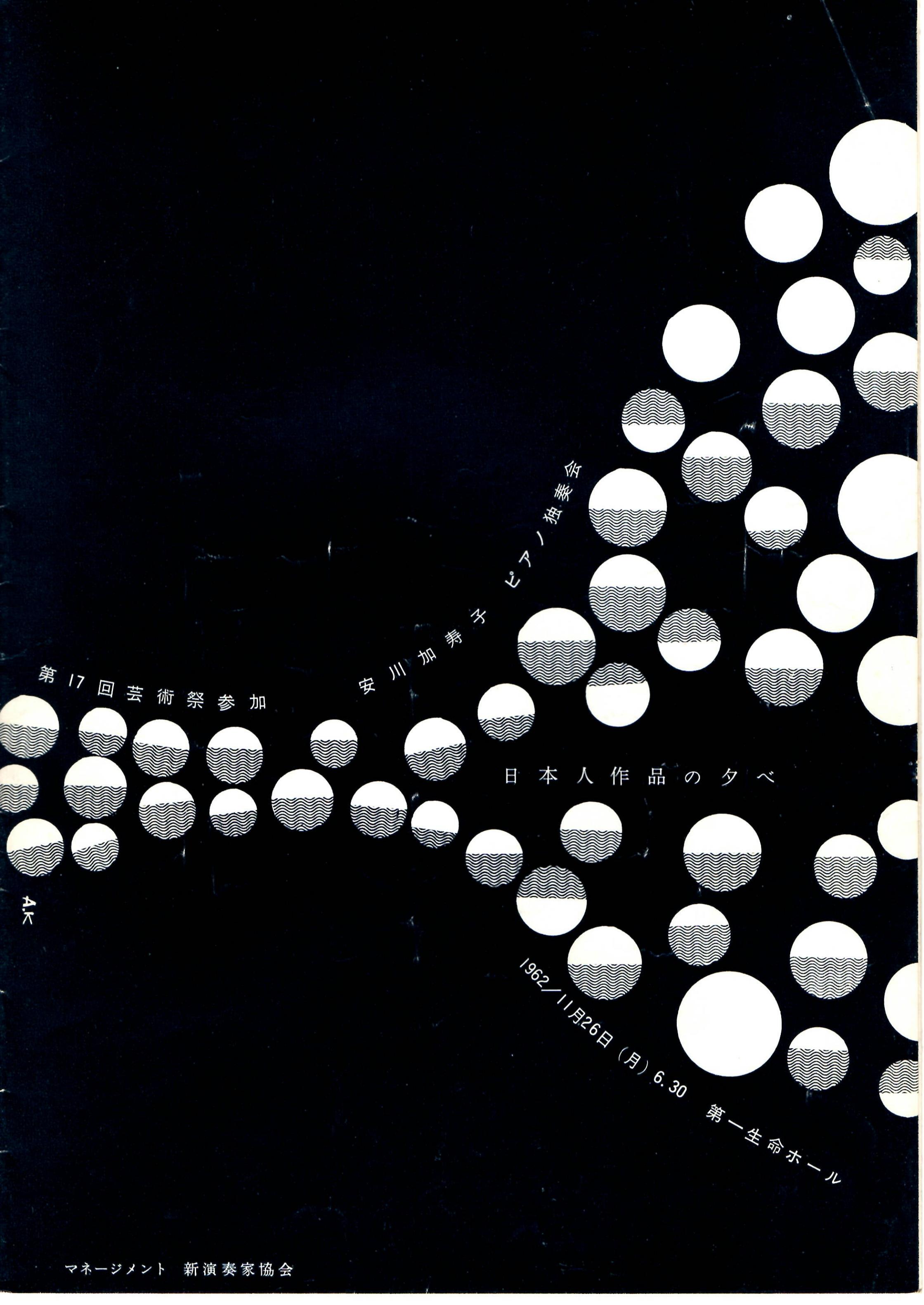
安川加寿子ピアノ独奏会 (Yasukawa Kazuko piano recital)
- Author
- Komei Hayama
- Year
- 1962
- Subject
- Komei Hayama
- Tags
- japan · hayama archive
Notes
From the 端山貢明アーカイブ (Hayama Kōmei Archive), item 9954 in the 音楽(演奏会) category, registered 2022-10-04: https://d-commons.net/hayama/?c=&p=9954. Published by the 端山貢明アーカイブプロジェクト (Hayama Kōmei Archive Project), directed by 前川道博 (Michihiro Maekawa) of Nagano University, on the D-Commons platform, and licensed CC BY (表示). The source documents come from the 端山文庫, the papers kept in Hayama's laboratory at Tohoku University of Art and Design, digitised by the project with the agreement of his family; his autograph scores were given to the University History Archives of the Tokyo University of the Arts in 2026. Source: 17th Art Festival entry; Dai-ichi Seimei Hall, Tokyo; management Shin-Ensōka Kyōkai (新演奏家協会). Dated: Monday 26 November 1962, 6:30 p.m.. The archive publishes this item as 7 separate page scans rather than as a PDF; the download here was assembled from those scans in page order, each taken at the higher of the two resolutions the archive serves. The programme book for Yasukawa Kazuko's recital 日本人作品の夕べ ('An evening of Japanese works'), entered in the 17th Art Festival, five months after Hayama's own concert in the same hall. Her programme was five Japanese sonatas and sonatinas: Otaka Hisatada's Piano Sonatina op. 13 (Allegretto moderato, Intermezzo, Allegro vivace); Hirao Kishio's Piano Sonata (Poco lento–Allegro molto, Lento, Allegro assai); two Sonatinas by Okumura Hajime, No. 3 and No. 4; Hayama's ピアノ ソナタ (Piano Sonata: Allegro assai, Lento, Allegro molto); and Yashiro Akio's Piano Sonata (Agitato; Toccata–Allegro ritmico; Thema and Variations–Lento). The book notes that all the works were Art Festival entries, and records Yasukawa's earlier Japanese-works recitals from 1950 on. Hayama contributed his own note on the sonata. The first movement, he writes, is shaped by ceaseless semiquaver undulation: fragments whose unit is two bars of indeterminate length ride waves of extreme dynamic change and of swelling and shrinking tone-clusters, and to find a directedness in non-tonal pitch he simplified the pitch material, a special mode giving the ear a kind of hardness; behind the sustained chords near the middle the unwritten semiquaver motion continues. The second movement is three-part counterpoint around a repeated simple figure, touching several modes. The third applies the same methods to another aspect of the same material. He ends by saying it is a great joy to have this piece, which he loves, played by Professor Yasukawa, who taught him so much about the depth of music through the piano. Contents as the document gives them: I 尾高尚忠:ピアノ ソナチネ 作品13 (Otaka Hisatada: Piano Sonatina op. 13) — Allegretto moderato / Intermezzo / Allegro vivace · II 平尾貴四男:ピアノ ソナタ (Hirao Kishio: Piano Sonata) — Poco lento–Allegro molto / Lento / Allegro assai · III 奥村一:ピアノ ソナチネ 第3番・第4番 (Okumura Hajime: Piano Sonatinas Nos. 3 and 4) · IV 端山貢明:ピアノ ソナタ (Hayama Kōmei: Piano Sonata) — Allegro assai / Lento / Allegro molto · V 矢代秋雄:ピアノ ソナタ (Yashiro Akio: Piano Sonata) — Agitato / Toccata–Allegro ritmico / Thema and Variations–Lento · 安川加寿子「日本人作品のリサイタル」の記録 (A record of Yasukawa's previous Japanese-works recitals, 1950 onwards) · 曲目解説 (Programme notes, Hayama writing on his own sonata) · English programme page with romanised names. People named: 端山貢明 (Hayama Kōmei), 安川加寿子 (Yasukawa Kazuko, piano), 尾高尚忠 (Otaka Hisatada, composer), 平尾貴四男 (Hirao Kishio, composer), 奥村一 (Okumura Hajime, composer), 矢代秋雄 (Yashiro Akio, composer), 林光 (Hayashi Hikaru, author of a programme note), 山岡優子 (Yamaoka Yūko, named as the first performer of Yashiro's sonata). Noted: The archive's description gives the first composer as 尾高忠直; the programme reads 尾高尚忠 (Otaka Hisatada), which has been followed. Pages 1 and 2 of the PDF are the same cover image. In Hayama's note one term, transliterated ミスタシオン, is left untranslated here; it appears to be the same idea of 変応 (mutation) he credits to Ikenouchi elsewhere.