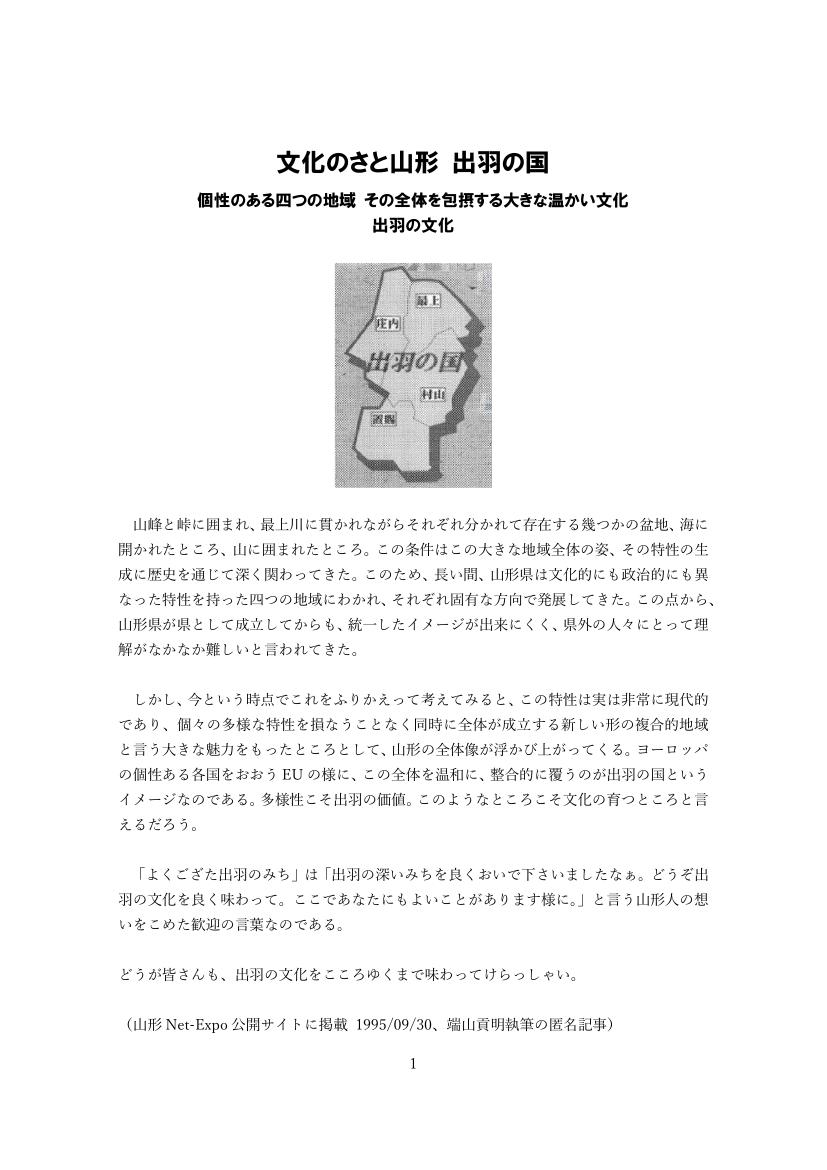
文化のさと山形 出羽の国 (Yamagata, Home of Culture: the Land of Dewa)
- Author
- Komei Hayama
- Year
- 1995
- Published in
- 山形Net-Expo公開サイト (the Yamagata Net-Expo public website), 30 September 1995; unsigned article written by Hayama Komei
- Subject
- Komei Hayama
- Tags
- japan · hayama archive · essay
Notes
From the 端山貢明アーカイブ (Hayama Kōmei Archive), item 9880 in the 執筆記事 (articles) category, registered 2022-10-02: https://d-commons.net/hayama/?c=&p=9880. Published by the 端山貢明アーカイブプロジェクト (Hayama Kōmei Archive Project), directed by 前川道博 (Michihiro Maekawa) of Nagano University, on the D-Commons platform, and licensed CC BY (表示). The source documents come from the 端山文庫, the papers kept in Hayama's laboratory at Tohoku University of Art and Design, digitised by the project with the agreement of his family; his autograph scores were given to the University History Archives of the Tokyo University of the Arts in 2026. Source: 山形Net-Expo公開サイト (the Yamagata Net-Expo public website), 30 September 1995; unsigned article written by Hayama Komei. Dated: Posted to the Yamagata Net-Expo public website on 30 September 1995; the closing note states Hayama wrote it but that it appeared anonymously.. Companion piece to Hayama's Net-Expo proposal, on the same website and the same date, this single page argues that Yamagata's geography has already given it the shape the networked age rewards. It begins with the terrain: several basins existing separately, ringed by peaks and passes and threaded by the Mogami River, some places open to the sea and some closed in by mountains. That condition, he writes, has been deeply involved through history in generating the character of the whole region, so that Yamagata Prefecture long divided culturally and politically into four regions of distinct character, each developing in its own direction — which is why, he notes, a unified image has been hard to form and outsiders are said to find Yamagata hard to understand. The second movement reverses the complaint. Seen from the present, he says, that characteristic is in fact extremely contemporary: Yamagata emerges as a composite region of a new kind, attractive precisely because the whole holds together without damaging the diverse character of its parts. His analogy is current — as the EU covers the distinctive nations of Europe, so the image of the land of Dewa (出羽, the old province covering present-day Yamagata and Akita) covers this whole genially and consistently. 「多様性こそ出羽の価値」, diversity is exactly Dewa's value, and such a place, he concludes, is where culture grows. The last paragraph turns to dialect. He glosses the greeting 「よくござた出羽のみち」 as carrying a Yamagata person's feeling: thank you for coming all this way along the deep roads of Dewa, please savour its culture, may good things come to you here. He then signs off in dialect himself, inviting readers to taste Dewa's culture to their heart's content. Written for the launch of the prefecture's first large web presence, the piece supplies cultural self-description for an audience the author expects to arrive over a network rather than at a gate: it provides the content for which the Net-Expo text provides the method. Contents as the document gives them: 個性のある四つの地域 その全体を包摂する大きな温かい文化 (Four regions each with its own character, and a large, warm culture that encompasses the whole) · 出羽の文化 (The culture of Dewa). Noted: The text refers to four distinct regions of Yamagata but does not name them, so I have not named them. The transcription has 「どうが皆さんも」 where 「どうぞ」 is evidently meant. No byline appears on the page itself; the attribution to Hayama comes from the archive's closing note.