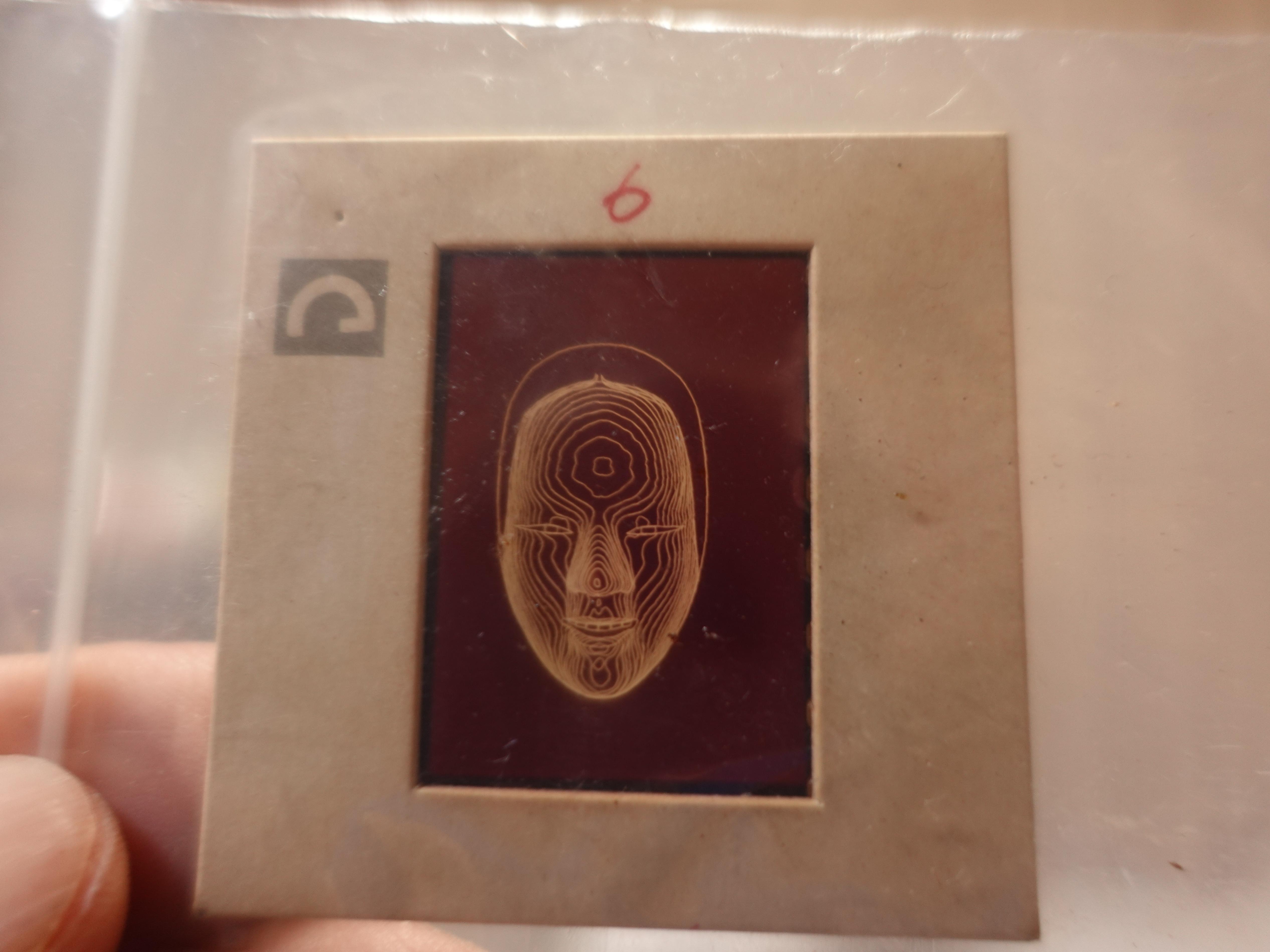
能面のワイヤーフレーム (Wireframe of a Noh mask)
- Author
- Komei Hayama
- Subject
- Komei Hayama
- Tags
- japan · hayama archive · computer art history · media art
Notes
From the 端山貢明アーカイブ (Hayama Kōmei Archive), item 124966 in the コンピュータアート category, registered 2023-08-19: https://d-commons.net/hayama/?c=&p=124966. Published by the 端山貢明アーカイブプロジェクト (Hayama Kōmei Archive Project), directed by 前川道博 (Michihiro Maekawa) of Nagano University, on the D-Commons platform, and licensed CC BY (表示). The source documents come from the 端山文庫, the papers kept in Hayama's laboratory at Tohoku University of Art and Design, digitised by the project with the agreement of his family; his autograph scores were given to the University History Archives of the Tokyo University of the Arts in 2026. Source: A 35 mm colour slide, photographed in its sleeve, with a second photograph of a framed print; 3 scanned pages, of which the first is a duplicate.. The archive publishes this item as 3 separate page scans rather than as a PDF; the download here was assembled from those scans in page order, each taken at the higher of the two resolutions the archive serves. Two photographs record a strand of Hayama's later research: the representation of the Noh mask in three dimensions. The first is a close photograph of a 35 mm slide still in its plastic sleeve, the card mount numbered 6 in red ink. The transparency holds a wireframe rendering of a Noh mask on a deep maroon ground, drawn in fine cream lines: an outer oval giving the silhouette of the mask, and within it a dense field of contour lines that model the brow, the swell of the cheeks, the bridge and wings of the nose, the lips and the chin, with the eye openings cut as narrow slits and a tight nest of rings over each brow. The lines read as sections through a measured surface rather than as a drawing, which is what makes the image evidence: the mask has been digitised as a surface and plotted back out. The second photograph, cropped from a view of a room, shows the finished computer-graphic version framed under glass on a wall, with a small caption label above it. Here the wireframe has become a shaded rendering — a smooth white mask, its eyes and mouth dark slots, floating on a dark ground. The archive records that this finished image was one of the works Hayama was particularly fond of, that it hung in his laboratory at Tohoku University of Art and Design, and that the original has not been located; the photograph is a crop from a 1998 picture of the laboratory supplied by Le Mars. The pair matters because it attaches a concrete artefact to an otherwise undocumented project. Hayama's writing of the 1970s is almost entirely about sound, space and interaction; the Noh mask work shows him later turning the same instruments — measurement, numerical description, plotting — onto a traditional Japanese object, and taking enough pleasure in the result to hang it on his own wall. Noted: Neither photograph carries a date, a caption or any technical note; the year is unknown and the attribution of the work to Hayama rests on the archive's cataloguing. The red "6" on the slide mount implies a numbered sequence; the rest of that sequence is not in this item. No machine, program, plotter or capture method is recorded, and it is not stated which mask type (ko-omote, zō-onna or another) was digitised. Pages 1 and 2 of the scan are the same photograph. The provider of the 1998 laboratory photograph is given by the archive as ル・マルス, rendered here as Le Mars; the name has not been verified.