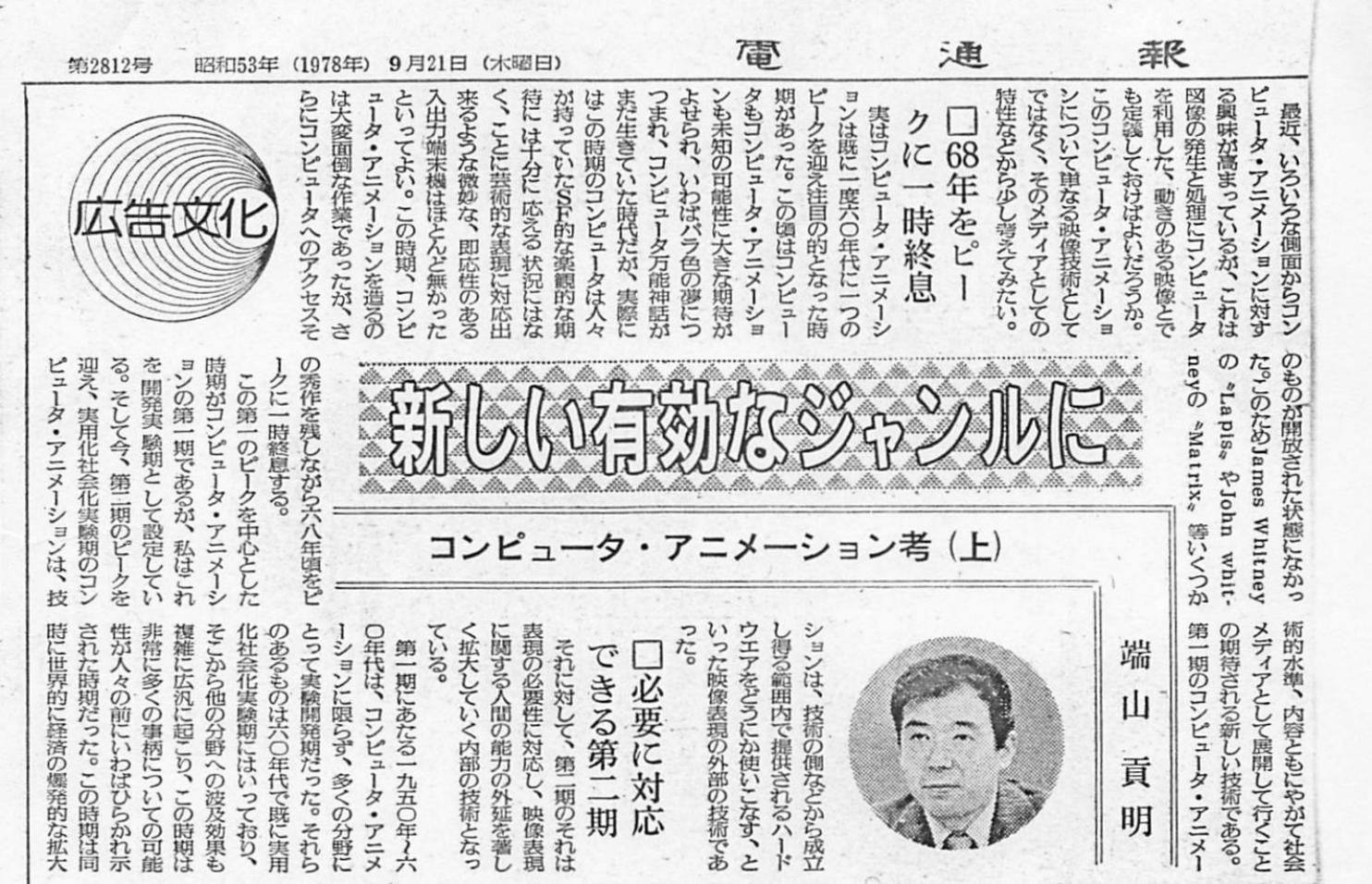
コンピュータ・アニメーション考(上)(下) (Thoughts on Computer Animation, Parts 1 and 2)
- Author
- Komei Hayama
- Year
- 1978
- Subjects
- A. Michael Noll, Komei Hayama
- Tags
- japan · hayama archive · essay
Notes
From the 端山貢明アーカイブ (Hayama Kōmei Archive), item 54992 in the 著書・論文 category, registered 2023-03-25: https://d-commons.net/hayama/?c=&p=54992. Published by the 端山貢明アーカイブプロジェクト (Hayama Kōmei Archive Project), directed by 前川道博 (Michihiro Maekawa) of Nagano University, on the D-Commons platform, and licensed CC BY (表示). The source documents come from the 端山文庫, the papers kept in Hayama's laboratory at Tohoku University of Art and Design, digitised by the project with the agreement of his family; his autograph scores were given to the University History Archives of the Tokyo University of the Arts in 2026. Source: 電通報 (Dentsu Ho, the house paper of the advertising agency Dentsu), in the column 広告文化 (Advertising Culture): no. 2812, Thursday 21 September 1978 (part 1, headlined 「新しい有効なジャンルに」) and no. 2813, Monday 25 September 1978 (part 2, headlined 「広告制作でも大きな効果」). Hayama is bylined with a portrait photograph and signs as コンピュータ・アート・センター代表 (director, Computer Art Center). The archive copy is a clippings scan.. Dated: part 1 (上) 21 September 1978; part 2 (下) 25 September 1978. The archive publishes this item as 3 separate page scans rather than as a PDF; the download here was assembled from those scans in page order, each taken at the higher of the two resolutions the archive serves. Written for an advertising readership two months before the longer Eizogaku essay, this two-part column compresses the same argument and adds a commercial one. Part 1 periodises the field. Computer animation — moving images whose figures are generated and processed by computer — peaked once already in the 1960s, when the machine was wrapped in science-fiction optimism it could not meet: terminals responsive enough for artistic expression barely existed and access to the computer was closed. That first peak, the development-and-experiment period (開発実験期), ended around 1968, leaving James Whitney's Lapis and John Whitney's Matrix. The second, now beginning, he calls the practicalisation-and-socialisation experiment period (実用化社会化実験期): the first period's technology stayed external to image-making; the second answers the needs of expression from inside. Part 2 makes the case for the medium. Animation visualises with conviction what does not exist, cannot be seen for its size or speed, or has not yet been built; the computer adds mathematical accuracy, stability and smooth change. His examples are M. Noll's rotating perspective of a four-dimensional solid and General Electric's space shuttle simulation. From this he argues that corporate identity (CI) is not a selling technique but the technology of bringing an organisation into a consistent relation with society, and notes that American studios already make computer-processed commercials, though some repeat the same tricks until their information value drains away. He closes on the system his group is building, whose watchword is extensibility in software rather than added hardware and whose output is deliberately multiple: digital image generation, analogue processing, video, and "laser animation" (レーザーアニメーション), his coinage for computer-controlled lasers animating letters and figures, shown in part on the TV programme 11PM on 3 August. The whole he names Image Synthetics (イメージ・シンセティクス), the title he later gave a book. Contents as the document gives them: (上) ①68年をピークに一時終息 (Part 1: peaked around 1968, then subsided) · (上) ②必要に対応できる第二期 (Part 1: a second period able to answer real needs) · (下) ①非日常的な感覚の世界を (Part 2: towards a world of extra-everyday sensation) · (下) ②教育・芸術に威力を発揮 (Part 2: powerful in education and art) · (下) ③米国ではCF作りに利用 (Part 2: used in the USA for making commercials) · (下) ④システム化で新しい展開 (Part 2: new developments through systematisation). People named: 端山貢明 (Hayama Komei), James Whitney (James ホイットニー), John Whitney (John ホイットニー), M. Noll (Michael Noll, ノル). Noted: The 11PM broadcast is dated only 「八月三日」 (3 August) with no year; 1978 is inferred from the publication date. Pages 1 and 2 of the PDF show the same clipping of part 1; part 2 is on page 3, where the masthead date digits are torn away but the issue number (2813) and weekday are legible and match the archive's cataloguing. Whether Hayama's term レーザーアニメーション corresponds to a built device or a proposal is not stated beyond the 11PM demonstration.