人間とロボットの未来(朝日カルチャーセンター講座) (The Future of Humans and Robots (Asahi Culture Center course))
- Author
- Komei Hayama
- Year
- 1982
- Subject
- Komei Hayama
- Tags
- japan · hayama archive
Notes
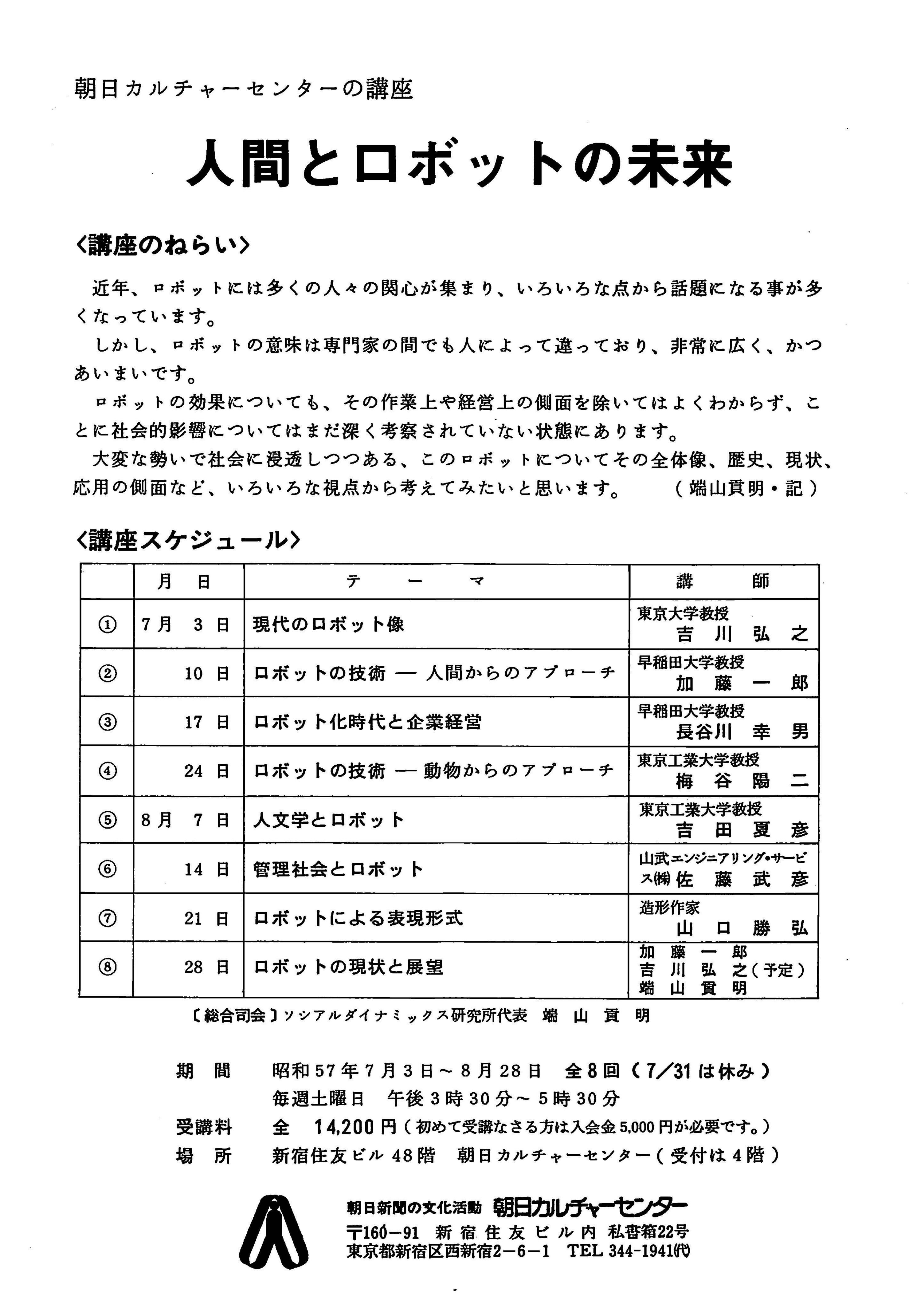
From the 端山貢明アーカイブ (Hayama Kōmei Archive), item 54993 in the 講演・講義 category, registered 2023-03-25: https://d-commons.net/hayama/?c=&p=54993. Published by the 端山貢明アーカイブプロジェクト (Hayama Kōmei Archive Project), directed by 前川道博 (Michihiro Maekawa) of Nagano University, on the D-Commons platform, and licensed CC BY (表示). The source documents come from the 端山文庫, the papers kept in Hayama's laboratory at Tohoku University of Art and Design, digitised by the project with the agreement of his family; his autograph scores were given to the University History Archives of the Tokyo University of the Arts in 2026. Source: Printed single-sheet prospectus for a course at the 朝日カルチャーセンター (Asahi Culture Center, the cultural arm of the Asahi Shimbun), 48th floor of the Shinjuku Sumitomo Building, Tokyo; eight sessions, fee ¥14,200. Pages 1 and 2 of the PDF are identical scans of the sheet; page 3 is a leaf of handwritten notes in Hayama's hand.. Dated: 3 July – 28 August 1982, Saturdays 15:30–17:30 (no session on 31 July). The archive publishes this item as 3 separate page scans rather than as a PDF; the download here was assembled from those scans in page order, each taken at the higher of the two resolutions the archive serves. A course prospectus rather than a text, but a useful one: it shows Hayama acting as convenor and compère for a public eight-week series on robots, billed as 総合司会 and as representative of the Social Dynamics Institute (ソシアルダイナミクス研究所). The aim, which he signs, is characteristically deflationary — robots attract attention but the word means different things to different specialists and is extremely broad and vague; their effects are reasonably understood in operational and managerial terms but their social consequences have barely been examined; the course will look at the whole picture, the history, the present state and the applications. The programme is a roster of the Japanese robotics establishment: Yoshikawa Hiroyuki of the University of Tokyo on the contemporary image of the robot (3 July); Katō Ichirō of Waseda on robot technology approached from the human (10 July); Hasegawa of Waseda on the robotised era and company management (17 July); Umetani Yōji of Tokyo Institute of Technology on robot technology approached from the animal (24 July); Yoshida Natsuhiko of Tokyo Tech on the humanities and the robot (7 August); Satō Takehiko of Yamatake Engineering Service on the managed society and the robot (14 August); and, of most interest for an art library, the artist Yamaguchi Katsuhiro — co-founder of Jikken Kōbō and a central figure in Japanese video and kinetic art — on forms of expression using robots (21 August). The final session on 28 August returns Katō, Yoshikawa and Hayama for a panel on the present state and prospects. The third leaf is a handwritten chronology of machine and kinetic art in Hayama's hand, running from the Bauhaus and Kurt Schmidt's "Man + Machine" through Moholy-Nagy's film, Nicolas Schöffer's cybernetically controlled tower, Tinguely, Calder and Yamaguchi, to Harold Cohen's drawing machine and Nam June Paik with Abe Shuya. Contents as the document gives them: 講座のねらい (Aim of the course) · 講座スケジュール (Course schedule, eight sessions with lecturers) · ① 現代のロボット像 (The contemporary image of the robot) · ② ロボットの技術—人間からのアプローチ (Robot technology: the approach from the human) · ③ ロボット化時代と企業経営 (The robotised era and company management) · ④ ロボットの技術—動物からのアプローチ (Robot technology: the approach from the animal) · ⑤ 人文学とロボット (The humanities and the robot) · ⑥ 管理社会とロボット (The managed society and the robot) · ⑦ ロボットによる表現形式 (Forms of expression using robots) · ⑧ ロボットの現状と展望 (The present state and prospects of robots). People named: 端山貢明 (Hayama Kōmei), 吉川弘之 (Yoshikawa Hiroyuki), 加藤一郎 (Katō Ichirō), 長谷川幸男 (Hasegawa — given name reading uncertain), 梅谷陽二 (Umetani Yōji), 吉田夏彦 (Yoshida Natsuhiko), 佐藤武彦 (Satō Takehiko), 山口勝弘 (Yamaguchi Katsuhiro), Kurt Schmidt, モホリ=ナギ (László Moholy-Nagy), ニコラ・シェフェール (Nicolas Schöffer), ティンゲリー (Jean Tinguely), カルダー (Alexander Calder), ハロルド・コーエン (Harold Cohen), ナムジュン・パイク (Nam June Paik), 阿部修也 (Abe Shuya). Noted: The handwritten leaf (page 3) carries dates as late as 1980 and what may be 1991, so it is probably not contemporary with the 1982 flyer and may have been filed with it later; several of its entries, including the one read as ハロルド・コーエン … 1948/1998, cannot be deciphered with confidence. The Waseda lecturer's given name reads 幸男 in the printed table but the character is not crisp; Hasegawa Yukio is the likeliest reading and is not verified. The reading of 三田-style personal names and the final lines of the handwritten leaf (「センター 1991」 or similar) could not be resolved. The year 1982 is printed as 昭和57年; the archive's date range matches.