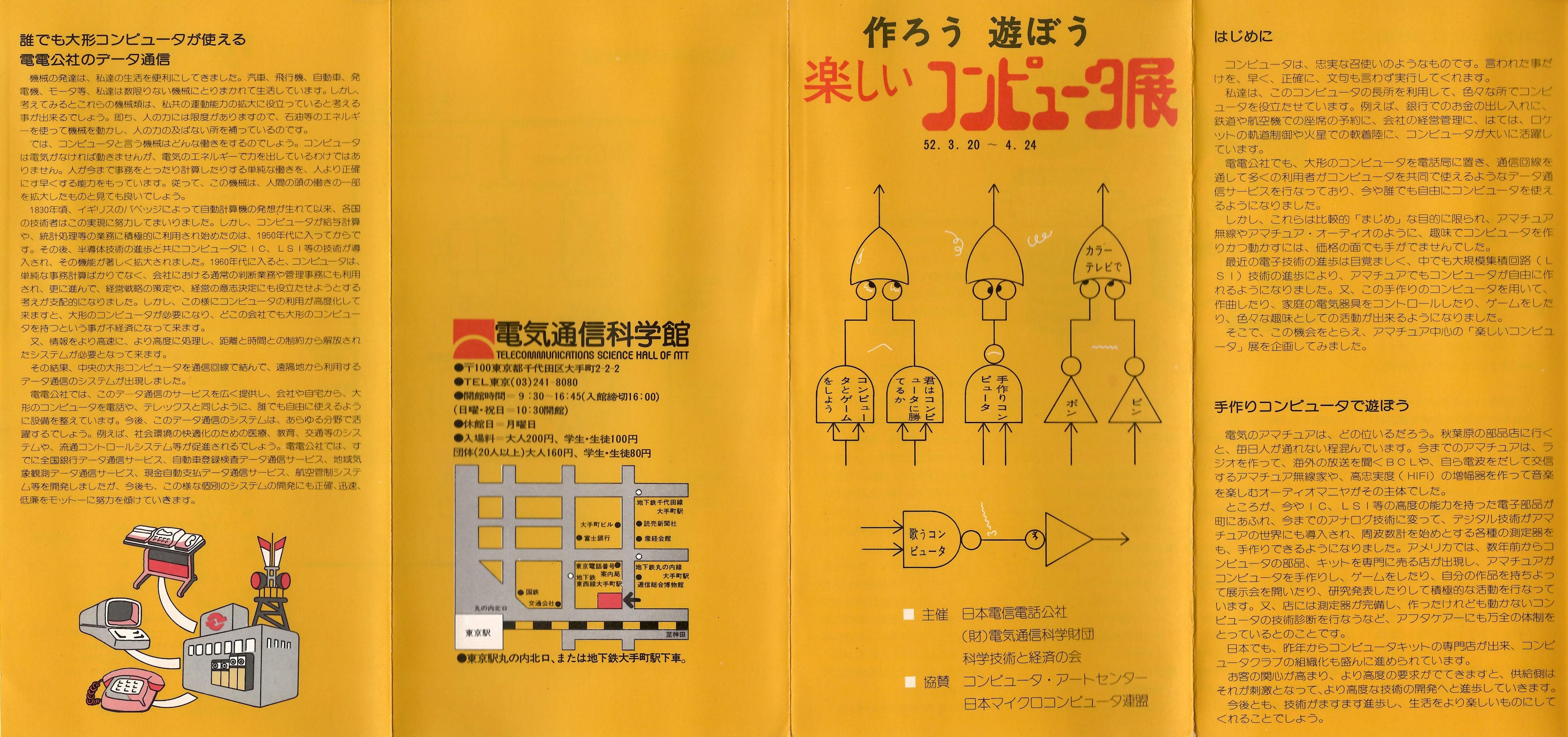
楽しいコンピュータ展@電気通信科学館 (The Enjoyable Computer Exhibition at the Telecommunications Science Hall)
- Author
- Komei Hayama
- Year
- 1977
- Subject
- Komei Hayama
- Tags
- japan · hayama archive · computer art history · media art · exhibition catalog
Notes
From the 端山貢明アーカイブ (Hayama Kōmei Archive), item 55385 in the コンピュータアート category, registered 2023-06-19: https://d-commons.net/hayama/?c=&p=55385. Published by the 端山貢明アーカイブプロジェクト (Hayama Kōmei Archive Project), directed by 前川道博 (Michihiro Maekawa) of Nagano University, on the D-Commons platform, and licensed CC BY (表示). The source documents come from the 端山文庫, the papers kept in Hayama's laboratory at Tohoku University of Art and Design, digitised by the project with the agreement of his family; his autograph scores were given to the University History Archives of the Tokyo University of the Arts in 2026. Source: Printed folding leaflet in yellow, red and black; 2 scanned spreads.. Dated: 52.3.20–4.24, i.e. 20 March to 24 April 1977 (Shōwa 52).. The archive publishes this item as 2 separate page scans rather than as a PDF; the download here was assembled from those scans in page order, each taken at the higher of the two resolutions the archive serves. The visitor leaflet for 「作ろう 遊ぼう 楽しいコンピュータ展」, an exhibition at the Telecommunications Science Hall of NTT at Ōtemachi 2-2-2, 20 March to 24 April 1977. It was organised by Nippon Telegraph and Telephone Public Corporation, the Telecommunications Science Foundation and the 科学技術と経済の会, with the Computer Art Center and the Japan Microcomputer Federation as sponsors — which is how Hayama's name attaches to it. The cover turns AND, OR and NOT gate symbols into cartoon characters with eyes, each captioned with an exhibit: play a game with a computer, can you beat a computer, home-made computer, Pong, Ping, a singing computer. The text makes the occasion plain. Progress in LSI, it says, has put computers within reach of amateurs, who can now compose music, control household appliances and play games; in America parts and kit shops appeared years ago, while in Japan specialist kit shops opened only last year and computer clubs are beginning to organise. A second panel sets this against NTT's data communication services — banking, vehicle registration, meteorological data, cash dispensers, air traffic control — and a third is a glossary of computer terms. The floor plan numbers seventeen exhibits, two of them the Computer Art Center's. Exhibit 5, computer art on video, lists 「Lichtspiel-76 (experiment-19)」 by Yoshizumi Ken, 「Optische Gestah Tong」 by Kawaguchi Yoichiro, Lillian Schwartz's Vail of Years, Peano Boogie by Thomas DeFanti, Dan Sandin and Phil Morton, and Ms. Muffet by William Etra, Louise Etra and Lou Katz. Exhibit 17, computer art in graphics, lists 「菊と宇宙」 by Kōmura Masao, Return to Square by CTG, Field by Stan VanDerBeek, Diamond Variation by Ruth Leavitt and 「樹木のシュミレーション」 by Dehara Eiichi. The rest is an amateur-computing fairground: a pneumatic computer playing music, a TV blackboard, a life game, a horse-race game, a rally meter, an amateur satellite, and DEMOS-E, NTT's scientific computing system, running Star Trek, maze-making and flight simulation. Contents as the document gives them: はじめに (introduction) · 手作りコンピュータで遊ぼう (play with a home-made computer) · 誰でも大形コンピュータが使える・電電公社のデータ通信 · これだけは知っておきたいコンピュータの豆知識 (glossary) · 特別展示会場案内図 (plan of the special exhibition, exhibits 1–17). People named: 吉積健 (Yoshizumi Ken), 河口洋一郎 (Kawaguchi Yoichiro), Lillian Schwartz, Thomas DeFanti, Dan Sandin, Phil Morton, William Etra, Louise Etra, Lou Katz, 幸村真佐男 (Kōmura Masao), S. Van Der Beek (Stan VanDerBeek), R. Leavitt (Ruth Leavitt), 出原栄一 (Dehara Eiichi), M. Horvat (Miljenko Horvat). Noted: Hayama is not named anywhere on the leaflet; the archive states that he took part in planning and production, and the Computer Art Center appears only in the list of sponsors. The video work credited to Kawaguchi Yoichiro is printed as 「Optische Gestah Tong」, which appears to be garbled; no correct form is given. The glossary is credited only to 「図解電子計算機用語事典」 with no publisher or date. Several exhibit captions on the plan are set very small and a few readings are approximate.