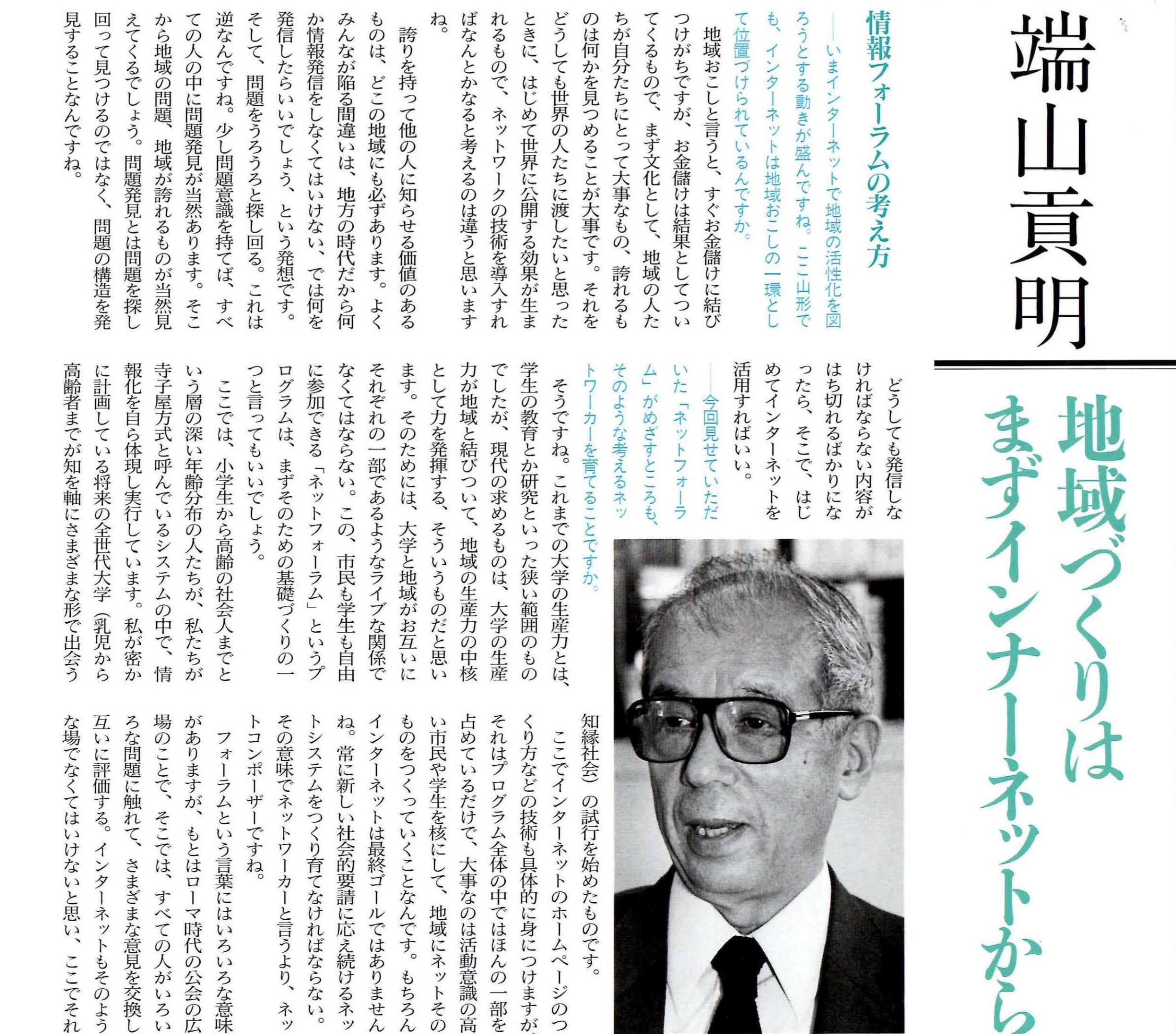
端山貢明/地域づくりはまずインナーネットから (Hayama Kōmei: Regional Development Starts with the Inner-net)
- Author
- Komei Hayama
- Year
- 1998
- Subject
- Komei Hayama
- Tags
- japan · hayama archive · essay
Notes
From the 端山貢明アーカイブ (Hayama Kōmei Archive), item 9882 in the 著書・論文 category, registered 2022-10-02: https://d-commons.net/hayama/?c=&p=9882. Published by the 端山貢明アーカイブプロジェクト (Hayama Kōmei Archive Project), directed by 前川道博 (Michihiro Maekawa) of Nagano University, on the D-Commons platform, and licensed CC BY (表示). The source documents come from the 端山文庫, the papers kept in Hayama's laboratory at Tohoku University of Art and Design, digitised by the project with the agreement of his family; his autograph scores were given to the University History Archives of the Tokyo University of the Arts in 2026. Source: 『GRAPHICATION』no. 98, August 1998, special feature 「電子知識社会のゆくえ」, pp. 20–22; published by Fuji Xerox Co., Ltd. (富士ゼロックス株式会社). Interviewer unnamed, credited to the editorial staff; photographs taken in Hayama's office at Tohoku University of Art & Design.. Dated: August 1998 issue. The archive publishes this item as 4 separate page scans rather than as a PDF; the download here was assembled from those scans in page order, each taken at the higher of the two resolutions the archive serves. The clearest short account of Hayama's media thinking in his own words, and the piece that gives this batch its keyword. Asked how the internet fits into regional development, he refuses the usual framing: do not start by asking what to transmit, start by finding something worth transmitting, and that means problem-finding — "problem-finding is to find the structure of a problem" — inside the place itself. Hence the pun of the title: before the inter-net, the inner-net (インナーネット). He dates his own position precisely. In 1974, under a commission from MITI, his group studied a computer-centred network they called INFORUM (from Information + Forum), proposing servers on a net that anyone could reach from home — a system built around what he calls the agency of the access side (アクセス側の主体性). That characteristic of media, he says, became unmistakable when UNIVAC I was released in 1951 and above all when IBM offered time-sharing on the 360 in 1964; computer communication was socialised by the end of the 1960s, the same years the internet took shape in America. The Net Forum at Tohoku University of Art & Design, run on terakoya (寺子屋) lines, is the small core of that idea, and he wants it to grow into an all-generation university (全世代大学) running from infants to the elderly, producing not networkers but net-composers. Two images carry the theory. The net is the human brain turned inside out to wrap the earth — a second neocortex for the species — and its ideal is Sun Wukong's somersault cloud (きんと雲), which appears when needed and vanishes when not: non-deterministic constancy. And media must satisfy five WHOMs — FOR, OF, BY, WITH and TO WHOM. The last section turns to Yamagata: a knowledge-tie society (知縁社会) replacing a land-tie one, a constellation (コンステレーション) of small distinctive places rather than one metropolis, and the 1995 broadcast of the Yamagata International Documentary Film Festival over a temporary leased line as the proof. Contents as the document gives them: 情報フォーラムの考え方 (The thinking behind the information forum) · WHOMを考えよう (Let us think about WHOM) · 開かれた地域に向けて (Towards an open region). People named: 端山貢明 (Hayama Kōmei), オリヴィエ・メシアン (Olivier Messiaen). Noted: No interviewer is named; the piece is credited only to the magazine's editorial staff. The year the film festival was first put online is partly obscured in the scan; the text reads 「一九九…年ですから他に比べて遅かった」 and the context points to 1995, which matches the archive's own account of 山形Net-Expo. The sidebar biography states he studied at the Paris Conservatoire under Messiaen and founded the Computer Art Center and the Social Dynamics Institute, but gives no founding years; it lists two books, 『今日と明日の間の科学技術』 and 『イメージ・シンセティクス』. Page range 20–22 is from the archive's cataloguing; folios 20, 21 and 22 are legible on the scans.