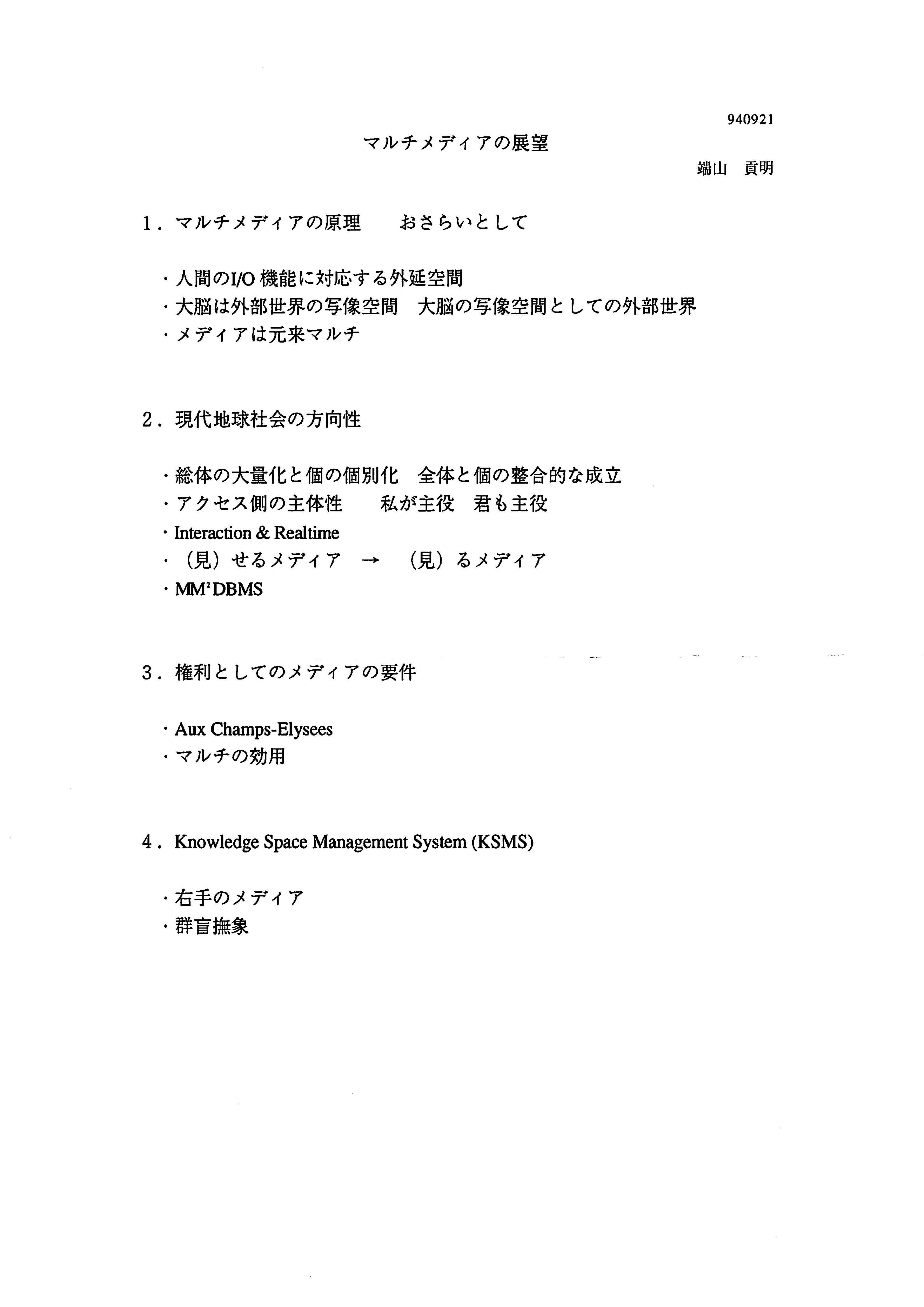
マルチメディアの展望(端山貢明) (Prospects for Multimedia)
- Author
- Komei Hayama
- Year
- 1994
- Subject
- Komei Hayama
- Tags
- japan · hayama archive · essay
Notes
From the 端山貢明アーカイブ (Hayama Kōmei Archive), item 54995 in the 講演・講義 category, registered 2023-03-25: https://d-commons.net/hayama/?c=&p=54995. Published by the 端山貢明アーカイブプロジェクト (Hayama Kōmei Archive Project), directed by 前川道博 (Michihiro Maekawa) of Nagano University, on the D-Commons platform, and licensed CC BY (表示). The source documents come from the 端山文庫, the papers kept in Hayama's laboratory at Tohoku University of Art and Design, digitised by the project with the agreement of his family; his autograph scores were given to the University History Archives of the Tokyo University of the Arts in 2026. Source: Hayama's own one-page typed handout for the final session of the Yamagata City citizens' course 「マルチメディアの織りなす世界」 (The World Woven by Multimedia), six sessions June–October 1994, planned by Professor 長谷川文雄 of Tohoku University of Art & Design. The PDF carries the handout twice and, as its third leaf, the course organisers' one-page summary of all six sessions.. Dated: 21 September 1994 (the sheet is headed 940921). The archive publishes this item as 3 separate page scans rather than as a PDF; the download here was assembled from those scans in page order, each taken at the higher of the two resolutions the archive serves. Four headings on a single sheet, and the most compressed statement of Hayama's media theory in this batch. Under "principles of multimedia, by way of revision" he sets out three propositions: media are an extension space (外延空間) answering to the human being's input/output functions; the brain is an image-space of the external world and the external world an image-space of the brain; and media were always multiple to begin with — "multimedia" names nothing new, only a recovery. The second heading, the direction of contemporary global society, gives his standing terms: mass-scaling of the whole together with individualisation of the single person, and the consistent constitution of whole and individual together; the agency of the access side (アクセス側の主体性), glossed as "I am the lead, and so are you"; interaction and real time; the shift from media that show ((見)せるメディア) to media that are looked at ((見)るメディア); and MM²DBMS. The third, requirements for media understood as a right, sets "Aux Champs-Elysées" against the utility of the multiple. The fourth introduces the Knowledge Space Management System (KSMS), with the right-hand medium (右手のメディア) and the proverb of the blind men and the elephant (群盲撫象). The course summary on the third leaf makes the context concrete and shows how far ahead of his co-teachers Hayama was pitching. Hasegawa Fumio opened on 23 June with zapping, zipping, karaoke over telecommunications, video conferencing and satellite religious broadcasting; Maekawa Michihiro followed on multimedia's three pillars, digital, interactive and meta-media; Kotō Hiroshi and Maekawa ran hands-on Macintosh sessions on 13 July with Maekawa's own HYPER CITY YAMAGATA and on 7 September with Kid Pix; Kotō gave the history on 24 August. Hayama's session on 21 September used video and looked at American multimedia research, summarising KSMS for the organisers as "a chair from which, anywhere and at any time, you can get the information you want with one right hand". Contents as the document gives them: 1. マルチメディアの原理 おさらいとして (Principles of multimedia, by way of revision) · 2. 現代地球社会の方向性 (The direction of contemporary global society) · 3. 権利としてのメディアの要件 (Requirements for media understood as a right) · 4. Knowledge Space Management System (KSMS). People named: 端山貢明 (Hayama Kōmei), 長谷川文雄 (Hasegawa Fumio), 前川道博 (Maekawa Michihiro), 古藤浩 (Kotō Hiroshi). Noted: The handout is an outline only; the body of the talk survives solely in the organisers' paragraph-long summary on the third leaf. 「MM²DBMS」 and 「Aux Champs-Elysees」 are given without explanation on Hayama's sheet. Pages 1 and 2 of the PDF are identical scans. The course's panel-discussion session on 19 October is listed in the summary without a named speaker.