連続講演シンポジウム企画メモ#2 (Planning memo #2 for the lecture series and symposium)
- Author
- Komei Hayama
- Year
- 1973
- Subject
- Komei Hayama
- Tags
- japan · hayama archive · computer art history · media art
Notes
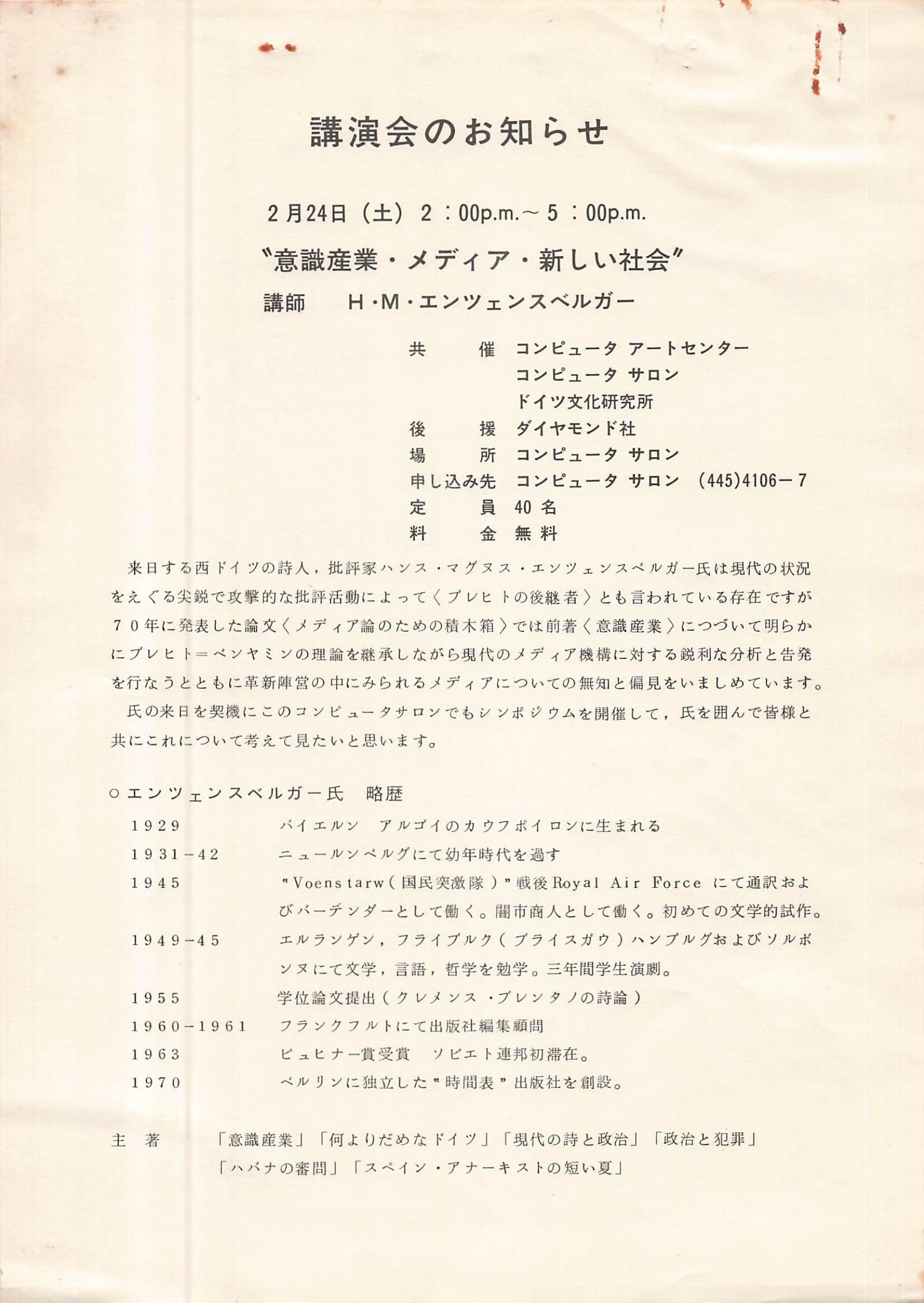
From the 端山貢明アーカイブ (Hayama Kōmei Archive), item 9868 in the コンピュータアート category, registered 2022-10-01: https://d-commons.net/hayama/?c=&p=9868. Published by the 端山貢明アーカイブプロジェクト (Hayama Kōmei Archive Project), directed by 前川道博 (Michihiro Maekawa) of Nagano University, on the D-Commons platform, and licensed CC BY (表示). The source documents come from the 端山文庫, the papers kept in Hayama's laboratory at Tohoku University of Art and Design, digitised by the project with the agreement of his family; his autograph scores were given to the University History Archives of the Tokyo University of the Arts in 2026. Source: A printed flyer (present twice) bound with eight pages of manuscript working notes from the 端山文庫 (Hayama Collection); several sheets on COMPUTER SALON letterhead. 10 pp.. Dated: The printed flyer announces 24 February (Saturday), 2–5 p.m., i.e. 24 February 1973; one manuscript sheet is dated 47.12.18 (18 December 1972). The archive catalogues the group as [1972–73].. The archive publishes this item as 10 separate page scans rather than as a PDF; the download here was assembled from those scans in page order, each taken at the higher of the two resolutions the archive serves. The printed flyer announces a lecture on Saturday 24 February, 2–5 p.m., "意識産業・メディア・新しい社会" (The Consciousness Industry, Media, the New Society), by H. M. Enzensberger, co-organised by the Computer Art Center, the Computer Salon and the German Cultural Institute, supported by Diamond Inc., held at the Computer Salon, free, with places for forty. The blurb calls Enzensberger a successor to Brecht and names his 1970 essay "メディア論のための積木箱" (Constituents of a Theory of the Media) as a sequel to The Consciousness Industry, with a chronology from his birth in 1929 to the Büchner Prize of 1963. The manuscript sheets cost the series out: income of ¥1,150,000 (¥20,000 × 50 attendees plus ¥3,000 × 50 students) against ¥320,000 in honoraria and ¥300,000 of publicity, office and staff costs. A sheet dated 18 December 1972 sets out the organisation — management outsourced project by project, Tōyama of Tokyo University proposed as a chairman-like figure, Ikeda of Fujitsu to be invited — and lists the projects: conference and symposium 18–20 April with a press party on the 13th, Enzensberger at the Salon, and an Osaka strand through "G. 大阪", Osaka University of Arts and the Kansai Information Center. The rest is casting. Under the heading "inter diciplinary conference 3日" the planned lecturers include Ikeda on computer media for Fujitsu, Sakagami on medicine and social systems at Kitasato, Kikutake and Isozaki Arata on architecture, Tōyama and Taketani Mitsuo on physics, Ōoka Makoto as poet and critic, Uzawa Hirofumi on mathematical economics and Ōmori Shōzō on philosophy, with Enzensberger pencilled in for 19–25 February. Other sheets add Niki on neoteny, Fukushima Akira on psychiatry and Obara Hideo on animal behaviour; a page of proxemic distances (65 cm intimate, 65–120 personal, 120–210 social, beyond 210 public); and a bubble diagram linking information science (Kitagawa Toshio), mathematics (Noguchi Hiroshi), media (Enzensberger) and catastrophe theory (Thom). Contents as the document gives them: 講演会のお知らせ (notice of the lecture) · エンツェンスベルガー氏 略歴 (Enzensberger: chronology) · 主著 (principal works) · 情報科学と芸術 (information science and art — bubble diagram) · 講師予定 (planned lecturers) · 対象の設定とリサーチ/内容の範囲規定/受講料/講師謝礼/パブリシティ/後援/実動する組織 (scope and research, fee, honoraria, publicity, sponsorship, working organisation) · 事務局・世話人・運営費・PROJECTS (secretariat, committee, running costs, projects). People named: 端山貢明 (Hayama Kōmei), ハンス・マグヌス・エンツェンスベルガー (Hans Magnus Enzensberger), クレメンス・ブレンタノ (Clemens Brentano), ブレヒト (Bertolt Brecht), ベンヤミン (Walter Benjamin), 池田 (Ikeda — Fujitsu; i.e. 池田敏雄, Ikeda Toshio), 竹内 (Takeuchi — geophysics, Tokyo), 坂上 (Sakagami — Kitasato University), 菊竹 (Kikutake Kiyonori), 磯崎新 (Isozaki Arata), 奈須 (Nasu), 田中 (Tanaka), 遠山 (Tōyama), 武谷三男 (Taketani Mitsuo), 大岡信 (Ōoka Makoto), 宇井 (Ui — i.e. 宇井純, Ui Jun), 西脇 (Nishiwaki), 宇沢弘文 (Uzawa Hirofumi), 大森荘蔵 (Ōmori Shōzō), 沢田 (Sawada — philosophy, Keio), 仁木 (Niki), 猪股修三 (Inomata Shūzō — Electrotechnical Laboratory), 片方善治 (Katagata Zenji), 福島章 (Fukushima Akira), 米山俊直 (Yoneyama Toshinao), 小原秀雄 (Obara Hideo), 北川敏男 (Kitagawa Toshio), 野口広 (Noguchi Hiroshi), トム (René Thom). Noted: The flyer prints the study years as "1949-45", which cannot be right; it is an error in the original, not a misreading. Several surnames on the lecturer lists are given without personal names (竹内, 坂上, 奈須, 田中, 遠山, 宇井, 西脇, 仁木, 沢田, 出原); the identifications offered in parentheses are inferences from the field and institution written beside them, not from the document. The name read as 猪股修三 of the 電気試験所 is a tentative reading of the handwriting; the institution above it reads 通産省 (MITI). On the lecturer sheet one entry reads 「梅尾(or 追尾)… 白花研」 and could not be deciphered. "G. 大阪" on the 18 December 1972 sheet is almost certainly the Goethe-Institut Osaka (it co-organised the 1974 Osaka exhibition), but the document writes only the initial. Page 8 carries only columns of three-digit numbers (104, 222, 233, 141, 333, 322, 444, 341, 242, 143 …) and small grids with some of them circled; its purpose is not stated and could not be determined. Pages 1 and 3 are two copies of the same flyer.