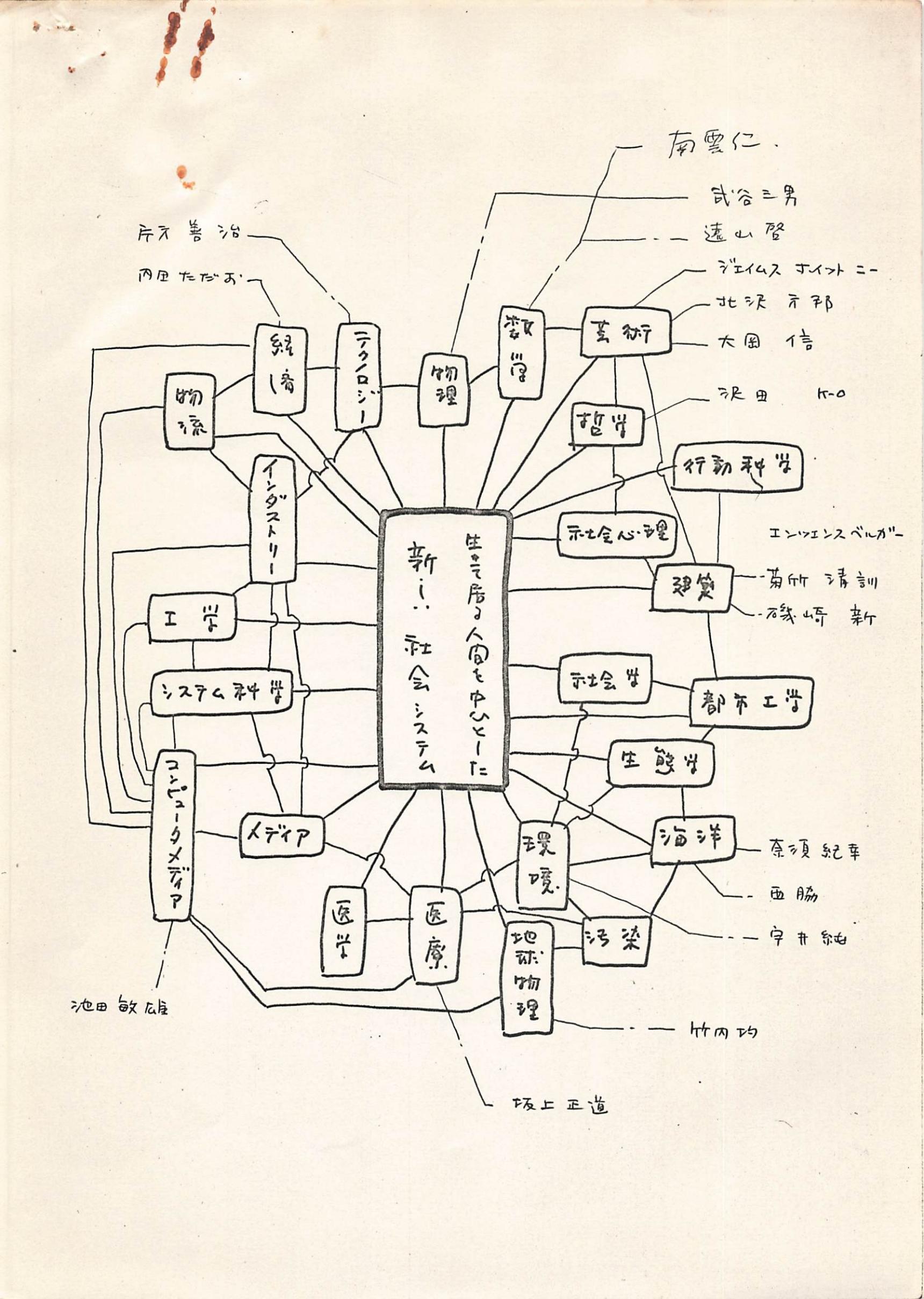
連続講演シンポジウム企画メモ#1 (Planning memo #1 for the lecture series and symposium)
- Author
- Komei Hayama
- Year
- 1972
- Subject
- Komei Hayama
- Tags
- japan · hayama archive · computer art history · media art
Notes
From the 端山貢明アーカイブ (Hayama Kōmei Archive), item 9867 in the コンピュータアート category, registered 2022-10-01: https://d-commons.net/hayama/?c=&p=9867. Published by the 端山貢明アーカイブプロジェクト (Hayama Kōmei Archive Project), directed by 前川道博 (Michihiro Maekawa) of Nagano University, on the D-Commons platform, and licensed CC BY (表示). The source documents come from the 端山文庫, the papers kept in Hayama's laboratory at Tohoku University of Art and Design, digitised by the project with the agreement of his family; his autograph scores were given to the University History Archives of the Tokyo University of the Arts in 2026. Source: Working papers from the 端山文庫 (Hayama Collection); 9 pp., on plain paper, on two different COMPUTER SALON letterheads (Kasumigaseki Building and 1-11-15 Higashi-Gotanda, Shinagawa-ku) and on "TASK FORCE・PRESIDENT SERVICE / 200 GREATS" letterhead (WTC Building, Shiba-Hamamatsucho).. Dated: Catalogued [1972–73]. One sheet is dated 26-DEC-72; the programme it lays out runs 13–20 April 1973, with a conference and symposium in June and an exhibition at the Sony Building in October.. The archive publishes this item as 9 separate page scans rather than as a PDF; the download here was assembled from those scans in page order, each taken at the higher of the two resolutions the archive serves. Hayama's working notes for a Computer Art Center programme titled "生きて居る人間を中心とした新しい社会システム" — a lecture series and symposium for thinking about a new social system centred on living human beings. Four elements are planned: a press party, the lecture series, the symposium, and a book made from the lectures. The audience is given as executives of medium-sized firms plus students, Y.P.O. and the Junior Chamber. The schedule grid fixes a press party on 13 April, 6–9 p.m., then two lectures on the 18th with Symposium I, three on the 19th (10–12, 1–3, 3–5) with Symposium II, and two on the 20th with Symposium III. The budget allows ¥320,000 in honoraria (¥40,000 × 8), ¥100,000 each for publicity, office costs and staff, and an uncosted party line. A second timeline runs the year: System Science in February–March, a contest, a conference plus symposium in June, and in October an exhibition at the Sony Building travelling on to Osaka, with "FRANKE'S" pencilled beside it. The halls named are the Nikkei Hall and the Asahi Lecture Hall. The centrepiece, drawn twice, is the 社会システム concept diagram: a central box spoked out to some two dozen fields, from physics and art to pollution, medicine and computer media. Candidate speakers stand against them — Taketani Mitsuo and Tōyama Hiraku; Kitazawa Masakuni and Ōoka Makoto for art; Kikutake Kiyonori and Isozaki Arata for architecture; Nasu Noriyuki and Ui Jun for oceanography and pollution; Ikeda Toshio for computer media; Enzensberger beside behavioural science. A further sheet lists the symposiasts: Takemura Chihaya, the graphic designers Sugiura Kōhei, Katsui Mitsuo and Ishioka Eiko, Dehara of the Product Science Research Institute, Yoshizumi Ken of Kyoto Institute of Technology, the architects Yamada Manabu and Tsukio Yoshio, and the critic Katsumi Masaru. A note dated 26 December 1972 tracks loose ends: second-hand computer, party and calendar pending, incorporation in January, and "エンツェンスベルガー → Salon 講演" (a Salon lecture). Contents as the document gives them: プレスパーティ (press party) · 連続講演会 (lecture series) · シンポジウム (symposium) · 出版(講演の内容をもとに出版の予定)(publication based on the lectures) · 主催・後援・対象・期間・会場 (organiser, supporters, audience, period, venue) · 経費:講師謝礼、広報、事務費、人件費、パーティ費 (budget: honoraria, publicity, office costs, staff, party) · 社会システム概念図 (social-system concept diagram). People named: 端山貢明 (Hayama Kōmei), 南雲仁 (Nagumo), 武谷三男 (Taketani Mitsuo), 遠山啓 (Tōyama Hiraku), ジェイムスナイトニー (as written; the same bundle writes "HOITNNEY" in Latin letters, so James Whitney is probably meant), 北沢方邦 (Kitazawa Masakuni), 大岡信 (Ōoka Makoto), 沢田 (Sawada — given name written as initials, unread), エンツェンスベルガー (Hans Magnus Enzensberger), 菊竹清訓 (Kikutake Kiyonori), 磯崎新 (Isozaki Arata), 奈須紀幸 (Nasu Noriyuki), 西脇 (Nishiwaki), 宇井純 (Ui Jun), 竹内均 (Takeuchi Hitoshi), 坂上正道 (Sakagami Masamichi), 池田敏雄 (Ikeda Toshio), 片方善治 (Katagata Zenji), 内田ただお (Uchida Tadao), 竹村千早 (Takemura Chihaya), 杉浦康平 (Sugiura Kōhei), 勝井三雄 (Katsui Mitsuo), 石岡暇子 (Ishioka Eiko), 出原 (Dehara), 吉積健 (Yoshizumi Ken), 山田学 (Yamada Manabu), 月尾嘉男 (Tsukio Yoshio), 勝見勝 (Katsumi Masaru), FRANKE (written "FRANKE'S"; probably Herbert W. Franke). Noted: The artist name written ジェイムスナイトニー on the concept diagram is ambiguous: the katakana clearly begins ナ, but p. 9 of the same bundle writes "HOITNNEY" beside GRAPHICS / FILM / SOUND / VIDEO, which points to James Whitney. Transcribed as written; the identification is inferred, not stated. The given name beside 沢田 is written as two Latin-looking characters ("K-O") and could not be read. "FRANKE'S" appears only as a pencilled word with an arrow to EXHIB. (SONY); the identification with Herbert W. Franke is an inference. Page 6 is the verso of the 200 GREATS sheet and carries only pencil doodles — a sawtooth wave with arrows, a banded corridor filled with small circles, a concentric-circle target and a wave with rays converging on a point. They look like acoustic sketches but carry no legible labels beyond "150γ" (reading uncertain). On p. 7 the phrase after 講師 → (two kanji, then リストアップ) could not be read; the venue is written "A経ホール", which the archive reads as 日経ホール(Nikkei Hall). On p. 5 the line 私…の経費の件 → 12万/an has one illegible character. Pages 1 and 3 are two copies of the same diagram; the dating [1972–73] is the archive's.