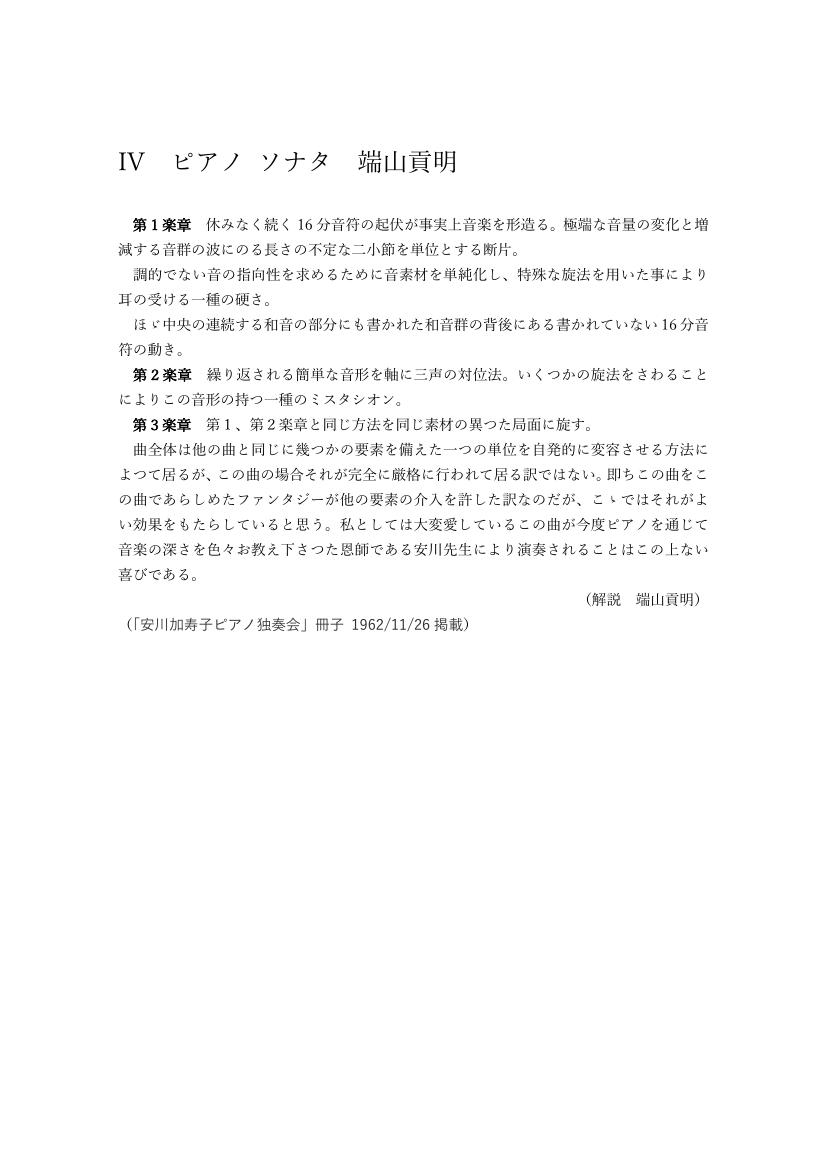
ピアノ・ソナタ(解説:端山貢明) (Piano Sonata (composer's note))
- Author
- Komei Hayama
- Year
- 1962
- Published in
- Kazuko Yasukawa piano recital booklet, 26 November 1962 (17th Art Festival); 1 p.
- Subject
- Komei Hayama
- Tags
- japan · hayama archive
Notes
From the 端山貢明アーカイブ (Hayama Kōmei Archive), item 9955 in the 執筆記事 (articles) category, registered 2022-10-04: https://d-commons.net/hayama/?c=&p=9955. Published by the 端山貢明アーカイブプロジェクト (Hayama Kōmei Archive Project), directed by 前川道博 (Michihiro Maekawa) of Nagano University, on the D-Commons platform, and licensed CC BY (表示). The source documents come from the 端山文庫, the papers kept in Hayama's laboratory at Tohoku University of Art and Design, digitised by the project with the agreement of his family; his autograph scores were given to the University History Archives of the Tokyo University of the Arts in 2026. Source: Kazuko Yasukawa piano recital booklet, 26 November 1962 (17th Art Festival); 1 p.. Dated: recital of 26 November 1962; the sonata was composed in 1960. Hayama's note on his Piano Sonata of 1960, written for the recital Kazuko Yasukawa (安川加寿子) gave on 26 November 1962 as part of the 17th Art Festival. He describes the first movement as being formed in effect by an unbroken rise and fall of semiquavers, with extreme changes of dynamic and fragments of indefinite length riding waves of thickening and thinning note groups, built in two-bar units. To find a directionality of pitch that is not tonal he simplified the pitch material and used a particular mode, which gives the ear a certain hardness; even in the passage of continuous chords near the middle, he notes, there is an unwritten semiquaver motion behind the written chords. The second movement he describes as three-part counterpoint turning on a simple repeated figure, touching several modes. The sonata was played again at Gendai no Ongaku Ten '80 in February 1980 and at the Japan Chopin Society in July of the same year, and in 2022, the year after his death, at Shinichirō Ikebe's concert series on the trajectory of Japanese contemporary music at Tokyo Opera City; all three occasions are documented elsewhere in this archive. People named: 端山貢明 (Hayama Kōmei), 安川加寿子 (Yasukawa Kazuko).