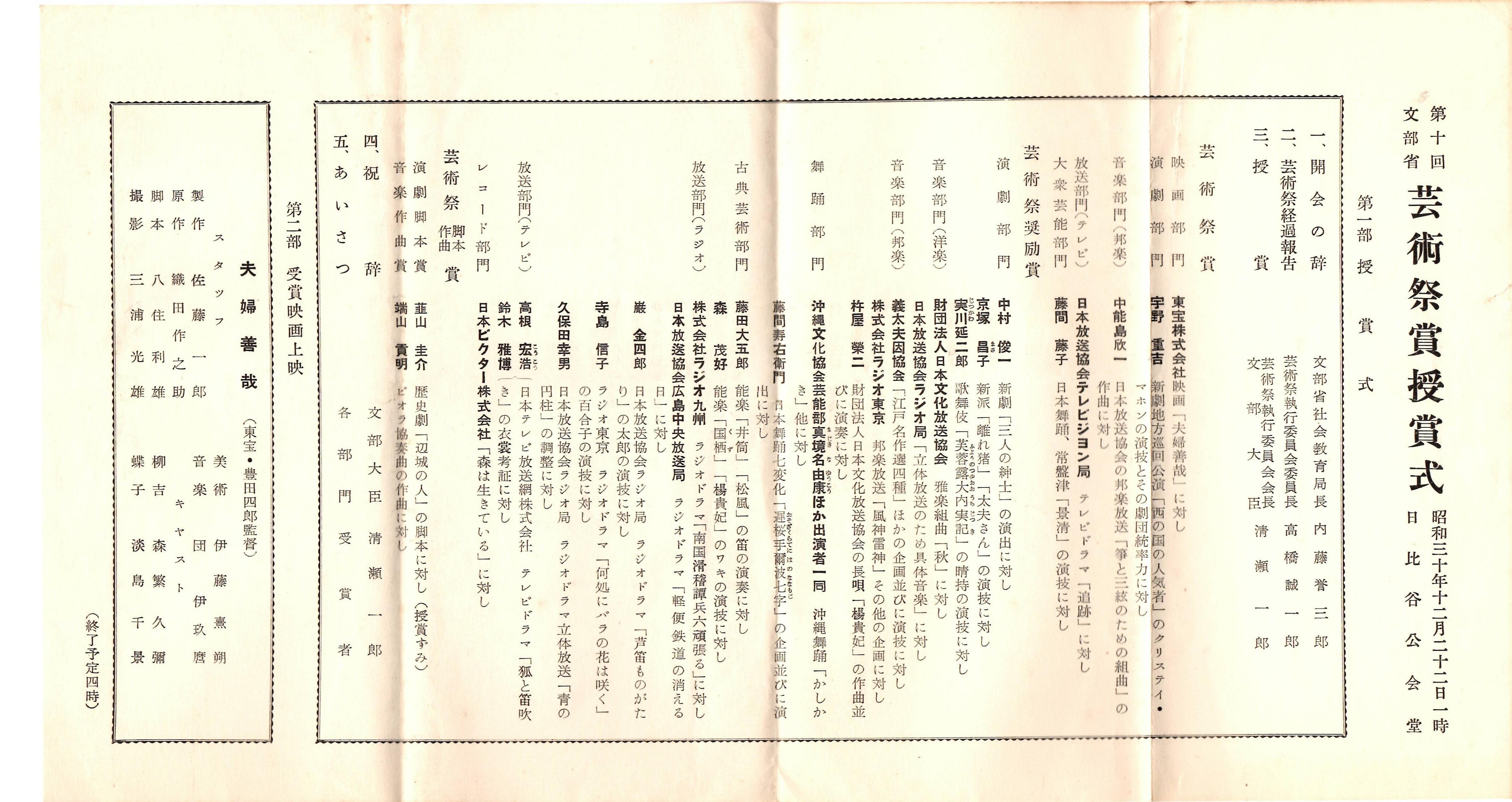
芸術祭賞授賞式次第 (Order of ceremony, Art Festival prize-giving)
- Author
- Komei Hayama
- Year
- 1955
- Subject
- Komei Hayama
- Tags
- japan · hayama archive
Notes
From the 端山貢明アーカイブ (Hayama Kōmei Archive), item 9943 in the 音楽(演奏会) category, registered 2022-10-03: https://d-commons.net/hayama/?c=&p=9943. Published by the 端山貢明アーカイブプロジェクト (Hayama Kōmei Archive Project), directed by 前川道博 (Michihiro Maekawa) of Nagano University, on the D-Commons platform, and licensed CC BY (表示). The source documents come from the 端山文庫, the papers kept in Hayama's laboratory at Tohoku University of Art and Design, digitised by the project with the agreement of his family; his autograph scores were given to the University History Archives of the Tokyo University of the Arts in 2026. Source: 10th Ministry of Education Art Festival Executive Committee; Hibiya Public Hall, Tokyo. Dated: Thursday 22 December 1955 (Shōwa 30), 1:00 p.m.; the ceremony and film screening were expected to end at about 4:00 p.m.. The archive publishes this item as 1 separate page scan rather than as a PDF; the download here was assembled from those scans in page order, each taken at the higher of the two resolutions the archive serves. The single printed sheet setting out the order of ceremony for the 10th Ministry of Education Art Festival prize-giving, at which Hayama received the music composition prize 'for the composition of the Viola Concerto' (ビオラ協奏曲の作曲に対し), the work heard a week earlier at the festival's orchestral concert. His is one of only two awards under the heading of script and composition prizes, the other going to Nirayama Keisuke for the historical play 辺城の人. Part One of the afternoon was the ceremony itself: an opening address by Naitō Yosaburō of the Ministry's Social Education Bureau; a report on the festival by Takahashi Seiichirō, chairman of the executive committee; the presentation of prizes by the Minister of Education, Kiyose Ichirō; the Minister's congratulatory address; and remarks from the recipients. The sheet also lists the festival's other awards, which place Hayama's prize in its field. Art Festival Prizes went to Tōhō for the film 夫婦善哉, to Uno Jūkichi for his Christy Mahon in a touring Playboy of the Western World, to Nakanoshima Kin'ichi for a suite for koto and sangen written for NHK, to NHK's television division for the drama 追跡, and to Fujima Fujiko for Japanese dance. Encouragement prizes ran through theatre, Western and Japanese music, dance, classical arts, radio and television drama and records. Part Two was a screening of 夫婦善哉 (Tōhō, directed by Toyoda Shirō from Oda Sakunosuke, music by Dan Ikuma, with Morishige Hisaya and Awashima Chikage). Admission was free. Contents as the document gives them: 第一部 授賞式 (Part One: the prize-giving) — 開会の辞/芸術祭経過報告/授賞/祝辞/あいさつ · 芸術祭賞 (Art Festival Prizes): film, theatre, Japanese music, broadcasting (television), popular entertainment · 芸術祭奨励賞 (Art Festival Encouragement Prizes): theatre, Western music, Japanese music, dance, classical arts, radio and television, records · 芸術祭脚本賞・作曲賞 (Art Festival script and composition prizes): 演劇脚本賞 韮山圭介/音楽作曲賞 端山貢明 ビオラ協奏曲の作曲に対し · 第二部 受賞映画上映「夫婦善哉」(Part Two: screening of the prize-winning film Meoto Zenzai). People named: 端山貢明 (Hayama Kōmei), 内藤誉三郎 (Naitō Yosaburō), 高橋誠一郎 (Takahashi Seiichirō), 清瀬一郎 (Kiyose Ichirō, Minister of Education), 韮山圭介 (Nirayama Keisuke — reading uncertain), 宇野重吉 (Uno Jūkichi), 中能島欣一 (Nakanoshima Kin'ichi), 藤間藤子 (Fujima Fujiko), 京塚昌子 (Kyōzuka Masako), 実川延二郎 (Jitsukawa Enjirō), 杵屋榮二 (Kineya Eiji), 真境名由康 (Majikina Yūkō), 藤田大五郎 (Fujita Daigorō), 森茂好 (Mori Shigeyoshi), 巌金四郎 (Iwa Kinshirō), 豊田四郎 (Toyoda Shirō, film director), 織田作之助 (Oda Sakunosuke, original author), 八住利雄 (Yasumi Toshio, screenwriter), 団伊玖磨 (Dan Ikuma, film composer), 森繁久彌 (Morishige Hisaya), 淡島千景 (Awashima Chikage). Noted: 韮山圭介, the playwright awarded alongside Hayama, is an unusual name; the reading Nirayama Keisuke is a guess from the characters. Several names in the long encouragement-prize list are printed small and some readings (京塚, 杵屋榮二, 巌金四郎, 真境名由康) are offered from the characters rather than from any stated reading. A few entries in the radio and television section are abbreviated on the sheet and could not be transcribed with confidence.