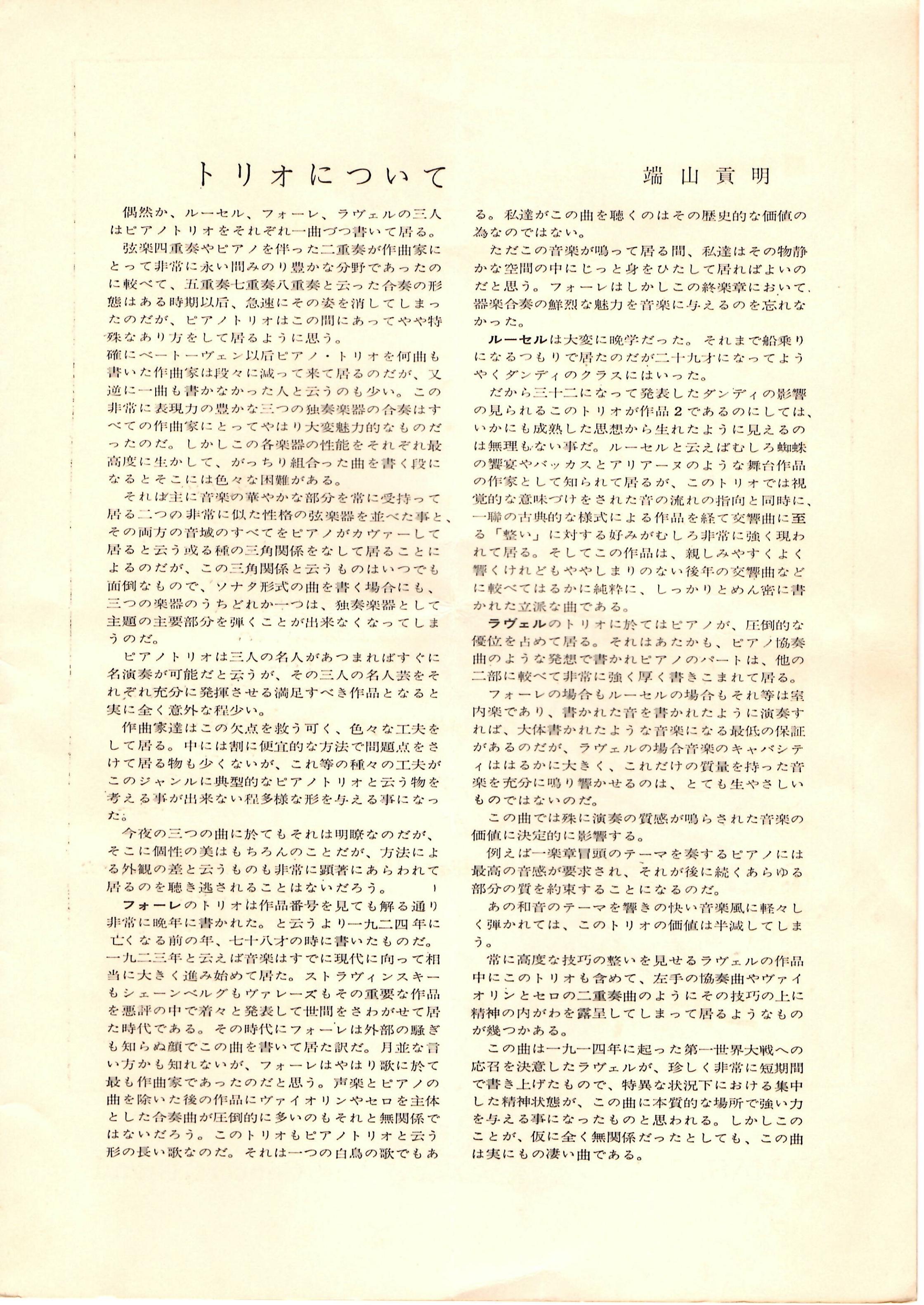
端山貢明「トリオについて」 (Hayama Kōmei, 'On the trio')
- Author
- Komei Hayama
- Year
- 1967
- Subject
- Komei Hayama
- Tags
- japan · hayama archive · essay
Notes
From the 端山貢明アーカイブ (Hayama Kōmei Archive), item 9959 in the 執筆記事 category, registered 2022-10-04: https://d-commons.net/hayama/?c=&p=9959. Published by the 端山貢明アーカイブプロジェクト (Hayama Kōmei Archive Project), directed by 前川道博 (Michihiro Maekawa) of Nagano University, on the D-Commons platform, and licensed CC BY (表示). The source documents come from the 端山文庫, the papers kept in Hayama's laboratory at Tohoku University of Art and Design, digitised by the project with the agreement of his family; his autograph scores were given to the University History Archives of the Tokyo University of the Arts in 2026. Source: A single page of the booklet for ピアノ三重奏曲の夕べ (An evening of piano trios), Maison Franco-Japonaise hall, 6 April 1967, presented by the Maison Franco-Japonaise and the Japanese-French Music Society. Dated: Thursday 6 April 1967 (Shōwa 42), 6:30 p.m.. The archive publishes this item as 1 separate page scan rather than as a PDF; the download here was assembled from those scans in page order, each taken at the higher of the two resolutions the archive serves. Hayama's commentary on the three works played at the Maison Franco-Japonaise on 6 April 1967 by Hattori Toyoko, Suzuki Akira and Yasukawa Kazuko: the piano trios of Fauré, Roussel (a Japanese premiere) and Ravel. He opens with the coincidence that each wrote exactly one, and with the genre's awkwardness: since Beethoven few composers have written several trios, though few have written none. Three strongly expressive solo instruments are attractive, but two are strings of similar character carrying the showy part while the piano covers both their ranges, a triangular relation in which one instrument cannot present the theme as a soloist. Composers have devised such varied, sometimes expedient solutions that no typical piano trio can be imagined. On Fauré he notes that the trio was written at seventy-eight, the year before his death, while Stravinsky, Schoenberg and Varèse were publishing major works to bad reviews outside; Fauré, above all a composer of song, wrote a long song in trio form, a swan song, though in the finale he did not forget the charm of instrumental ensemble. Roussel was a late starter who entered d'Indy's class at twenty-nine, so that an op. 2 published at thirty-two sounds like mature thought, and it is written far more purely and tightly than the later symphonies. Ravel's he calls tremendous: composed unusually fast after Ravel decided to enlist in 1914, with the piano written almost as a concerto, it is one of several works — with the Left-hand Concerto and the Sonata for violin and cello — in which the inner spirit shows above the technique. Contents as the document gives them: I ガブリエル・フォーレ:ピアノ三重奏曲 作品120 ニ短調 (Fauré: Piano Trio in D minor, op. 120) · II アルベール・ルーセル:ピアノ三重奏曲 作品2 ハ短調(初演)(Roussel: Piano Trio in C minor, op. 2 — Japanese premiere) · III モーリス・ラヴェル:ピアノ三重奏曲 イ短調 (Ravel: Piano Trio in A minor) · トリオについて 端山貢明 ('On the trio', Hayama Kōmei). People named: 端山貢明 (Hayama Kōmei, author of the programme notes), 服部豊子 (Hattori Toyoko, violin), 鈴木聡 (Suzuki Akira, cello), 安川加寿子 (Yasukawa Kazuko, piano), ガブリエル・フォーレ (Gabriel Fauré), アルベール・ルーセル (Albert Roussel), モーリス・ラヴェル (Maurice Ravel), ヴァンサン・ダンディ (Vincent d'Indy, named in the note on Roussel). Noted: This page is also page 4 of the booklet catalogued as item 9958. The essay gives no date for the works discussed beyond the ones named in the text, and Hayama's figures (Fauré at seventy-eight, Roussel's op. 2 published at thirty-two) are his own.