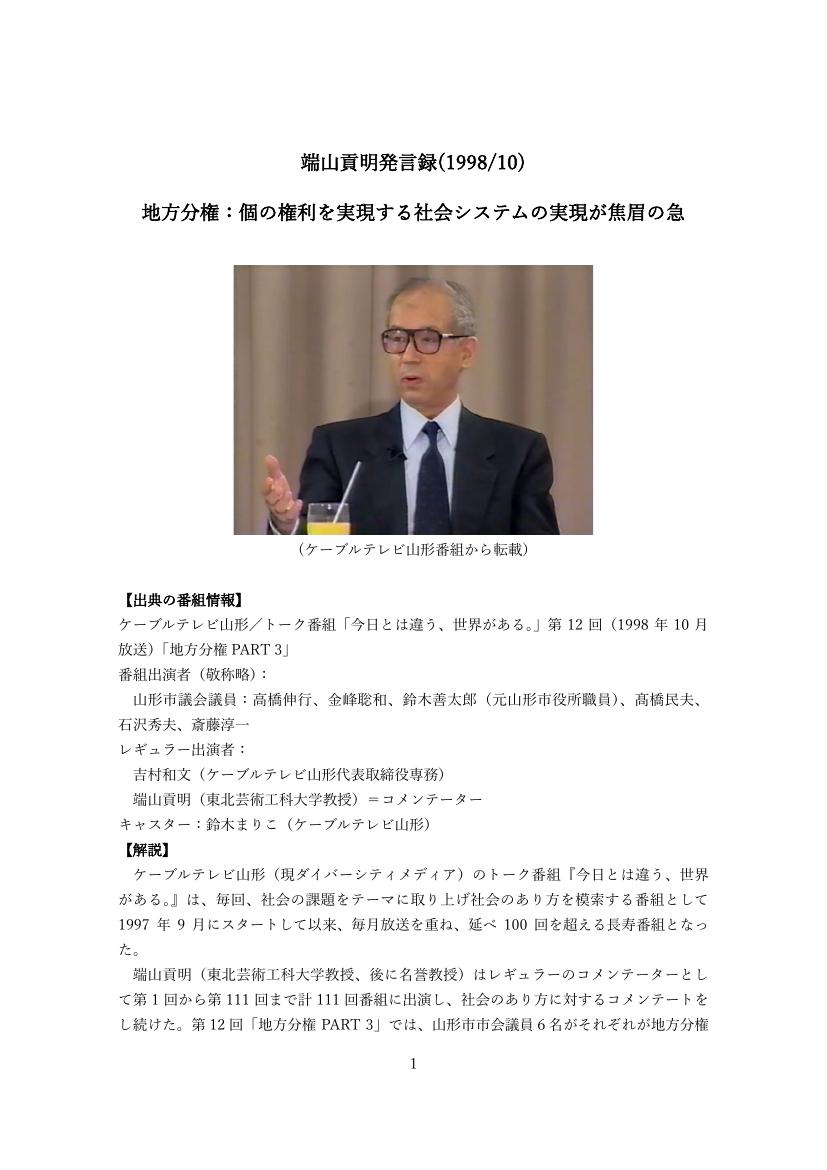
端山貢明発言録「地方分権:個の権利を実現する社会システムの実現が焦眉の急」 (Hayama Komei on Record: "Decentralisation — the Urgent Task Is a Social System That Realises the Rights of the Individual")
- Author
- Komei Hayama
- Year
- 1998
- Published in
- ケーブルテレビ山形 (Cable Television Yamagata, now ダイバーシティメディア), talk programme 『今日とは違う、世界がある。』, episode 12, 「地方分権 PART 3」, broadcast October 1998
- Subject
- Komei Hayama
- Tags
- japan · hayama archive · essay
Notes
From the 端山貢明アーカイブ (Hayama Kōmei Archive), item 127320 in the 講演・講義 (lectures) category, registered 2024-03-21: https://d-commons.net/hayama/?c=&p=127320. Published by the 端山貢明アーカイブプロジェクト (Hayama Kōmei Archive Project), directed by 前川道博 (Michihiro Maekawa) of Nagano University, on the D-Commons platform, and licensed CC BY (表示). The source documents come from the 端山文庫, the papers kept in Hayama's laboratory at Tohoku University of Art and Design, digitised by the project with the agreement of his family; his autograph scores were given to the University History Archives of the Tokyo University of the Arts in 2026. Source: ケーブルテレビ山形 (Cable Television Yamagata, now ダイバーシティメディア), talk programme 『今日とは違う、世界がある。』, episode 12, 「地方分権 PART 3」, broadcast October 1998. Dated: Broadcast October 1998 (episode 12). The archive's framing commentary is signed 前川道博 and written from 2024.. A four-page record drawn by the archive from Cable Television Yamagata's monthly talk programme 『今日とは違う、世界がある。』, begun in September 1997; Hayama was regular commentator on all 111 episodes. In episode 12, "Decentralisation Part 3", six city councillors each set out their view of decentralisation and of what Yamagata should be, with Yoshimura Kazufumi of the station and the presenter Suzuki Mariko; Hayama summed up. A commentary by Maekawa Michihiro, who runs the archive, asks whether that right of individual existence has since been realised. Hayama begins by saying he was moved by how freely the councillors spoke, and warns that holding office hardens one's viewpoint. Ideas are no longer enough at this point in history: everything must be made concrete. The councillors' origin as citizens is where their activity starts — 「市民をやめて議員になったんじゃない」, they did not stop being citizens in order to become councillors. Japan has lofty ideas and individual methods but a thin system for supporting them as a whole, so good proposals fade and the same things repeat. Building a system in which each citizen's mandate can be realised is the 焦眉の急, the urgent task. Its foundation is 個の存在(=生得)の権利, the right of individual existence, which he dates not to birth but to the moment a fertilised egg forms: the basic right is complete there, and each person then receives a unique set of genes and contributes differently. On scale he judges Yamagata City's roughly 250,000 people right, against a Tokyo of tens of millions needing re-editing before individual rights could stand. He discloses that he was born and raised in Tokyo and hardly knew Yamagata before coming for the university, and declares it his "third hometown" after Tokyo and Paris — a hometown being a place that gives you enough to constitute yourself and that you can contribute to. His own contribution is the dream of making Yamagata a centre of the world: not hegemonic but gravitational, which requires information infrastructure. Contents as the document gives them: 【出典の番組情報】 (Source programme information) · 【解説】 (Commentary, by Maekawa Michihiro) · ▼番組中での端山貢明のコメンテート (Hayama Komei's commentary during the programme). People named: 端山貢明 (Hayama Komei), 東北芸術工科大学教授 — regular commentator, 高橋伸行 (Takahashi Nobuyuki), 山形市議会議員, 金峰聡和 (Kanemine Toshikazu — reading uncertain), 山形市議会議員, 鈴木善太郎 (Suzuki Zentaro), 山形市議会議員, former city-hall official, 髙橋民夫 (Takahashi Tamio), 山形市議会議員, 石沢秀夫 (Ishizawa Hideo), 山形市議会議員, 斎藤淳一 (Saito Jun'ichi), 山形市議会議員, 吉村和文 (Yoshimura Kazufumi), ケーブルテレビ山形 代表取締役専務 — regular, 鈴木まりこ (Suzuki Mariko), ケーブルテレビ山形 — presenter, 前川道博 (Maekawa Michihiro), Nagano University — author of the commentary. Noted: Romanisations of the councillors' names are my best readings from the kanji; 金峰聡和 is especially uncertain and the file gives no readings. The file records only Hayama's closing commentary; the councillors' own statements are summarised by the archive, not transcribed. Only the month of broadcast (October 1998) is given, not the day.