マルチハビテーションは権利の表現 (Multi-habitation Is an Expression of Rights)
- Author
- Komei Hayama
- Year
- 1993
- Published in
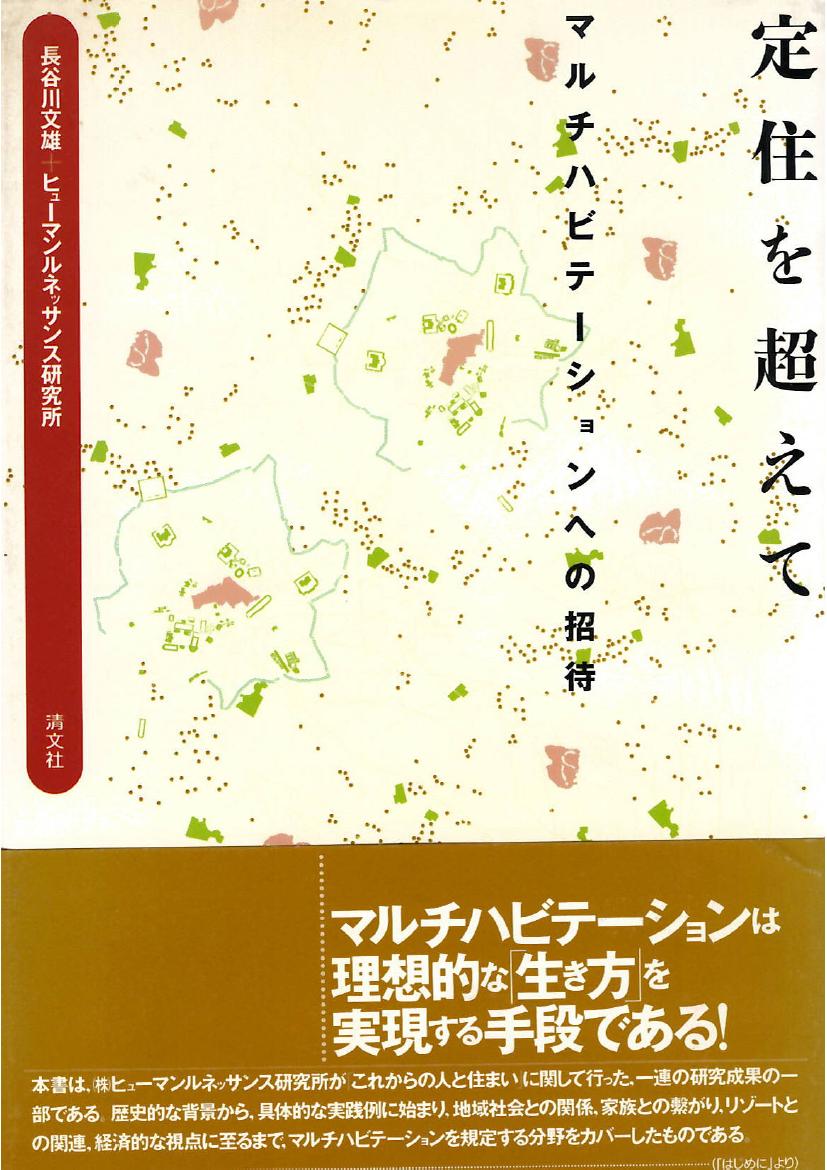
- 長谷川文雄+株式会社ヒューマンルネッサンス研究所『定住を超えて―マルチハビテーションへの招待―』, 清文社 (Seibunsha), 10 July 1993, chapter 12, pp. 213–226; ISBN 4-7960-4293-8, ¥2,000. The colophon credits Hayama as professor, Tohoku University of Art & Design.
- Subject
- Komei Hayama
- Tags
- japan · hayama archive · essay
Notes
From the 端山貢明アーカイブ (Hayama Kōmei Archive), item 9895 in the 著書・論文 (books and papers) category, registered 2022-10-02: https://d-commons.net/hayama/?c=&p=9895. Published by the 端山貢明アーカイブプロジェクト (Hayama Kōmei Archive Project), directed by 前川道博 (Michihiro Maekawa) of Nagano University, on the D-Commons platform, and licensed CC BY (表示). The source documents come from the 端山文庫, the papers kept in Hayama's laboratory at Tohoku University of Art and Design, digitised by the project with the agreement of his family; his autograph scores were given to the University History Archives of the Tokyo University of the Arts in 2026. Source: 長谷川文雄+株式会社ヒューマンルネッサンス研究所『定住を超えて―マルチハビテーションへの招待―』, 清文社 (Seibunsha), 10 July 1993, chapter 12, pp. 213–226; ISBN 4-7960-4293-8, ¥2,000. The colophon credits Hayama as professor, Tohoku University of Art & Design.. Dated: Volume dated 10 July 1993 (printing dated 1 July 1993).. Hayama's chapter closes a collective volume on multi-habitation by Hasegawa Fumio and the Human Renaissance Institute. Where the others are concrete, he takes the principle. Habitation is the support and compensation environment (支援・補障環境) for the innate right, which he defines as realising without obstruction what DNA promised. The environment in which a person lives, acts and grows is therefore that right's realisation — Whole Life Habitation — and where obstructed, a compensating environment must be built. A habitation is a space with potential, an incubator for growth from the fertilised egg on. The second principle is 回復性, recoverability: what is lost is valued by the burden of restoring it. A society of low recoverability exhausts itself and never accumulates; he contrasts Japan with Europe's stock-type society. Home's maintenance functions are externalised one by one — fish sold filleted, washed rice, bakers, fast food, nappy rental — and city scale is what makes rarely used ones viable. What is pushed out cannot be recovered once dispersed, so 「鬼は外」, demons out, is the wrong consciousness. He asks why people want to own: because what one needs is not otherwise certainly to hand. Nobody wants to own air, or an escalator. That is his bridge to 非決定的な恒常性, non-deterministic constancy: what is needed exists when needed, in the state needed, so it need not be possessed decisively. He invokes 無常, Laozi's 「道可道 非常道」 and Kamo no Chōmei's river, and defines Multi Habitation as settlement extended — a person existing probabilistically everywhere on earth, using each place and contributing to it, until settlement's domain is the planet: 量子論的定住, quantum-theoretic settling. He expects this to be revolutionary for construction. It ends with the ホテル・コンパウンド: Boston's Copley Place — two high-rise hotels, 100 shops, nine cinemas, four office buildings, apartments and parking for 1,400 cars — needs only a high-grade information network to become Whole Life Habitation. Contents as the document gives them: 1 原理──ハビテーションの視点 (Principle: the viewpoint of habitation) — 1 生得の権利の実現のための支援・補障環境としてのハビテーション / 2 ポテンシャルのある空間 / 3 ハビテーションにおける回復性 · 2 機能──ハビテーションとマルチハビテーションの間にあるもの (Function: what lies between habitation and multi-habitation) — 1 ハビテーションに関わる維持機能の外部化、Homeの機能の外部化 / 2 権利の条件としての機能の恒常性、連続性(空間、時間、内容) / 3 機能の恒常化から非決定へ、3への推移部 · 3 機能──マルチハビテーションの視点 (Function: the viewpoint of multi-habitation) — 1 非決定的な恒常性 / 2 Multi Habitation 定住の拡大、非決定的定住 / 3 ホテル・コンパウンド、権利の非決定的な実現. People named: 端山貢明 (Hayama Komei) — author of chapter 12, 長谷川文雄 (Hasegawa Fumio), Tohoku University of Art & Design — lead author of the volume, credited with はじめに and chapter 11, 老子 (Laozi), quoted 「道可道 非常道」, 鴨長明 (Kamo no Chomei), quoted from 『方丈記』, 大江守之 (Oe Moriyuki), 厚生省人口問題研究所 — chapter 5, 木村通治 (Kimura Michiharu), 埼玉短期大学 — chapter 4 section 3, 嶋村和恵 (Shimamura Kazue), 早稲田大学商学部 — chapter 6, 竹原由佳子 (Takehara Yukako), ヒューマンルネッサンス研究所 — chapter 4 sections 1–2 and appendix, 中野善浩 (Nakano Yoshihiro), ヒューマンルネッサンス研究所 — chapters 1, 3, 7, 13, 檜槇貢 (Himaki Mitsugu), 日本都市センター — chapter 8, 前田博 (Maeda Hiroshi), 環境文化研究所 — chapter 2, 室崎純一郎 (Murosaki Jun'ichiro), 北陸電力 — chapter 9, 横内憲久 (Yokouchi Norihisa), 日本大学理工学部海洋建築工学科 — chapter 10, 成松丞一 (Narimatsu Joichi), publisher, 清文社, 丸岡一志 (Maruoka Kazushi), book design, 横田英子 (Yokota Eiko), hand phototypesetting. Noted: The file is an image-only scan with no text layer; I rendered and read it as images. The file contains only the cover, Hayama's chapter (pp. 213–226) and the colophon; the rest of the book is not included. Romanisations of the contributors listed in the colophon are my best readings and several are uncertain, in particular 檜槇貢, 室崎純一郎 and 成松丞一; the colophon gives no readings. The heading of part 3 appears to read 「機能──マルチハビテーションの視点」, parallel to part 2; in Hayama's 1991 lecture handout on the same material the equivalent part is headed 「様態」. The ISBN and price were read from a low-resolution colophon scan.