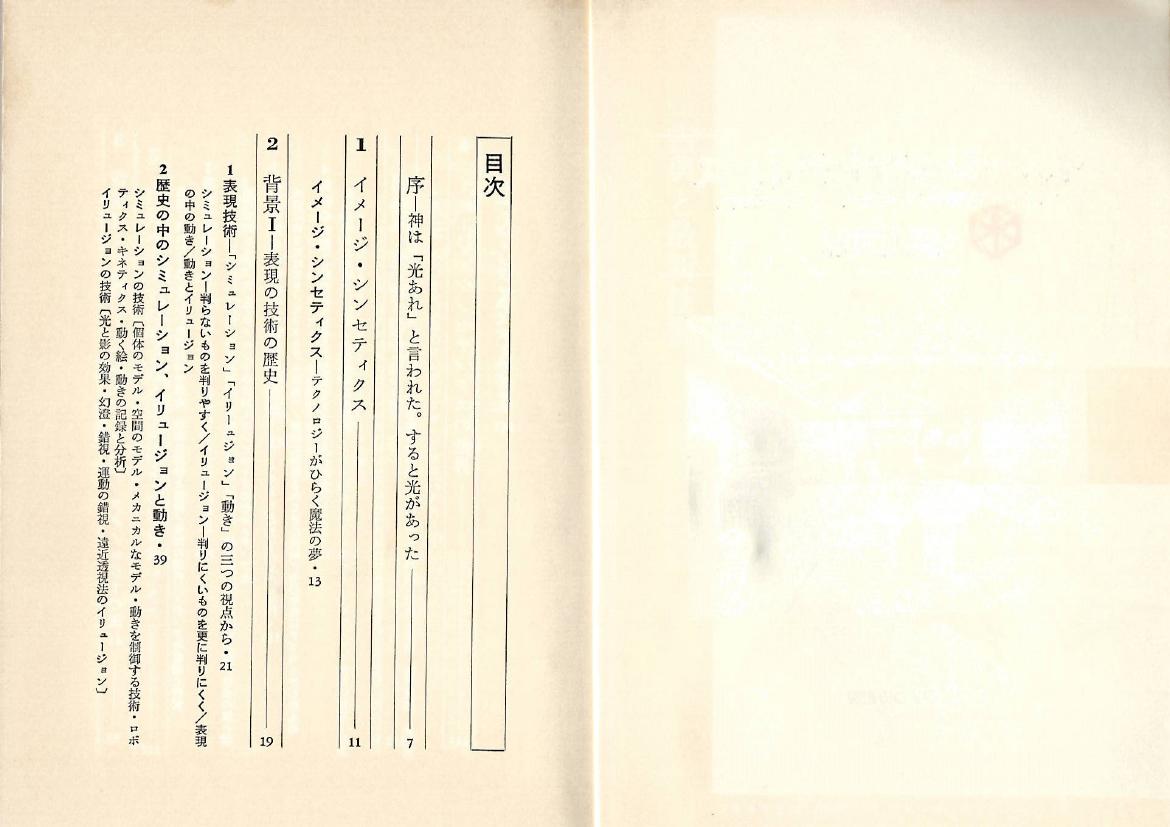
端山貢明著『イメージ・シンセティクス ラスコーの壁画からコンピュータ・グラフィクスへ』 (Image Synthetics: From the Lascaux Cave Paintings to Computer Graphics, by Hayama Kōmei)
- Author
- Komei Hayama
- Year
- 1983
- Published in
- みずうみ書房 (Mizuumi Shobō), 東京都千代田区神田小川町3-5-3; 342 pp.; ¥1,200; 発行者 坂田秀馬; 印刷所 図書印刷株式会社; 装幀 小川公男; 表紙I トリプルエ社提供 (Triple-I / Information International Inc., copyright 1980), 表紙IV ディジタル・エフェクツ社提供 (Digital Effects Inc.)
- Subjects
- Komei Hayama, Masao Komura
- Tags
- japan · hayama archive · computer art history · media art · pioneers
Notes
From the 端山貢明アーカイブ (Hayama Kōmei Archive), item 9878 in the 著書・論文 (books and papers) category, registered 2022-10-02: https://d-commons.net/hayama/?c=&p=9878. Published by the 端山貢明アーカイブプロジェクト (Hayama Kōmei Archive Project), directed by 前川道博 (Michihiro Maekawa) of Nagano University, on the D-Commons platform, and licensed CC BY (表示). The source documents come from the 端山文庫, the papers kept in Hayama's laboratory at Tohoku University of Art and Design, digitised by the project with the agreement of his family; his autograph scores were given to the University History Archives of the Tokyo University of the Arts in 2026. Source: みずうみ書房 (Mizuumi Shobō), 東京都千代田区神田小川町3-5-3; 342 pp.; ¥1,200; 発行者 坂田秀馬; 印刷所 図書印刷株式会社; 装幀 小川公男; 表紙I トリプルエ社提供 (Triple-I / Information International Inc., copyright 1980), 表紙IV ディジタル・エフェクツ社提供 (Digital Effects Inc.). Dated: Afterword dated 一九八三年 七月 (July 1983); colophon: 1983年9月25日 第一刷発行 (first printing 25 September 1983). Hayama states he began writing the book in 1978.. The two scans give the book's front and back matter: the table of contents, the preface's opening and the first page of chapter 1, then the closing chapter, afterword, bibliography and colophon. Mizuumi Shobō, first printing 25 September 1983, 342 pages, ¥1,200. The jacket is by Ogawa Kimio, with cover images from Triple-I (copyright 1980) and Digital Effects Inc.; a Lascaux cave painting faces the preface, which starts from Genesis — God said let there be light — and asks, as a composer, why scripture records light and not sound. The afterword is the historically valuable part. Hayama began writing in 1978 and took five years, rewriting sections yearly as technology and society changed. He deliberately avoided detailed hardware description, because his own institute was working on machine-independent, portable software, and avoided the field's more eccentric fashions so its proper development could be judged fairly. The closing chapter argues that these separately developed media technologies are converging into one domain which will then individualise to answer each person's demand, providing a social medium enveloping society as a whole. Then the record. In 1972 he founded the Computer Art Center with Komura Masao, by 1983 a Tsukuba lecturer, and staged a small International Computer Art Exhibition organised by CAC, supported by Fujitsu, at the Computer Salon; from the following year it was adopted as an official event of Information Week and ran until 1978 at the Sony Building. He credits Kawabata, Kubo and Furusawa of Computer Age and Sony Kigyō's managing director Kada; Watanabe Shigeru, president of Tokyo Metropolitan Institute of Technology, chaired the committee throughout; Yamaguchi Katsuhiro and Mitsui Hideki of Tsukuba were central. He records the parallel Computer Animation Anthology (CAC, supported by the Japan Society of Image Arts and Sciences, Nikkei Science, Computer Age and the American Center) and dates the afterword July 1983. Contents as the document gives them: 序―神は「光あれ」と言われた。すると光があった (Preface: God said 'let there be light', and there was light) · 7 · 1 イメージ・シンセティクス (Image synthetics) · 11 — イメージ・シンセティクス―テクノロジーがひらく魔法の夢 (the magical dream technology opens) · 13 · 2 背景I―表現の技術の歴史 (Background I: a history of the technology of expression) · 19 — 1 表現技術「シミュレーション」「イリュージョン」「動き」の三つの視点から · 21; 2 歴史の中のシミュレーション、イリュージョンと動き · 39 (models of the individual and of space, mechanical models, robotics, kinetics, moving pictures, recording and analysis of motion, light-and-shadow effects, phantasmagoria, optical and motion illusion, perspective) · 3 背景II―一九四〇~八〇年代のメディア・テクノロジーの流れ (Background II: the course of media technology, 1940s–80s) · 83 — 1 新しい表現技術 · 86; 2 提言の時期―新しい思想と概念を社会に呈示した六〇年代 · 100; 3 実用化社会化のための技術の充墳期―モラトリアムとしての七〇年代 · 115; 4 実効の時期―八〇年代 · 125 · 間奏曲―少し私のことを (Intermezzo: a little about myself) · 132 · 4 イメージ・シンセティクスの世界 (The world of image synthetics) · 145/147 — 1 コンピュータ・グラフィクス · 149 (第一期 · 153; 第二期 七〇年代以降 · 173: 3-D basics, hidden-surface removal, shading, output, interactivity and real-time response, GRASS, flight simulator, ANIMA II, fractals, ray tracing, texture of object surfaces, international standards); 2 ビデオ・シンセサイザー―偏向制御 · 278; 3 キネティクス · 290; 4 ホログラフィ · 300 · 5 社会メディアの中でのイメージ・シンセティクス (Image synthetics within the social medium) · 311 — メディア・テクノロジーの新しい展開 · 313; 第三期のコンピュータ・グラフィクス/シミュレーション/CAI/CATV/ビデオテクス/広域高度情報システム; コンピュータ・グラフィクスの商業的応用 · 332; マイコン・グラフィクスの向上 · 335 · おわりに (In closing) · 336 · あとがき (Afterword) · 337 · 参考文献 (Bibliography) · 342. People named: 端山貢明 (Hayama Kōmei) — author, 幸村真佐男 (Komura Masao) — co-founder of CAC, described as 筑波大学講師, 河端照孝 — コンピュータ・エージ社 (Computer Age), 久保悌二郎 — コンピュータ・エージ社, 古沢繁夫 — コンピュータ・エージ社, 賀田恭弘 — ソニー企業常務 (managing director, Sony Kigyō), 渡辺茂 (Watanabe Shigeru) — 東京都立工科大学学長, standing chair of the exhibition committee, 山口勝弘 (Yamaguchi Katsuhiro) — 筑波大学, 三井秀樹 (Mitsui Hideki) — 筑波大学, 勝間秀俊 — 多摩芸術学園講師, advised on holography, 池田 (the late managing director Ikeda of 富士通株式会社; given name not stated), 小川公男 (Ogawa Kimio) — book design, 坂田秀馬 — publisher, みずうみ書房, 中島久美子 (Nakajima Kumiko) — editor, みずうみ書房, ジャシア・ライカート (Jasia Reichardt) — cited in the bibliography (The Computer in Art), デュシャン (Marcel Duchamp) — bibliography (新潮美術文庫「デュシャン」). Two files are held here: the download above is the first set of scanned pages (5 pp.); attached alongside it is the second set of scanned pages (4 pp.), at https://auzflodykqpwhwkadtpq.supabase.co/storage/v1/object/public/library-files/hayama-image-synthetics/scan-2.pdf. Noted: Only the front and back matter are in the archive's files; the body of the book (pp. 11–335) was not seen, so the summary of its argument rests on the table of contents, the preface opening, the closing chapter and the afterword. Readings of several names in the afterword could not be established and are left unromanised: 河端照孝, 久保悌二郎, 古沢繁夫, 賀田恭弘, 勝間秀俊, 坂田秀馬. The Fujitsu director is named only as 故池田常務 ('the late managing director Ikeda'); no given name is given. 'トリプルエ社' on the cover credit is read as Triple-I (Information International, Inc.); the Japanese is ambiguous between トリプルエー and トリプルアイ. The archive's own table of contents omits 間奏曲―少し私のことを, which the printed contents page does include. The 東京都立工科大学 attached to 渡辺茂 is as printed; no further detail is given.