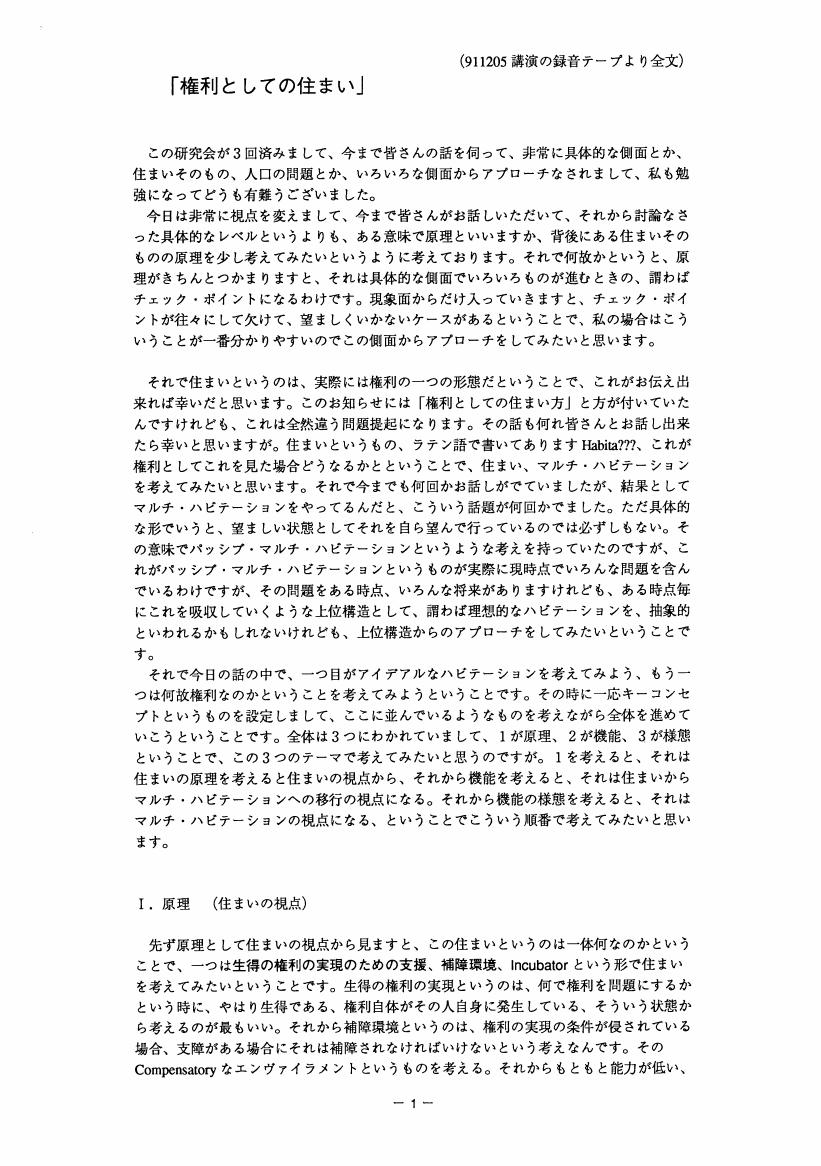
12/05権利としての住まい (Housing as a Right (lecture of 5 December))
- Author
- Komei Hayama
- Year
- 1991
- Subject
- Komei Hayama
- Tags
- japan · hayama archive · essay
Notes
From the 端山貢明アーカイブ (Hayama Kōmei Archive), item 9893 in the 講演・講義 (lectures) category, registered 2022-10-02: https://d-commons.net/hayama/?c=&p=9893. Published by the 端山貢明アーカイブプロジェクト (Hayama Kōmei Archive Project), directed by 前川道博 (Michihiro Maekawa) of Nagano University, on the D-Commons platform, and licensed CC BY (表示). The source documents come from the 端山文庫, the papers kept in Hayama's laboratory at Tohoku University of Art and Design, digitised by the project with the agreement of his family; his autograph scores were given to the University History Archives of the Tokyo University of the Arts in 2026. Dated: 5 December 1991. The transcript is headed 「(911205 講演の録音テープより全文)」 — the complete text from the tape of the lecture. Hayama opens by noting that three sessions of the study group have already taken place.. A lecture of 5 December 1991, transcribed from the tape, with Hayama's own six-page handout. It is the study group's fourth session; the previous three were concrete, and he will instead talk about principle, which gives check-points for concrete work. His thesis is that 住まい, dwelling, is one form of a right, and he rewrites the classical eighteenth-century definition — "to do all that does not harm others" — into a modern one: 「DNA の記述する状況を支障なく実現出来ること」, realising without obstruction what one's DNA describes. Since merely existing harms others, rights presuppose 回復性, recoverability. Part I builds a Latin apparatus — habitat, habilito, habilitas, habitatio, habitio — so a dwelling becomes a medium of survival and a space with potential. He introduces 中間集合, the intermediate mass: some 30 per cent of the economic population brought into the economic classes by the 1960s boom under Prime Minister Ikeda's income-doubling pledge. When that mass demands the same resources, Japan has not enough. Media have thresholds of existence, illustrated by the descending count of righteous men in Genesis 18, the public bath with too few bathers, and the Japan Philharmonic affair, when Fuji Television cut an orchestra it could not justify by ratings. Part II externalises the house: 皮膚空間, skin space, and エクソスケルトン, exoskeleton, are the layers wrapped round the soft body, and the history of technology is the moving of Home's functions outside it — the baker, pre-washed rice, packed fish, fast food, nappy rental. A right then depends on the 恒常性, constancy, of those functions in time, space and content: being able, the moment you move anywhere, to use that place and contribute to it as if you had been there thirty years. Part III moves to 非決定的恒常性, non-deterministic constancy, and defines Multi Habitation as 量子論的定住, a quantum-theoretic settling in which a person exists probabilistically everywhere on earth — with Laozi's 「道可道 非常道」 and Kamo no Chōmei's river as images of impermanence. Contents as the document gives them: キー・コンセプト (KC): 権利/回復性/皮膚空間/恒常性/非決定性/現代の質の成就過程 (right, recoverability, skin space, constancy, non-determinacy, the achievement process of the modern quality) · I 原理 住まいの視点 (Principle: the viewpoint of dwelling) — 1 生存の媒質としての住まい / 2 権利の実現度の一つのアスペクトとしてのリソースの専有度 / 3 メディアの存立の条件と維持技術、及びその対価の性質 / 4 Capacityと社会的技術、維持技術 / 5 そこで SOLUTION 時空間の重層利用、超時空間的マルチハビテーション · II 機能 住まいからマルチハビテーションへの視点 (Function: from dwelling towards multi-habitation) — 1 Habito に関わる維持機能の Externalization / 2 権利の条件としての恒常性、連続性(空間、時間、内容) / 4 IIIへの推移部 機能の恒常化から非決定へ · III 様態 マルチハビテーションの視点 (Mode: the viewpoint of multi-habitation) — 1 非決定的な恒常性 / 2 Multi Habitation 定住の拡大 / 3 メディア・コンパウンド、メディア・アマルガメーションの、権利に対応した非決定的な実現. People named: 端山貢明 (Hayama Komei) — speaker, 老子 (Laozi), quoted 「道可道 非常道」, 鴨長明 (Kamo no Chomei), quoted from 『方丈記』, dated 1212 in the handout, 池田内閣総理大臣 (Prime Minister Ikeda [Hayato]), named only by surname, for the income-doubling plan, 長谷川さん (Mr Hasegawa — evidently Hasegawa Fumio), addressed as present in the room, パパート (Seymour Papert), for LOGO at MIT, クストー (Jacques Cousteau), for the oceanographic museum in Les Halles, アブラハム/アブラム (Abraham) and ロト (Lot), from Genesis 13 and 18, 孫悟空 (Sun Wukong) and 観音菩薩 (Kannon), from 『西遊記』, used as images. Two files are held here: the download above is the main scanned document (27 pp.); attached alongside it is a second scanned document (6 pp.), at https://auzflodykqpwhwkadtpq.supabase.co/storage/v1/object/public/library-files/hayama-housing-as-a-right/scan-2.pdf. Noted: Both files are image-only scans with no text layer; I rendered and read them as images. The transcript is peppered with 「???」 where the tape was inaudible, including the Latin term at the first mention of 「Habita???」, so some wording is irrecoverable. Neither file names the convening body, the venue or the other participants; the identification of 「長谷川さん」 as Hasegawa Fumio is my inference from the fact that the same material became Hayama's chapter 12 of Hasegawa's 1993 book 『定住を超えて』. In the handout, section II jumps from 2 to 4 (the heading numbered 3 is not visible); this is as printed. Pages 26 and 27 of the transcript are untitled hand-drawn diagrams — one of administration/citizen information flows, one of a BRAIN/EFFECTER "FORUM" structure — with no caption tying them to a point in the talk. Prime Minister Ikeda's given name is not stated in the transcript.