新しいメディアとしてのコンピュータスペース(3) (Computer space as a new medium (3): Cybernetic ARTRIP)
- Author
- Komei Hayama
- Year
- 1973
- Subject
- Komei Hayama
- Tags
- japan · hayama archive · computer art history · media art · essay
Notes
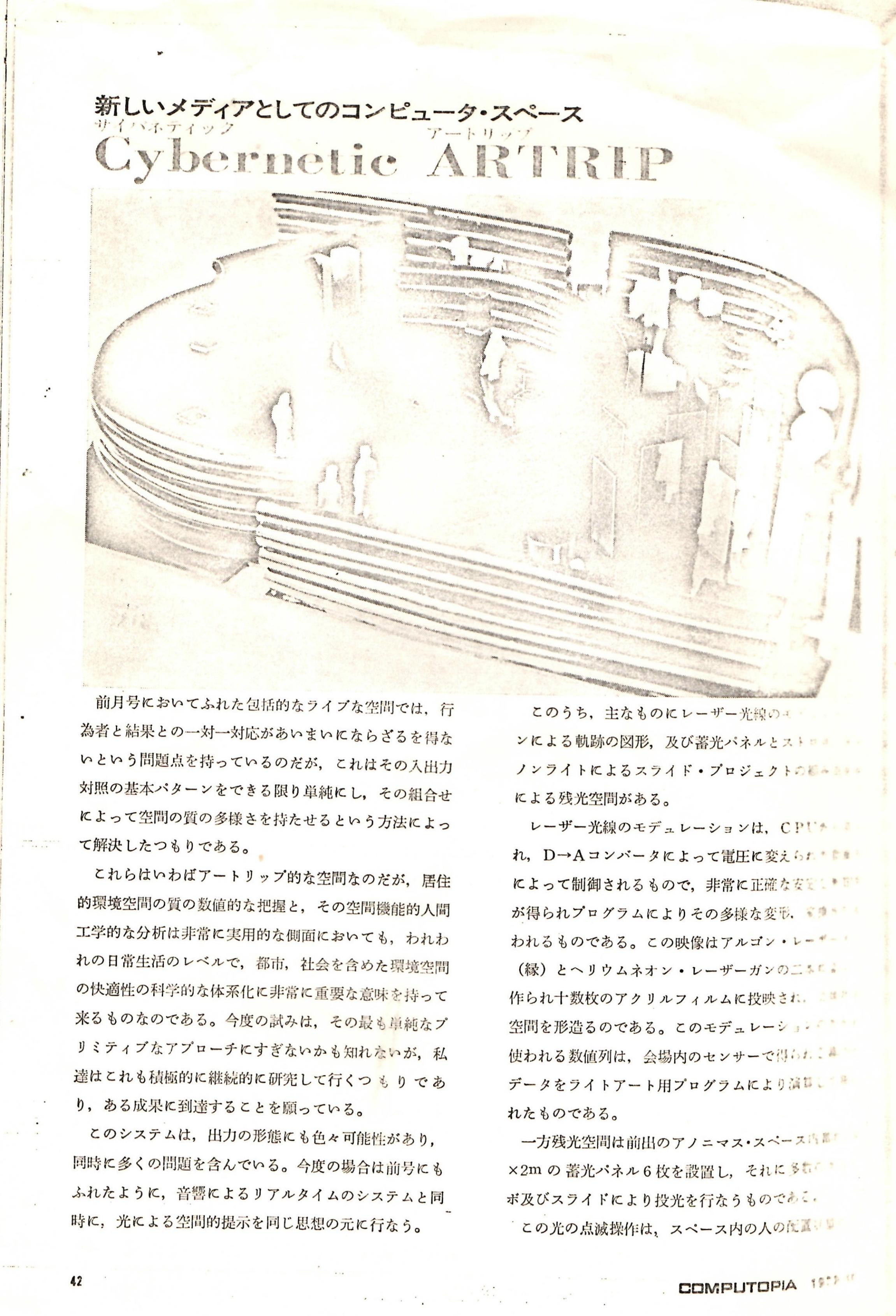
From the 端山貢明アーカイブ (Hayama Kōmei Archive), item 9964 in the コンピュータアート category, registered 2022-10-04: https://d-commons.net/hayama/?c=&p=9964. Published by the 端山貢明アーカイブプロジェクト (Hayama Kōmei Archive Project), directed by 前川道博 (Michihiro Maekawa) of Nagano University, on the D-Commons platform, and licensed CC BY (表示). The source documents come from the 端山文庫, the papers kept in Hayama's laboratory at Tohoku University of Art and Design, digitised by the project with the agreement of his family; his autograph scores were given to the University History Archives of the Tokyo University of the Arts in 2026. Source: 端山貢明「新しいメディアとしてのコンピュータスペース Cybernetic ARTRIP」『コンピュートピア』(Computopia) 1973年10月号, pp. 42–44. Scanned from a photocopy in the 端山文庫.. Dated: Published October 1973; the exhibition ran 5–21 October 1973.. The archive publishes this item as 4 separate page scans rather than as a PDF; the download here was assembled from those scans in page order, each taken at the higher of the two resolutions the archive serves. The last article carries the exhibition's own title, Cybernetic ARTRIP. Hayama concedes that in a comprehensive live space the correspondence between actor and result goes blurred, and says he has met this by keeping the basic input-output patterns simple and getting variety from their combination. Then the works. Argon and helium-neon laser guns, controlled from the CPU through a D/A converter, project traces onto ten-odd acrylic films, their number series computed by a light-art program from the hall's sensor data. An afterglow space sets six phosphorescent panels inside the Anonymous Space, lit by strobe and slide and driven by the arrangement of people, so visitors' shadows and computer graphics linger and overlap. The hardware pieces include seven fantastical bird marionettes modelled on the crested ibis, about a metre in height and wingspan, digitally controlled; a metal mobile that is also an instrument, steel balls rolling down a maze of vertical steel bars whose flip-flop logic gates change their path so a different combination of sounds plays each time — not powered, not online, "論理式のアート的模型" (an art model of a logical formula); パイプの波, a hundred acrylic spheres of luminous material floating one to each of a hundred pipes set 10 × 10, their heights controlled so the surface draws slow waves; and a plotter corner where visitors type variables into stored drawing formulas and take the drawing home. Also shown were bio-music, converting EEG, heart sounds and EMG taken through ME terminals into sound; 老人の知恵, a retrieval of philosophy and life wisdom gathered beforehand from old people, cut back from a planned ten-thousand-item kanji-keyword system; a graphic section with 100 works from West Germany; a forest of video monitors with 16 mm computer films; and a four-channel computer sound space. The hall on the Sony Building's eighth floor measured 390 m², built around vinyl sheet and air structures. A guide system for blind visitors was planned but never built. Contents as the document gives them: 来場者とのインタラクション (interaction with the visitor) · グラフィック・プロージョン/ビデオの森/コンピュータ・サウンド・スペース. Noted: The archive warns that this copy is the least legible of the three; much of the right-hand column of p. 42 and parts of p. 44 are broken up, and some readings here are reconstructions from context. The name of the graphic section is printed as グラフィック・プロージョン and has been left untranslated; the intended English word is not clear. The number of phosphorescent panels is given as six but their first dimension is illegible ("…×2m"). The reading P-Nイメージリング for the real-time visual work is uncertain.