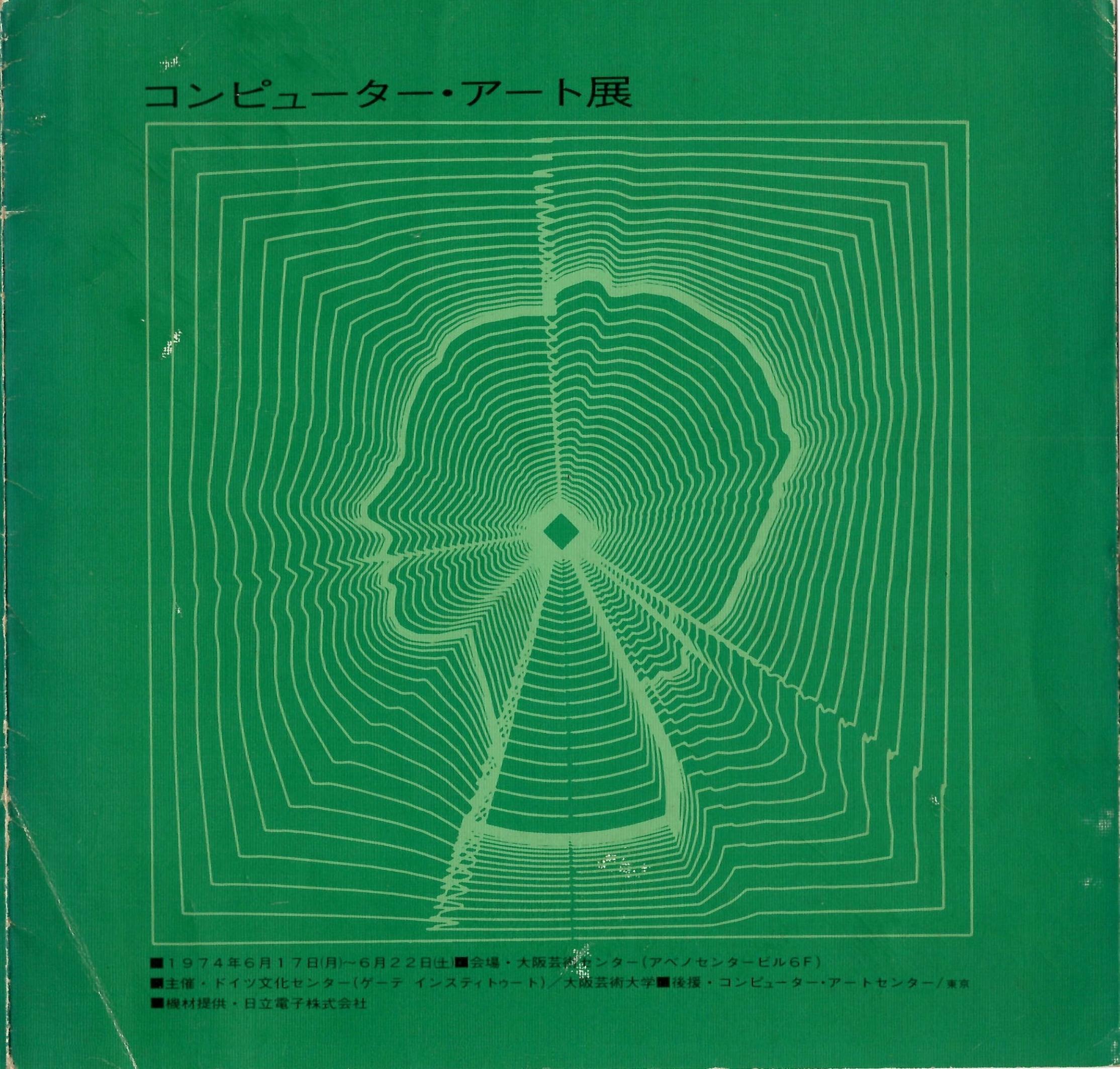
コンピュータ・アート展(大阪) (Computer Art Exhibition (Osaka))
- Author
- Komei Hayama
- Year
- 1974
- Subject
- Komei Hayama
- Tags
- japan · hayama archive · computer art history · media art · exhibition catalog
Notes
From the 端山貢明アーカイブ (Hayama Kōmei Archive), item 124963 in the コンピュータアート category, registered 2023-08-18: https://d-commons.net/hayama/?c=&p=124963. Published by the 端山貢明アーカイブプロジェクト (Hayama Kōmei Archive Project), directed by 前川道博 (Michihiro Maekawa) of Nagano University, on the D-Commons platform, and licensed CC BY (表示). The source documents come from the 端山文庫, the papers kept in Hayama's laboratory at Tohoku University of Art and Design, digitised by the project with the agreement of his family; his autograph scores were given to the University History Archives of the Tokyo University of the Arts in 2026. Source: Printed programme booklet, green and pale blue card, 5 scanned openings; cover carries 幸村真佐男's plotter work Return to Square (b).. Dated: 17 June (Monday) to 22 June (Saturday) 1974, 12:30–18:00.. The archive publishes this item as 5 separate page scans rather than as a PDF; the download here was assembled from those scans in page order, each taken at the higher of the two resolutions the archive serves. The booklet for the Osaka Computer Art Exhibition, 17–22 June 1974, at the Osaka Art Center on the sixth floor of the Abeno Center Building. It was organised by the German Cultural Centre (Goethe-Institut) and Osaka University of Arts, supported by the Computer Art Center in Tokyo, with equipment from Hitachi Electronics; admission was free. The subtitle runs "グラフィック+音楽+フィルム+講演" under two questions: can this become a new means for art, and a new place for creation. The graphics section was assembled by Herbert W. Franke from the exhibition of the same name co-organised by the Massachusetts Institute of Technology and the Technical University of Berlin in Berlin in the summer of 1968, supplemented with recent work. Franke's essay "コンピューター芸術への道" argues that art is an informational phenomenon whose mechanisation could bear fruit only once information-processing systems existed, and that the computer's field is structuralist work. The German list is Klaus Basset, Franke, Hein Gravenhorst, Karl M. Holzhäuser, Gottfried Jäger, Manfred Mohr, Frieder Nake and Georg Nees; the American list runs from Lillian Schwartz and Stan VanDerBeek through Kerry Strand, Charles Csuri, Manfred Schroeder, Ken Knowlton, Ruth Leavitt and Roger Vilder; the Japanese section is CTG, with Kōmura Masao, Kōriyama Tadashi, Ōhira Tomohiro, Dehara Eiichi, Kawano Hiroshi and Shimomura Chihaya. Music played continuously from tape supplied by the Center: Vercoe's Synthesism, Chowning's Turenas, Behrman's Home made synthesizer music, Dodge's Earth's magnetic field, Cage's HPSCHD, Shibamoto's Continuity and Olive's Study No. 5. The 16 mm colour films were Whitney's Lapis, John Whitney Jr's Terminal Self and Metrics, Nees's Spuren von Bedeutung and CTG's Computer voice No. 1. Hayama lectured on 17 June on music and computer space as a new medium and Kōmura on 18 June on computer art as a demand of the present; Uenami Wataru chaired the discussion on 19 June with Hayama, Ichiyanagi Toshi and Kōmura. Contents as the document gives them: I. コンピューター・グラフィック · "コンピューター芸術への道" H.W. フランケ · 出品作家:ドイツの部/アメリカの部/日本の部 · II. コンピューター音楽とコンピューター映画 · III. 講演とディスカッション · 講師紹介 (introductions to the speakers). People named: 端山貢明 (Hayama Kōmei), 一柳慧 (Ichiyanagi Toshi), 幸村真佐男 (Kōmura Masao), 上浪渡 (Uenami Wataru), H・W・フランケ / Herbert W. Franke, Klaus Basset, Hein Gravenhorst, Karl M. Holzhäuser, Gottfried Jäger, Manfred Mohr, Frieder Nake, Georg Nees, Ludwig Rase, Lillian Schwartz, Stan Vanderbeek, Len Sacon (Adage·co), Kerry Strand, C. Csuri, J. Shaffen, D. W. Roboins, Philip Peterson, Dan Cohen, Dick Land, Manfred Schroeder, Manuel Barbadillo, Ken Knowlton, Ruth Leavitt, Jacques Palumbo, Miljenko Horvat, Roger Vilder, 郡山正 (Kōriyama Tadashi), 大平智弘 (Ōhira Tomohiro), 出原栄一 (Dehara Eiichi), 川野洋 (Kawano Hiroshi), 下村千早 (Shimomura Chihaya), Vercoe, Chowning, Behrman, Dodge, Cage, 芝本 (Shibamoto), Olive, Mathews, Ashley, Raudall (printed thus; probably J. K. Randall), John Whitney, John Whitney Jr.. Noted: Several names in the American list are set with evident errors and are transcribed as printed: "G·Jager apporative grafik", "Len Sacon (Adage·co)", "J·Shaffen", "D·W·Roboins", "Raudall". Lapis is credited in the film programme to John Whitney; the film is in fact by James Whitney, as Hayama himself writes in his 1973 Computopia article. The 1968 Berlin exhibition is described only as "同名の展示会" co-organised by MIT and the Technical University of Berlin; the booklet gives no title of its own for it. The given name of 芝本, composer of Continuity, is not printed. "Turenus" is printed for Chowning's Turenas.