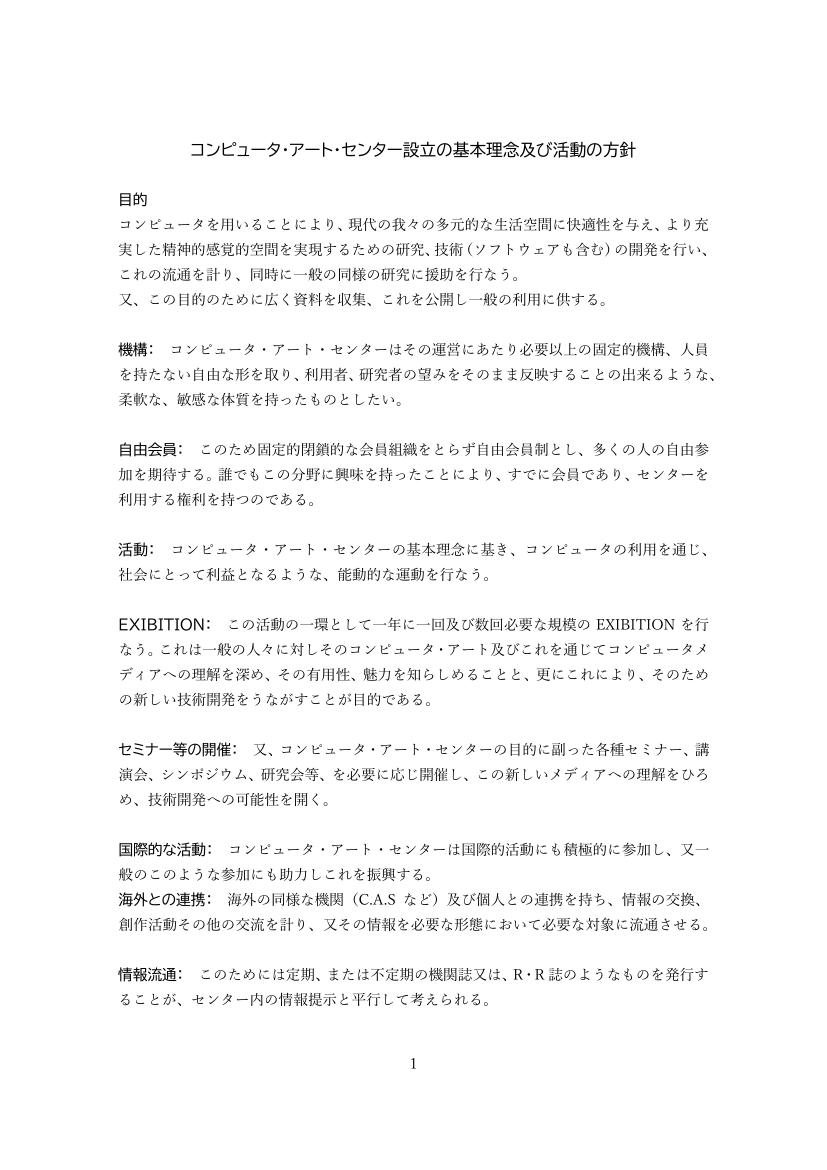
コンピュータ・アート・センター設立の基本理念及び活動の方針 (Founding Principles and Activity Policy of the Computer Art Center)
- Author
- Komei Hayama
- Year
- 1972
- Subject
- Komei Hayama
- Tags
- japan · hayama archive · computer art history · media art · pioneers
Notes
From the 端山貢明アーカイブ (Hayama Kōmei Archive), item 9869 in the コンピュータアート (computer art) category, registered 2022-10-02: https://d-commons.net/hayama/?c=&p=9869. Published by the 端山貢明アーカイブプロジェクト (Hayama Kōmei Archive Project), directed by 前川道博 (Michihiro Maekawa) of Nagano University, on the D-Commons platform, and licensed CC BY (表示). The source documents come from the 端山文庫, the papers kept in Hayama's laboratory at Tohoku University of Art and Design, digitised by the project with the agreement of his family; his autograph scores were given to the University History Archives of the Tokyo University of the Arts in 2026. Two typed pages setting out what the Computer Art Center is for and how it will run. The purpose clause is one sentence: by using computers, to research and develop technology (software included) that gives comfort to our plural contemporary living space and realises a fuller spiritual and sensory space; to circulate it; to assist similar research by others; and to collect materials widely, make them public and put them at general disposal. Its most striking provisions are organisational. The centre is to hold no more fixed structure or staff than strictly necessary, staying flexible enough to reflect users' and researchers' wishes directly. In place of a closed membership it adopts a free-member system: anyone who has come to take an interest in the field is already a member and has the right to use the centre. An EXIBITION [sic] is to be held once or several times a year at whatever scale is needed, to deepen public understanding of computer art and spur the techniques such shows require; seminars, symposia and study meetings follow as needed. The centre will join international activity, keep links with bodies abroad — C.A.S., the Computer Arts Society in London, is named — and publish a bulletin. Collected Japanese and foreign materials go on open display inside the Computer Salon for free consultation; equipment too is to be open as far as possible. Addresses close the sheet: the reference room at the Denpa Building, first floor, 1-11-15 Higashi-Gotanda, Shinagawa-ku, and the office at 4-7-13 Jingūmae, Shibuya-ku. In 1972 computers in Japan were still confined to routine work in particular industries and Xerox PARC's Alto was a year away, so a membership-free computer-art centre with a public reading room was an unusual proposition. The policy already contains in embryo Hayama's later doctrine that a medium is constituted by the agency of the receiving side: the centre exists in order to be used. Contents as the document gives them: 目的 (Purpose) · 機構 (Structure) · 自由会員 (Free membership) · 活動 (Activities) · EXIBITION [sic] (Exhibitions) · セミナー等の開催 (Holding seminars and the like) · 国際的な活動 (International activity) · 海外との連携 (Links with institutions abroad) · 情報流通 (Circulation of information) · 資料収集と公開 (Collecting materials and opening them) · 資料室及び連絡所 (Reference room and contact point) · 事務所 (Office). Noted: The document is undated and unsigned; the 1972 date is the archive's. No individual person is named anywhere in the document; only the organisation C.A.S. is. 「R・R誌のようなもの」 ("something like an R.R. magazine") is unexplained; what R.R. stands for could not be determined. 「コンピュータ・サロン(後期)」 appears to be a typo for 後記 ("see below"); the institutional relationship between CAC and the Computer Salon is not spelled out. EXIBITION is spelled thus in the original.