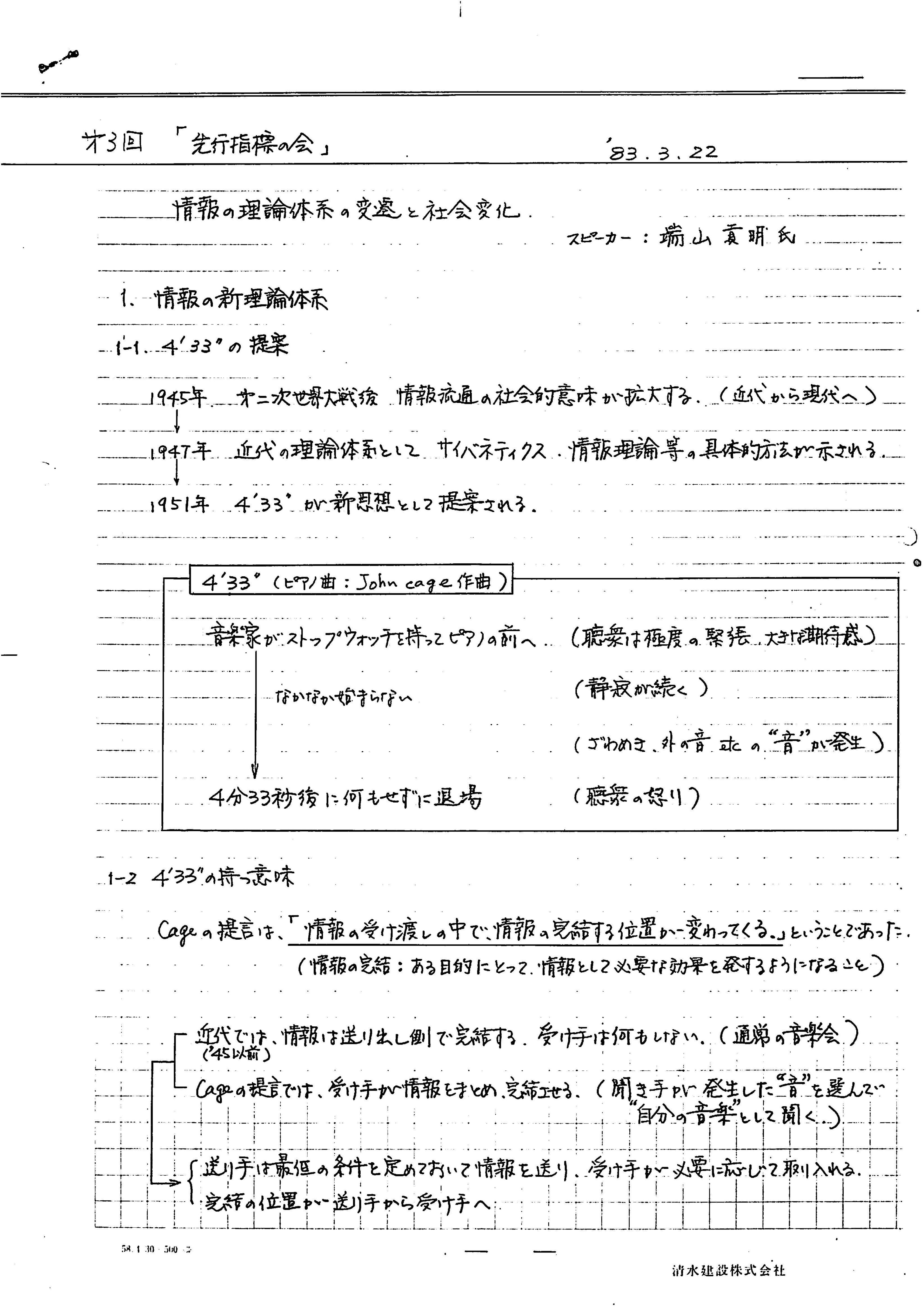
情報の理論体系の変遷と社会変化(端山貢明) (Changes in the Theoretical System of Information and Social Change)
- Author
- Komei Hayama
- Year
- 1983
- Subject
- Komei Hayama
- Tags
- japan · hayama archive · essay
Notes
From the 端山貢明アーカイブ (Hayama Kōmei Archive), item 54988 in the 講演・講義 category, registered 2023-03-25: https://d-commons.net/hayama/?c=&p=54988. Published by the 端山貢明アーカイブプロジェクト (Hayama Kōmei Archive Project), directed by 前川道博 (Michihiro Maekawa) of Nagano University, on the D-Commons platform, and licensed CC BY (表示). The source documents come from the 端山文庫, the papers kept in Hayama's laboratory at Tohoku University of Art and Design, digitised by the project with the agreement of his family; his autograph scores were given to the University History Archives of the Tokyo University of the Arts in 2026. Source: Handwritten minutes on ruled letterhead of 清水建設株式会社 (Shimizu Corporation) of the third meeting of the 先行指標の会 (Leading Indicators Society), a study circle of specialists convened with Shimizu's involvement; followed by Hayama's own handwritten speaking notes headed 「先行指標の会 にて 端山貢明 830322」. Pages 1 and 2 of the PDF are identical scans.. Dated: 22 March 1983. The archive publishes this item as 11 separate page scans rather than as a PDF; the download here was assembled from those scans in page order, each taken at the higher of the two resolutions the archive serves. The document in this batch that states most directly where Hayama's position comes from. Speaking to a circle of thirteen specialists — the archive names Sakamoto Tsutomu of Nomura Research Institute and Tsukio Yoshio of Nagoya University among them — he builds his account of postwar society out of a single piece of music. Section 1 sets a chronology: 1945, after the war, the social meaning of information circulation expands (the shift from the modern to the contemporary, 近代から現代へ); 1947, cybernetics and information theory supply concrete methods; 1951, 4'33" is proposed as a new idea. A boxed diagram narrates the piece — the musician comes to the piano with a stopwatch; nothing begins; sounds from outside arise; after four minutes thirty-three seconds he leaves having done nothing; the audience is angry. Cage's proposal, in Hayama's reading, is that the position at which information completes itself moves. Formerly it completed on the sending side and the receiver did nothing; under Cage the receiver assembles and completes it, choosing among the sounds that occur and hearing them as his own music. Sections 2 and 3 convert this into social history. Economic expansion in the 1950s–60s brought people below the old propertied middle class into the role of information access-subjects, collapsing the tree structure of class; this new 中間階級 has the income of the old one but no inherited cultural backbone. Participation spread from the early 1960s, peaked as technology began to support the access side (his example is the cash card), then collapsed in the mid-1970s when the artists who had been the leading indicators lost their social force. He expects a society of deliberate time-lags (時差) between generations. His own notes reduce the talk to three lines — 4'33" and the agency of the access side; the middle class, maturity and the second generation; a system matching the time-lagged structure — and end with the single English word "sustainability". Contents as the document gives them: 1. 情報の新理論体系 (A new theoretical system of information) · 1-1 4'33"の提案 (The proposal of 4'33") · 1-2 4'33"の持つ意味 (What 4'33" means) · 1-3 Cageの理論の社会への影響 (The social influence of Cage's theory) · 2. 中間階級の出現と社会変化 (The emergence of the middle class and social change) · 2-1 情報の完結の移動と中間階級 (The migration of informational completion and the middle class) · 2-2 中間階級の影響力の拡大 (The widening influence of the middle class) · 3. 時差のある社会構造 (A society structured by time-lags) · 3-1 中間階級二世時代 (The era of the second-generation middle class) · 3-2 現在の社会構造 (The present social structure) · 質疑応答 (Questions and answers). People named: 端山貢明 (Hayama Kōmei), John Cage (John cage), 坂本孜 (Sakamoto Tsutomu), 月尾嘉男 (Tsukio Yoshio), 帆足興次 (Hoashi Kōji). Noted: Hayama dates the proposal of 4'33" to 1951; the work was first performed in 1952. The minutes are a summary written up by an unnamed hand on Shimizu Corporation paper, not a verbatim transcript, and the speaker's words cannot be separated from the note-taker's compression. The names of the other participants, and Shimizu's role in convening the circle, come from the archive's catalogue note, not from the pages. The heading on Hayama's own notes reads 「分数の哲学」 ("philosophy of fractions") as far as the handwriting allows; 「分散の哲学」 ("philosophy of dispersion") cannot be excluded. Page 11 carries only a few illegible handwritten words.