端山貢明・来歴と業績 (Hayama Kōmei: Career and Achievements)
- Author
- Michihiro Maekawa
- Year
- 2021
- Published in
- Compiled by Michihiro Maekawa (前川道博), Professor, Faculty of Business Informatics, Nagano University; 3 pp.
- Subject
- Komei Hayama
- Tags
- japan · hayama archive · reference
Notes
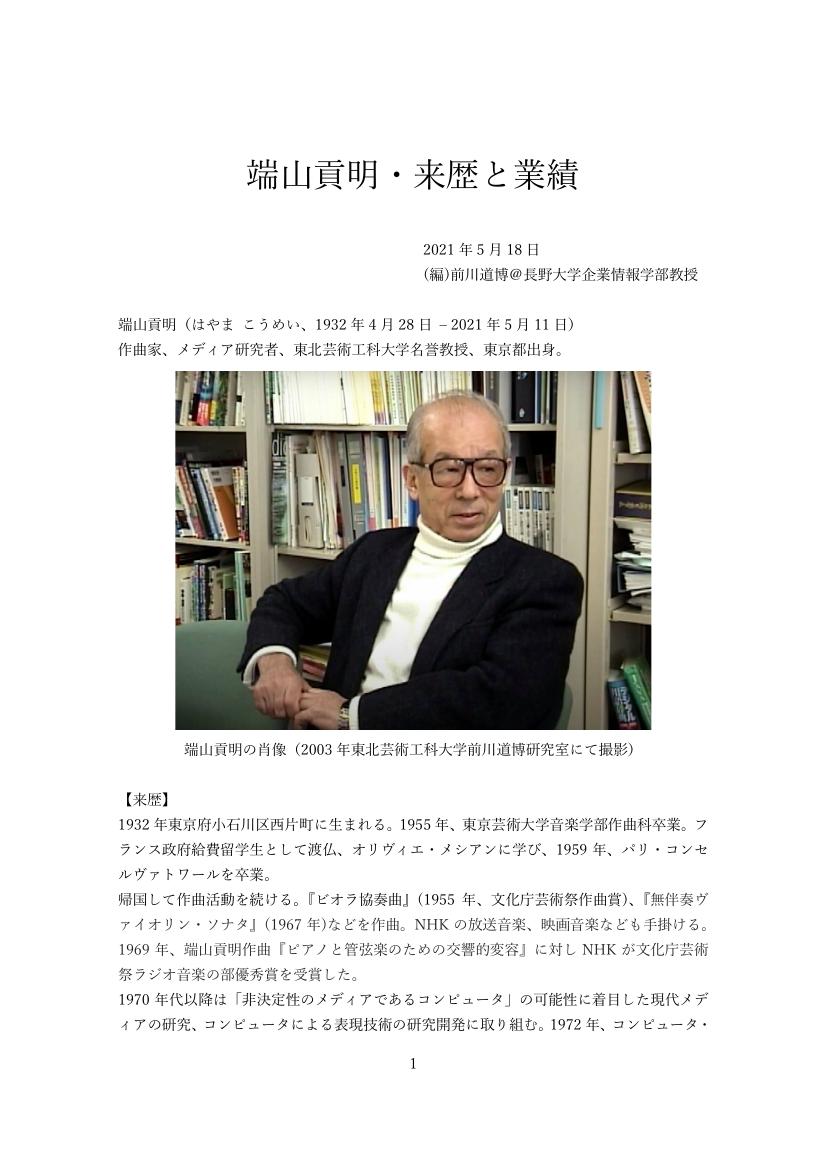
From the 端山貢明アーカイブ (Hayama Kōmei Archive), item 9849 in the 略歴・業績 (career) category, registered 2022-09-29: https://d-commons.net/hayama/?c=&p=9849. Published by the 端山貢明アーカイブプロジェクト (Hayama Kōmei Archive Project), directed by 前川道博 (Michihiro Maekawa) of Nagano University, on the D-Commons platform, and licensed CC BY (表示). The source documents come from the 端山文庫, the papers kept in Hayama's laboratory at Tohoku University of Art and Design, digitised by the project with the agreement of his family; his autograph scores were given to the University History Archives of the Tokyo University of the Arts in 2026. Source: Compiled by Michihiro Maekawa (前川道博), Professor, Faculty of Business Informatics, Nagano University; 3 pp.. Dated: compiled 18 May 2021, a week after Hayama's death on 11 May 2021. The memorial document the archive project compiled a week after Hayama's death, and the fullest account of his life in the collection. It records that he was born in Nishikata-chō, Koishikawa, Tokyo on 28 April 1932, graduated in composition from the Tokyo University of the Arts in 1955, went to France on a French government scholarship to study with Olivier Messiaen, and graduated from the Paris Conservatoire in 1959. Back in Japan he continued composing, writing the Viola Concerto (1955) and the Sonata for Unaccompanied Violin (1967) among others, and working on broadcast music for NHK and film scores. He twice took a Minister of Education prize at the Agency for Cultural Affairs Art Festival: the composition prize in 1955 for the Viola Concerto, and the radio-music award in 1969 for Symphonic Metamorphosis for Piano and Orchestra. From the 1970s he turned to the computer as what he called a medium of indeterminacy (非決定性のメディア), founding the Computer Art Center in 1972 and the Social Dynamics Institute in 1974, planning and running the International Computer Art Exhibition from 1973, and taking on computer-graphics work and commissioned research for the Ministry of International Trade and Industry. In 1993 he became professor of information environment studies in the Department of Information Design at the newly founded Tohoku University of Art and Design in Yamagata, serving as department head in 1998–99. With Maekawa he ran Yamagata Net-Expo in 1995, a trial of his Net Museion idea built around the Yamagata International Documentary Film Festival, helped establish the Yamagata prefectural and city websites in 1996, and appeared as a regular commentator on a Cable Television Yamagata talk programme 115 times from 1997. Maekawa's assessment is that Hayama recognised the limits of contemporary music as a social medium, cut off from society at large, and moved to a theory of media that could contain art and intellectual activity within it; the results are gathered in his paper Towards a Net Museion I. The document notes that Kazuhiko Nishi (西和彦), the engineer who founded ASCII, has said he was influenced by Hayama's thinking on computer media through the International Computer Art Exhibition. It closes with a works list covering the compositions from the Viola Concerto of 1955 to Symphonic Metamorphosis of 1969 and the books from 1982 to 2000, and a frank caveat that some dates and names in it may be in error. Contents as the document gives them: 【来歴】 Career · 【業績評価】 Assessment of his achievements · 【主な業績】 Principal works (compositions; writings) · 【参考サイト】 Reference sites. People named: 端山貢明 (Hayama Kōmei), 前川道博 (Maekawa Michihiro), オリヴィエ・メシアン (Olivier Messiaen), 西和彦 (Nishi Kazuhiko). Noted: The document itself warns that some dates and titles may be mistaken; it prints the book title as イメージ・インセティクス and the publisher as みずみ書房, both of which are typos for イメージ・シンセティクス and みずうみ書房.