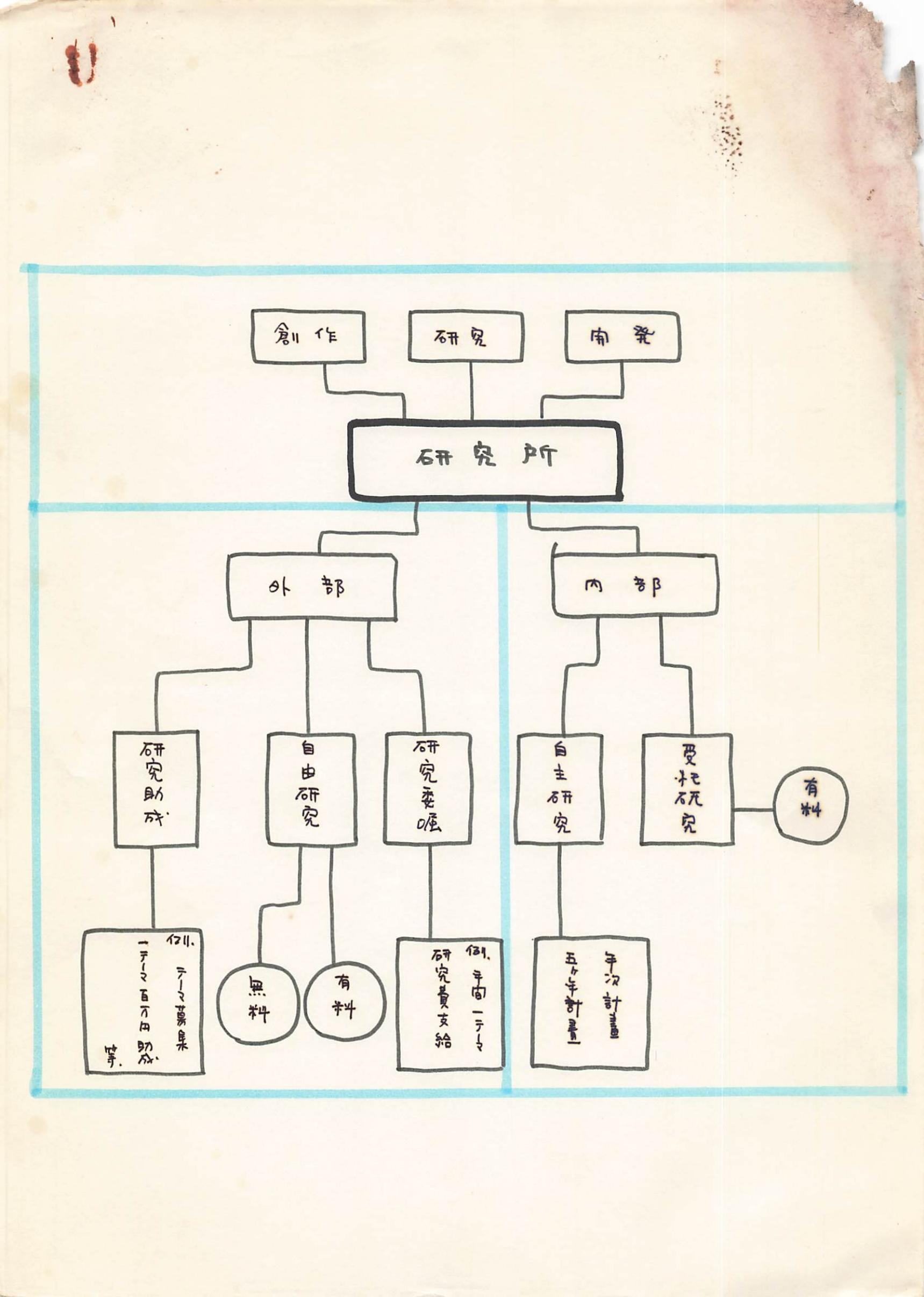
CAC初期投資予定と組織図 (CAC: planned initial investment and organisation charts)
- Author
- Komei Hayama
- Year
- 1972
- Subject
- Komei Hayama
- Tags
- japan · hayama archive · computer art history · media art
Notes
From the 端山貢明アーカイブ (Hayama Kōmei Archive), item 9870 in the コンピュータアート category, registered 2022-10-02: https://d-commons.net/hayama/?c=&p=9870. Published by the 端山貢明アーカイブプロジェクト (Hayama Kōmei Archive Project), directed by 前川道博 (Michihiro Maekawa) of Nagano University, on the D-Commons platform, and licensed CC BY (表示). The source documents come from the 端山文庫, the papers kept in Hayama's laboratory at Tohoku University of Art and Design, digitised by the project with the agreement of his family; his autograph scores were given to the University History Archives of the Tokyo University of the Arts in 2026. Source: Manuscript working papers from the 端山文庫 (Hayama Collection), one sheet on COMPUTER SALON letterhead; 7 pp. Band divisions on two of the charts are marked in blue highlighter.. Dated: No date appears on any sheet; the year 1972 is the archive's.. The archive publishes this item as 7 separate page scans rather than as a PDF; the download here was assembled from those scans in page order, each taken at the higher of the two resolutions the archive serves. This is the business case for the Computer Art Center as an institute. The sheet marked 6-1, 初期投資予定, puts ¥55,000,000 against "コンピュータ FACOM U-200(予定)及び附属施設", ¥30,000,000 against related acoustic and video systems, ¥1,000,000 for the lease and ¥2,000,000 for fit-out — ¥88,000,000 in all, or ¥68,000,000 on a cheaper variant. Sheet 6-2 gives running costs: ¥1,800,000 a month and ¥21,600,000 a year in salaries, ¥1,000,000 a year in office costs, ¥200,000 a month for premises, ¥100,000 a month each for materials and for grants — ¥2,500,000 a month, ¥30,000,000 a year. Three charts show how the institute was meant to work. The first ranges creation, research and development above the 研究所 and splits its work into external (research grants, free research free or paid, commissioned research) and internal (self-directed research on annual and five-year plans, paid contract research). The others are four-band diagrams: an authorising layer of advisers, council and board; a research layer of commissioned researchers, project teams, a directors' meeting, laboratories and a secretariat; an activity layer of grants, practical application, R&D and creation; and a structure of exchange and publicity, documentation, a workshop, machine systems (TSS, minicomputer, microcomputer) and related facilities — a music-synthesis system, a visual system, a studio and COM. The cleaner redrawing rings these as a first and a second phase. A separate sheet states the programme in six points: research, "コンピュータと芸術の出会う領域" (the field where computers and art meet), not merely the mutual application of existing art and existing computer technique but basic and applied research carrying computer art towards social effect as a new form of cultural expression; creation across many fields, feeding back into the research; development of the theory, programs and systems both need; a documentation centre open to researchers; seminars and symposia; and the production of computer art exhibitions. Contents as the document gives them: 初期投資予定 6-1 (planned initial investment) · 経常費 6-2 月間/年間 (running costs, monthly and annual) · 研究所:外部(研究助成・自由研究・研究委嘱)/内部(自主研究・受託研究) · オーソライズ機構/研究機構/活動内容/活動機構 (authorising, research, activity content, activity structure) · コンピュータ・アート・センター活動内容 I 研究 II 創作 III 開発 IV 資料センター V セミナー・レクチュア・シンポジウム等の開催 VI コンピュータアート展の制作. Noted: No sheet is dated and none carries a signature; both the 1972 date and the attribution to Hayama rest on the archive's cataloguing. Pages 1 and 2 are two copies of the same chart. On the chart on p. 5 the box feeding the synthesis and visual systems reads 共通施設 or 関連施設; the cleaner redrawing on p. 7 writes 関連施設, which is the reading adopted here. The note at the foot of the running-cost sheet, read as 〈コンサル 6000万/A(人件)1200万/A(マテリアル)〉, is faint and the reading is uncertain. The 研究費/図書費/活動費 line of ¥2,000,000 is struck through. Whether any of this was carried out is not shown by the documents; the archive states it has not been able to verify it.