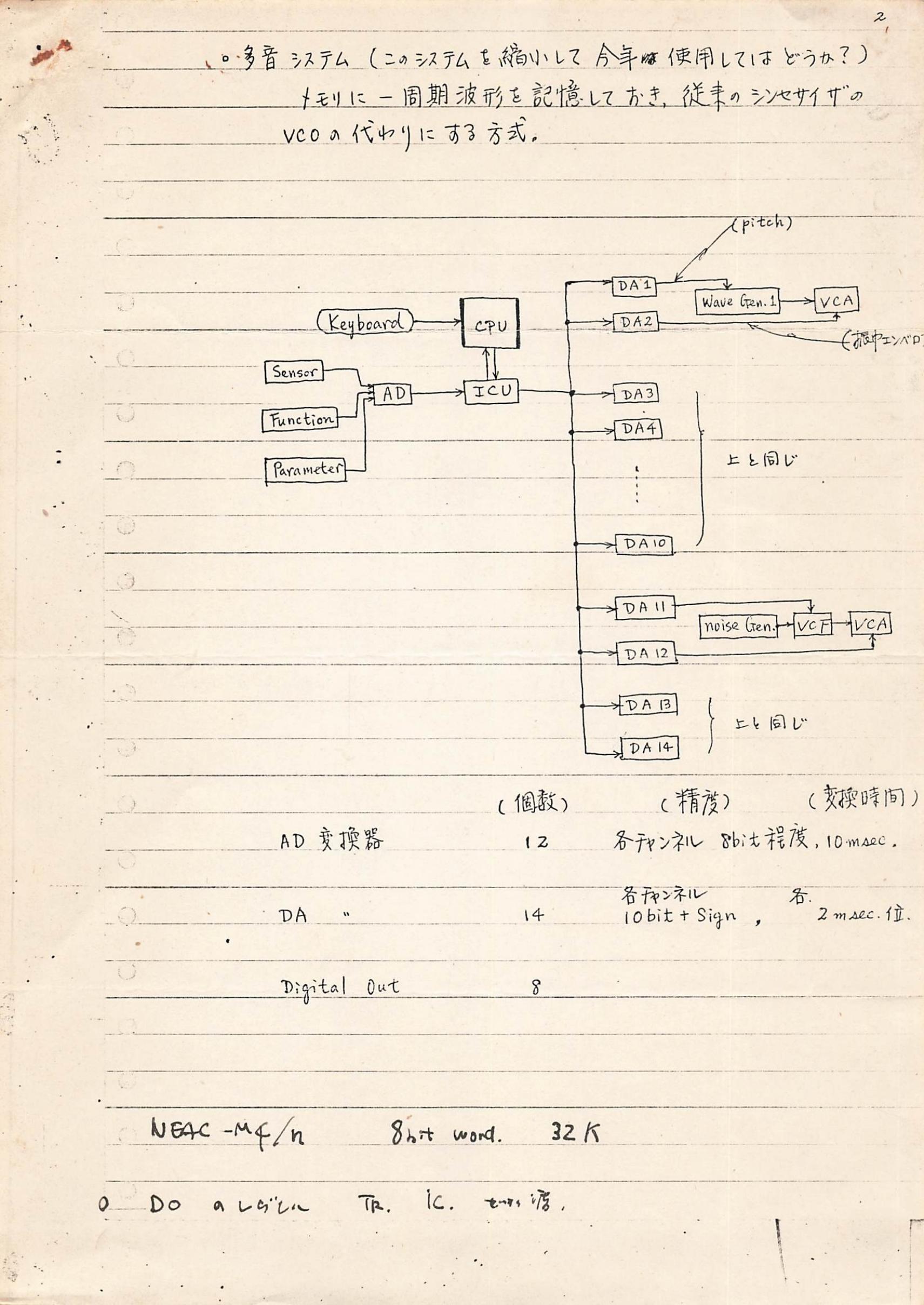
多音システム構成図 (Block diagrams for the polyphonic (tatō) system)
- Author
- Komei Hayama
- Year
- 1972
- Subject
- Komei Hayama
- Tags
- japan · hayama archive · computer art history · media art
Notes
From the 端山貢明アーカイブ (Hayama Kōmei Archive), item 9871 in the コンピュータアート category, registered 2022-10-02: https://d-commons.net/hayama/?c=&p=9871. Published by the 端山貢明アーカイブプロジェクト (Hayama Kōmei Archive Project), directed by 前川道博 (Michihiro Maekawa) of Nagano University, on the D-Commons platform, and licensed CC BY (表示). The source documents come from the 端山文庫, the papers kept in Hayama's laboratory at Tohoku University of Art and Design, digitised by the project with the agreement of his family; his autograph scores were given to the University History Archives of the Tokyo University of the Arts in 2026. Source: Manuscript working papers from the 端山文庫 (Hayama Collection); pen and pencil on ruled loose-leaf and on COMPUTER SALON letterhead, 13 pp.. Dated: No date appears on the sheets; the year 1972 is the archive's. One note asks whether a reduced version of the system might be used "this year".. The archive publishes this item as 13 separate page scans rather than as a PDF; the download here was assembled from those scans in page order, each taken at the higher of the two resolutions the archive serves. These sheets design a computer-controlled polyphonic synthesizer, the 多音システム. The principle is stated at the head: store one cycle of a waveform in memory and use it in place of the voltage-controlled oscillator of a conventional synthesizer. A keyboard runs into a CPU, and sensor, function and parameter inputs through an A/D converter into an interface control unit, which drives fourteen D/A channels: DA1 sets pitch for Wave Gen. 1 into a VCA, DA2 its amplitude envelope, DA3–DA10 repeat the pair, and DA11–DA14 feed a noise generator through a VCF into a VCA. It calls for twelve A/D converters at about 8 bits and 10 msec a channel, fourteen D/A converters at 10 bits plus sign, and eight digital outputs, on a NEAC-M4 with an 8-bit word and 32K. The wave generator is drawn out: a 32 × 8 memory clocked by a voltage-controlled clock, through a digitally controlled dynamic filter, a DAC and a DLF, with triangle, sine and noise outputs; the memory may be RAM written by the CPU, or ROM. Costs are kept to the component — ROM ¥4,000, clock ¥30,000 (marked TELEDYNE), filter ¥10,000, DAC ¥5,000 — so ¥57,000 per simultaneous voice, times about ten. Further sheets give the mixer as an op-amp summing circuit, four to a board, at ¥15,000; a pan pot taking a 5-bit word from the CPU through a binary-to-32 decoder, ¥18,000 a channel and ¥162,000 for nine; and a spring echo at ¥9,500. A later diagram prices a voice at ¥79,000 and the build at ¥1,110,000 in parts plus 130 hours. The last sheets draw the room it was to play into. One shows a double pyramid on a square base with a loudspeaker set into the lower face; another a four-speaker square plan fed by a mixer and four amplifiers; another an annular auditorium of four curved seating segments with speakers at their ends and a central console. Others sketch a domed hall marked "Black light" and "SONY" with speakers at its corners, a polygon with a speaker at each vertex, and a page of envelope curves headed "compositional". Contents as the document gives them: 多音システム (the polyphonic system — overall block diagram) · Wave Generator · 材料費 (material costs) · Fig. 1–3: 音響空間, Power Amp., Pan Pot Group/Spring Echo · Fig. 4 Mixer, Fig. 5 Fig.3の詳細 (detail of Fig. 3) · Pan Pot / Spring Echo · Synthesizer部・Pan、エコー部・その他(電源)部品費と人件費 · compositional (envelope sketches). Noted: No sheet is dated or signed; the 1972 date and the attribution to Hayama are the archive's. The machine named at the foot of the first diagram is read as NEAC-M4 (written "NEAC-M4/n"); the suffix is unclear. Pages 1 and 2 are two copies of the same sheet; page 13 is the blank verso of page 12 and shows only its drawing through the paper. Pages 11 and 12 carry unlabelled pencil sketches whose subject can only be guessed at; the small kanji at the centre of p. 12 could not be read. Some monetary figures are written in 万 and some in full yen, and several sub-totals on pp. 6–8 are overwritten; the per-voice figure of ¥79,000 is given as "6.9 + 1 = 7.9万".