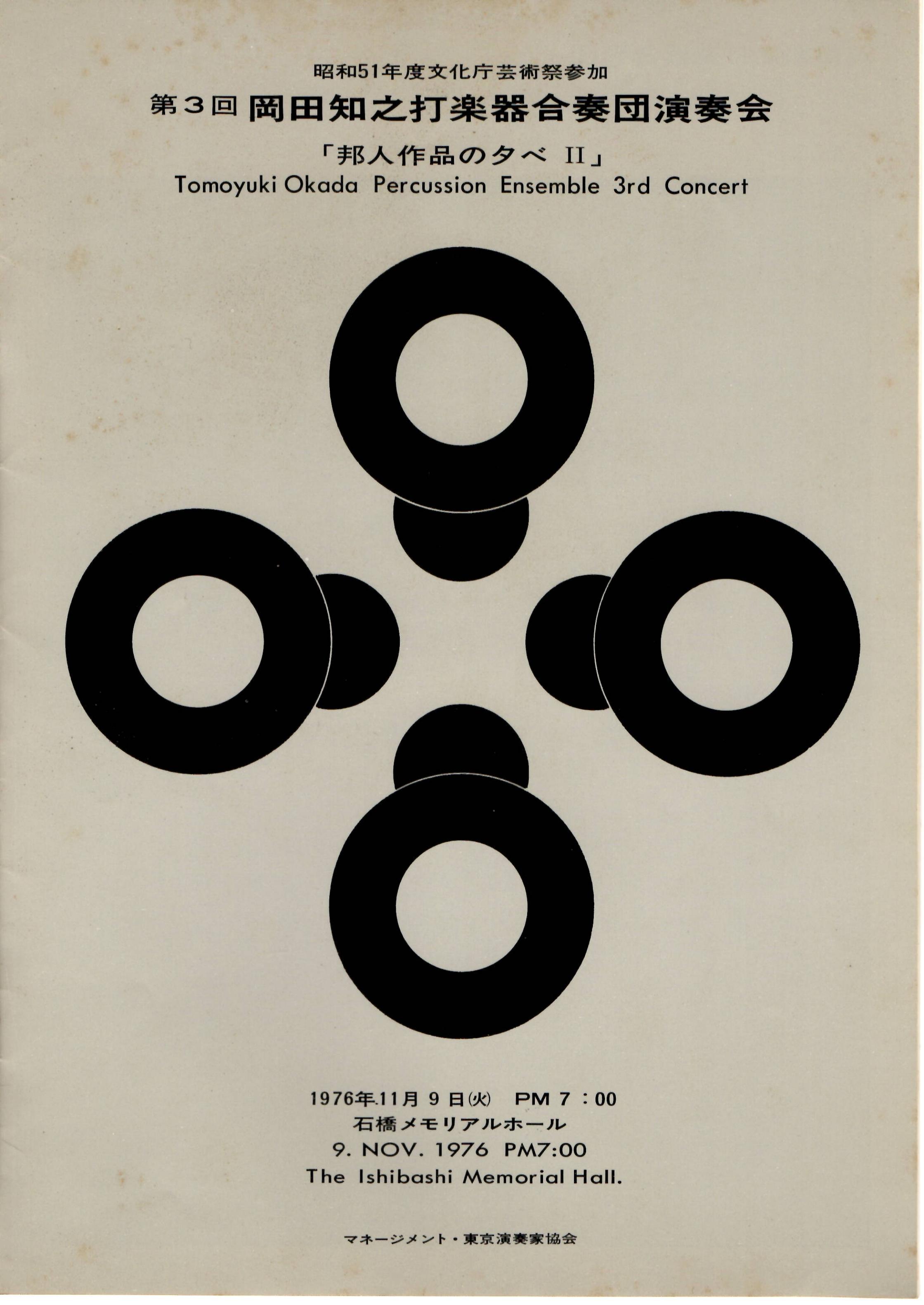
11/09岡田知之打楽器合奏団演奏会(《直会(なおらい)》初演) (9 November: Okada Tomoyuki Percussion Ensemble concert (Naorai))
- Author
- Komei Hayama
- Year
- 1976
- Subject
- Komei Hayama
- Tags
- japan · hayama archive
Notes
From the 端山貢明アーカイブ (Hayama Kōmei Archive), item 9978 in the 音楽(演奏会) category, registered 2022-10-08: https://d-commons.net/hayama/?c=&p=9978. Published by the 端山貢明アーカイブプロジェクト (Hayama Kōmei Archive Project), directed by 前川道博 (Michihiro Maekawa) of Nagano University, on the D-Commons platform, and licensed CC BY (表示). The source documents come from the 端山文庫, the papers kept in Hayama's laboratory at Tohoku University of Art and Design, digitised by the project with the agreement of his family; his autograph scores were given to the University History Archives of the Tokyo University of the Arts in 2026. Source: Third concert of the Okada Tomoyuki Percussion Ensemble, 'An evening of Japanese works II', entered in the 1976 Agency for Cultural Affairs Art Festival; Ishibashi Memorial Hall, Tokyo; management Tokyo Ensōka Kyōkai. Dated: Tuesday 9 November 1976, 7:00 p.m.. The archive publishes this item as 7 separate page scans rather than as a PDF; the download here was assembled from those scans in page order, each taken at the higher of the two resolutions the archive serves. The programme booklet for the Okada Tomoyuki Percussion Ensemble's third concert, 「邦人作品の夕べ II」, an entry in the 1976 Agency for Cultural Affairs Art Festival, at the Ishibashi Memorial Hall. Hayama's 直会(なおらい), printed in French as Naolaï, opened, followed by Kitazume Michio's レラシオン (Relation) and, after the interval, Nakamura Ryūichi's 八正道 (Hatsushodo), a commission, and Komori Akihiro's プサルテリウム (Psalterium). An inserted note states that the version played was a revision for six players, made for this ensemble, of a work previously scored for ten, so this was a 改訂初演, the premiere of the revised version. Hayama's own note is the key text in this group for the link between his music and his computer work. He explains naorai as a very old word for the ritual banquet, carrying beyond 'eating with the gods' the sense of applying one essential thing in different forms in different settings: at a festival the encounter with the god, then the banquet before the retainers, then the next day's looser repetition where gagaku gives way to bugaku, until expansion blurs the original. He had no wish to depict a festival or embody ethnic consciousness; he wanted to realise what the word holds in percussion, 'the oldest and constantly the newest medium'. Then: 'I used a computer with this medium in order to make a naorai space with more qualitative variation. Some may reject it on merely hearing the word computer, but I should be glad if you would ascertain what sound it makes.' A note names him head of the Computer Art Center and director of the Social Dynamics Research Institute. Contents as the document gives them: 直会(なおらい)/ Naolaï — 端山貢明 Kômei Hayama · レラシオン / Relation — 北爪道夫 Michio Kitazume · 八正道(委嘱作品)/ Hatsushodo — 中村隆一 Ryuichi Nakamura · プサルテリウム / Psalterium — 小森昭宏 Akihiro Komori · 岡田知之打楽器合奏団 (The ensemble's history, with a stage photograph) · 曲目について (Notes on the works) — Hayama's own note on Naorai · 作曲者紹介 (Note on the composer): works include 「ピアノとオーケストラのための交響的変容」and 「6人の打楽器奏者とオーケストラのための道」; head of the Computer Art Center and director of the Social Dynamics Research Institute. People named: 端山貢明 (Hayama Kōmei / Kômei Hayama), 岡田知之 (Okada Tomoyuki / Tomoyuki Okada), 北爪道夫 (Kitazume Michio / Michio Kitazume), 中村隆一 (Nakamura Ryūichi / Ryuichi Nakamura), 小森昭宏 (Komori Akihiro / Akihiro Komori), オリヴィエ・メシアン (Olivier Messiaen, named in Hayama's biographical note). Noted: The archive's title calls this the premiere of 直会; the booklet's note describes it as a 改訂初演, the first performance of a six-player revision of an earlier ten-player version. The date of the original version is not given. The note on the second work, Kitazume's Relation, is suppressed in the scan with the line 著作物のため、以下は除いてあります ('omitted for copyright reasons'), so the remaining programme notes are not available. Pages 1 and 2 of the PDF are the same cover image. The booklet names no individual players.