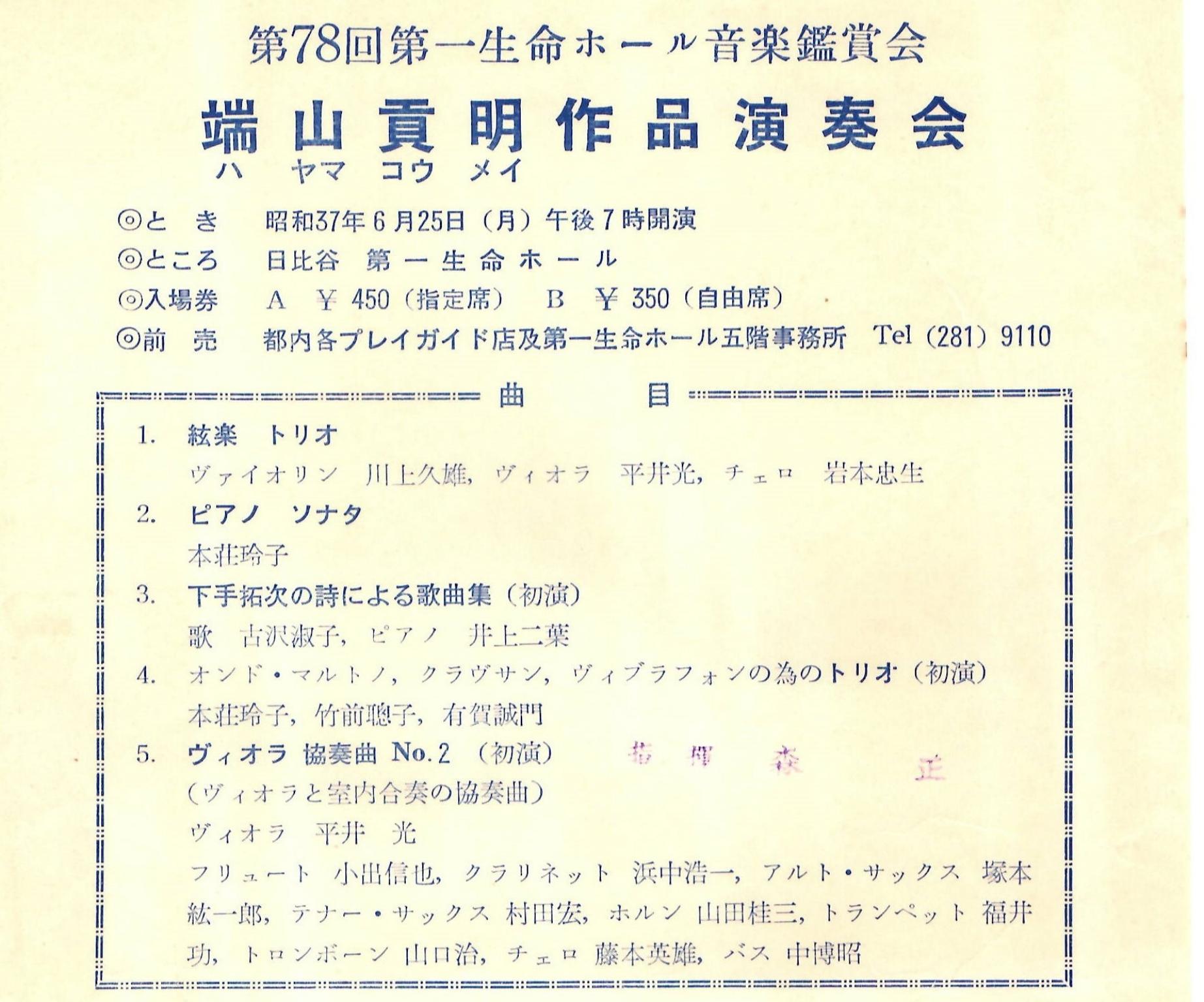
06/25端山貢明作品演奏会 (25 June: concert of works by Hayama Kōmei)
- Author
- Komei Hayama
- Year
- 1962
- Subject
- Komei Hayama
- Tags
- japan · hayama archive
Notes
From the 端山貢明アーカイブ (Hayama Kōmei Archive), item 9953 in the 音楽(演奏会) category, registered 2022-10-04: https://d-commons.net/hayama/?c=&p=9953. Published by the 端山貢明アーカイブプロジェクト (Hayama Kōmei Archive Project), directed by 前川道博 (Michihiro Maekawa) of Nagano University, on the D-Commons platform, and licensed CC BY (表示). The source documents come from the 端山文庫, the papers kept in Hayama's laboratory at Tohoku University of Art and Design, digitised by the project with the agreement of his family; his autograph scores were given to the University History Archives of the Tokyo University of the Arts in 2026. Source: 78th Dai-ichi Seimei Hall music appreciation concert, presented by the Dai-ichi Seimei Hall and the Asahi Shimbun Welfare and Culture Foundation; Dai-ichi Seimei Hall, Hibiya, Tokyo. Tickets A ¥450 reserved, B ¥350 unreserved. Dated: Monday 25 June 1962 (Shōwa 37), 7:00 p.m.. The archive publishes this item as 11 separate page scans rather than as a PDF; the download here was assembled from those scans in page order, each taken at the higher of the two resolutions the archive serves. The programme book and handbill for the only concert devoted entirely to Hayama's music, given as the 78th Dai-ichi Seimei Hall music appreciation concert. Five works were played, three of them premieres. I: 絃楽トリオ (String Trio, 1960) — Andante, Allegro, Sostenuto, Allegro assai — with Kawakami Hisao, Hirai Kō and Iwamoto Tadao. II: ピアノソナタ (Piano Sonata, 1960) — Allegro assai, Lento, Allegro molto — Honjō Reiko. III: 大手拓次の詩による歌曲集 (Three songs on poems by Ōte Takuji, 1960–62, premiere) — のびてゆく不具, 湿気の小馬, 盲目の鴉 — Furusawa Yoshiko, soprano, with Inoue Futaba. IV: オンド・マルトノ、クラヴサン、ヴィブラフォンの為のトリオ (Trio for ondes Martenot, harpsichord and vibraphone, 1961–62, premiere) — Honjō Reiko, Takemae Satoko and Ariga. V: ヴィオラ協奏曲 No. 2 (Viola Concerto No. 2, 1962, premiere), for viola and chamber ensemble, conducted by Mori Tadashi with Hirai Kō and eleven players drawn largely from the NHK Symphony. The book is unusually full. Messiaen, then in Japan at the NHK Symphony's invitation, sent a signed message — 'Dear friend… how greatly it pleases and moves me to be able to meet you again in Japan' — and attended the concert. Essays follow from Ikenouchi Tomojirō, Noro Shinjirō and Miyoshi Akira, whose memoir of their schooldays describes Hayama as chief of an 'Art Research Society'. Hayama's own statement and his notes on each work follow, with a biography listing Ikenouchi as his teacher from 1949, Messiaen and Noël Gallon at the Paris Conservatoire, and Jolivet and Chailley privately, plus piano with Yasukawa Kazuko, conducting with Watanabe Akeo and viola with Inoue Takeo. Contents as the document gives them: I 絃楽トリオ (1960) / Trio pour cordes — Andante, Allegro, Sostenuto, Allegro assai · II ピアノソナタ (1960) / Sonate pour piano — Allegro assai, Lento, Allegro molto · III 大手拓次の詩による歌曲(初演)/ Trois chants après les poésies d'Ōte Takuji (1960–62) — のびてゆく不具/湿気の小馬/盲目の鴉 · IV オンド・マルトノ、クラヴサン、ヴィブラフォンの為のトリオ(初演)(1961–62) · V ヴィオラ協奏曲 No. 2(初演)/ Concerto pour alto et l'orchestre de chambre (1962), in three movements · 親愛な友 — メシアンのメッセージ (Messiaen's signed message, with his photograph) · 池内友次郎・野呂信次郎「お祝いに代えて」・三善晃「端山のこと」(essays) · 作曲者のことば (The composer's statement) and 曲目解説 (Hayama's notes on each work) · 端山貢明略歴 (Biography) and 演奏者略歴 (Performers' biographies). People named: 端山貢明 (Hayama Kōmei), 森正 (Mori Tadashi, conductor), 平井光 (Hirai Kō, viola), 川上久雄 (Kawakami Hisao, violin), 岩本忠生 (Iwamoto Tadao, cello), 本荘玲子 (Honjō Reiko, piano and ondes Martenot), 古沢淑子 (Furusawa Yoshiko, soprano), 井上二葉 (Inoue Futaba, piano), 竹前聡子 (Takemae Satoko, harpsichord), 有賀誠門 (Aruga Seimon, vibraphone), 小出信也 (Koide Shinya, flute), 浜中浩一 (Hamanaka Kōichi, clarinet), 塚本絃一郎 (Tsukamoto Gen'ichirō, alto saxophone), 村田宏 (Murata Hiroshi, tenor saxophone), 山田桂三 (Yamada Keizō, horn), 福井功 (Fukui Isao, trumpet), 山口治 (Yamaguchi Osamu, trombone), 藤本英雄 (Fujimoto Hideo, cello), 中博昭 (Naka Hiroaki, double bass), オリヴィエ・メシアン (Olivier Messiaen, author of the congratulatory message), 池内友次郎 (Ikenouchi Tomojirō, essayist and teacher), 野呂信次郎 (Noro Shinjirō, essayist), 三善晃 (Miyoshi Akira, essayist), 皆川達夫 (Minagawa Tatsuo, named in Miyoshi's memoir), 梶原完 (Kajiwara Kan, who introduced Hayama to Ikenouchi), 大手拓次 (Ōte Takuji, poet), ノエル・ギャロン (Noël Gallon), アンドレ・ジョリヴェ (André Jolivet), ジャック・シャイエ (Jacques Chailley), 安川加寿子 (Yasukawa Kazuko, piano teacher), 渡辺暁雄 (Watanabe Akeo, conducting teacher), 井上武雄 (Inoue Takeo, viola teacher), 坂口新 (Sakaguchi Arata, saxophone teacher named in the players' biographies), 平井成子 (Hirai Shigeko, management). Noted: The handbill misprints the poet's surname as 下手拓次; the invitation and programme give 大手拓次 (Ōte Takuji) correctly. The vibraphone player 有賀誠門 is romanised on the French programme page only as 'M. ARIGA'; the common reading Aruga Seimon does not match that initial. The biography inside the booklet dates the Art Festival Minister of Education prize to 1952; the handbill in the same item correctly gives December 1955. The handbill also gives March 1956 as the date he graduated from the composition department. Readings for several performers (平井光 given as Hirai Kō after the French page's 'KO HIRAI', 竹前聡子, 中博昭, 平井成子) are not stated in Japanese and may differ.