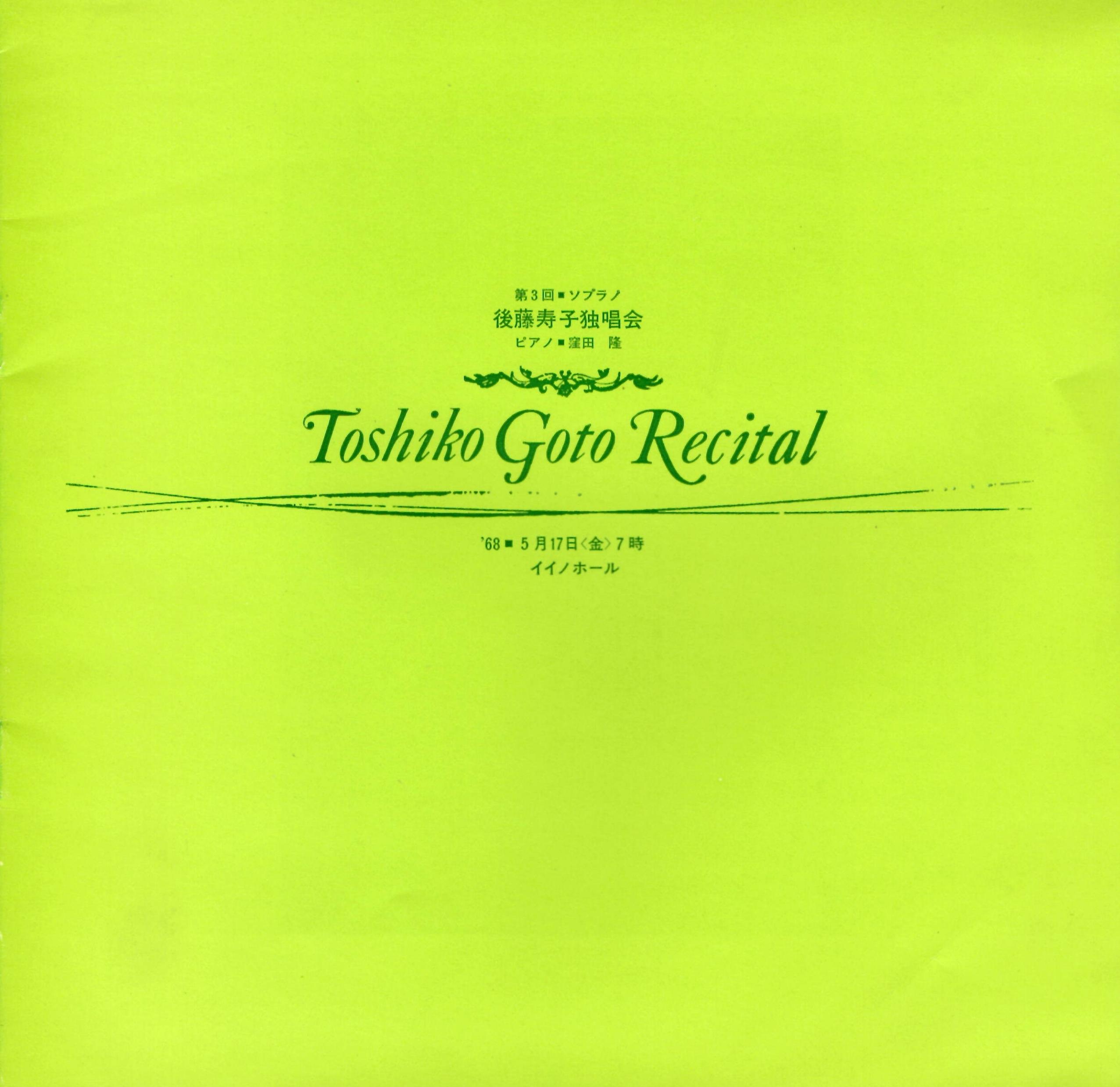
05/17後藤寿子独唱会(曲目解説:端山貢明) (17 May: Gotō Toshiko song recital (programme notes by Hayama Kōmei))
- Author
- Komei Hayama
- Year
- 1968
- Subject
- Komei Hayama
- Tags
- japan · hayama archive
Notes
From the 端山貢明アーカイブ (Hayama Kōmei Archive), item 9977 in the 執筆記事 category, registered 2022-10-08: https://d-commons.net/hayama/?c=&p=9977. Published by the 端山貢明アーカイブプロジェクト (Hayama Kōmei Archive Project), directed by 前川道博 (Michihiro Maekawa) of Nagano University, on the D-Commons platform, and licensed CC BY (表示). The source documents come from the 端山文庫, the papers kept in Hayama's laboratory at Tohoku University of Art and Design, digitised by the project with the agreement of his family; his autograph scores were given to the University History Archives of the Tokyo University of the Arts in 2026. Source: Third recital by the soprano Gotō Toshiko, with Kubota Takashi at the piano; Iino Hall, Tokyo. Cover printed in English as Toshiko Goto Recital. Dated: Friday 17 May 1968, 7:00 p.m.. The archive publishes this item as 7 separate page scans rather than as a PDF; the download here was assembled from those scans in page order, each taken at the higher of the two resolutions the archive serves. The programme booklet, printed in green on bright chartreuse card, for the soprano Gotō Toshiko's third recital, with Kubota Takashi at the piano. The programme is wholly French and set out bilingually: two Rameau arias, from Hippolyte et Aricie and the prologue of Les Fêtes d'Hébé; Fauré's complete La chanson d'Ève op. 95 in ten songs; and Messiaen's Chants de Terre et de Ciel in six, from Bail avec Mi to Résurrection. Hayama wrote the booklet's 曲目解説, a substantial essay on all three composers; it is the only item here in which he writes at length about his own teacher. On Rameau he recounts the frustrations before Hippolyte et Aricie reached the stage in 1733, when the composer was fifty — the theory treatises of 1722 and 1726 that went unrecognised, the Académie's refusal, La Motte declining a libretto, Voltaire's Samson banned on the eve of performance — before Les Indes galantes and Castor et Pollux succeeded and Les Fêtes d'Hébé followed in 1739. Of Fauré he quotes Henri Büsser's account of the idle student who warmed his seat at the Niedermeyer School for ten years, and argues that in Fauré music is first released inward and only fixed as a work once it has become resonance itself. Of Messiaen he writes that thirty years passed between the student's first pursuit of birdsong and the works bearing birds' names, that he systematised his methods in Technique de mon langage musical at thirty-six, and that Chants de Terre et de Ciel, written at thirty-one on his own poems, stands between La Nativité du Seigneur and the Quatuor pour la fin du temps. Contents as the document gives them: I ラモー:歌劇「イポリートとアリシー」より ディアナのニンフの小詠唱 (Rameau: Ariette d'une nymphe de Diane, from Hippolyte et Aricie) · II ラモー:「エベの祭り」の序曲の中の詠唱 (Rameau: Air dans le prologue, Les Fêtes d'Hébé) · III フォーレ:エヴァの歌 (Fauré: La chanson d'Ève) — 楽園/最初の言葉/燃えるばらよ/神は輝く/白い曙は/せせらぎよ/眼ざめているか 太陽のようなわたしの匂いよ/白ばらの匂いの中で/たそがれ/おお死よ 星屑よ · IV メシアン:地と天の歌 (Messiaen: Chants de Terre et de Ciel) — ミとのちぎり/沈黙の讃歌/丸薬坊やの踊り/無垢の虹/夜の裏と表/復活 · 曲目解説 端山貢明 (Programme notes by Hayama Kōmei) — on Rameau, Fauré and Messiaen · Portrait photograph of the singer. People named: 端山貢明 (Hayama Kōmei, author of the programme notes), 後藤寿子 (Gotō Toshiko, soprano), 窪田隆 (Kubota Takashi, piano), ジャン・フィリップ・ラモー (Jean-Philippe Rameau), ガブリエル・フォーレ (Gabriel Fauré), オリヴィエ・メシアン (Olivier Messiaen), アンリ・ビュッセル (Henri Büsser, quoted), 池内友次郎 (Ikenouchi Tomojirō, translator of the Büsser book), ヴォルテール (Voltaire, named in the Rameau note), アベ・ペルグラン (Abbé Pellegrin, librettist of Hippolyte et Aricie). Noted: Pages 1 and 2 of the PDF are the same cover; page 7 is a blank green inside cover. Hayama writes that Rameau was made to sign a bill for '500 roubles' as surety; the currency is evidently a slip in the original. The programme list heads the Messiaen cycle 地と天の歌 while Hayama's note writes 天と地の歌.