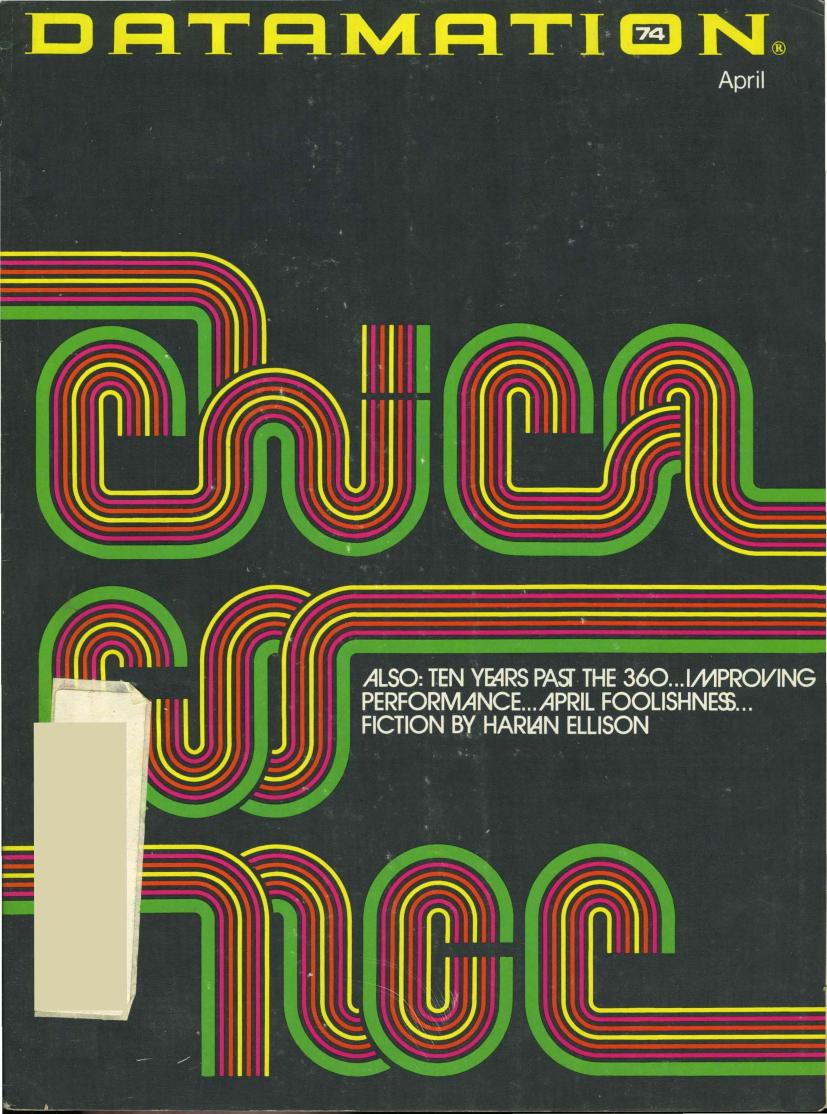
Datamation, Vol. 20 No. 4 (April 1974) — 'The Public and the Computer Artist': the First International Computer Film Festival
- Author
- John L. Kirkley (ed.)
- Year
- 1974
- Published in
- Datamation
- Publisher
- Technical Publishing Company
- Tags
- magazine · computer art history · datamation · digital-scan · computer-animation
Notes
Technical Publishing Company, April 1974. 222 pp., OCR'd scan from bitsavers.org (magazines/Datamation/197404.pdf), the source link. Edited by John L. Kirkley. The masthead gives the print run as 122,900 copies. This is the National Computer Conference issue, previewing the NCC at McCormick Place in Chicago, 6–10 May 1974, and the cover is a computer-drawn pattern made for it. The reason to hold it is a short report in the magazine's The Arts department, headed "The Public and the Computer Artist" (p. 153). It covers the First International Computer Film Festival, held at Evergreen State College in Olympia, Washington on 7–9 March 1974 — conceived and organised by two Evergreen students, Richard Speer and Frankie Foster, and sponsored by the college's computer services department, the Computer Arts Society of the United States and the Washington State Arts Commission. Close to a hundred films were shown over the two days, and about twenty-four were to be selected afterwards for a non-profit tour of universities, museums and research centres that asked for them. The festival is sparsely documented elsewhere, which makes this contemporaneous account useful. Its centrepiece was a panel on the future of computer film with five of the field's makers: John Whitney Sr. of the UCLA art department, Ronald Resch of the University of Utah computer science department, Lillian Schwartz and Ken Knowlton of Bell Labs, and William Fetter, then heading the computer graphics laboratory at Southern Illinois University. The report carries their positions. Fetter showed work from Boeing including the human figure he devised there to map a pilot's span of reach, reproduced alongside the article in three stages. Knowlton described a practical animation showing the path of least interference for microwave signals through a rainstorm. Resch, disappointed with the field's progress, judged it to demand too much technical knowledge and likened the artist working in computer graphics to a Renaissance painter obliged to learn chemistry to mix paints; he was working towards tools that would let an artist communicate more naturally, among them spatial input using sensors on the fingers. Schwartz said the technology was at first so daunting one hardly wanted to learn it, and advised anyone wanting to make computer film to train in both the artistic and the scientific side, as she had come to it as an already mature artist. The piece also records the credit problem in the field's early years. Resch argued the public grants no empathy to the artist using computer graphics: where an audience watching dance recognises the difficulty of execution, the mention of a computer makes people assume the result was automatic and therefore effortless. Fetter told of a publication that reproduced his human figure without crediting him, explaining when challenged only that they had been told a computer did it. Schwartz thought the public less hostile to technology than before and wondered aloud whether an audience needs to know how a film was made or should simply enjoy it; the panel agreed that the test of computer art would be the same as for any art. The rest of the issue is ordinary trade press and is listed here for searching: Richard L. Nolan and K. Eric Knutsen on the computerisation of a fictional widget company; James O. Mulford on an optimisation study; Jerre D. Noe on acquiring and using a hardware monitor; Donald L. Black on controlling a computer system; an April Foolishness section of fiction and verse that reprints Harlan Ellison's Hugo-winning story "I Have No Mouth, and I Must Scream"; Thornton J. Parker III in The Forum; and the News in Perspective departments on antitrust, people, companies, memories, retailing, modelling, service bureaus, banking, the arts and international news.