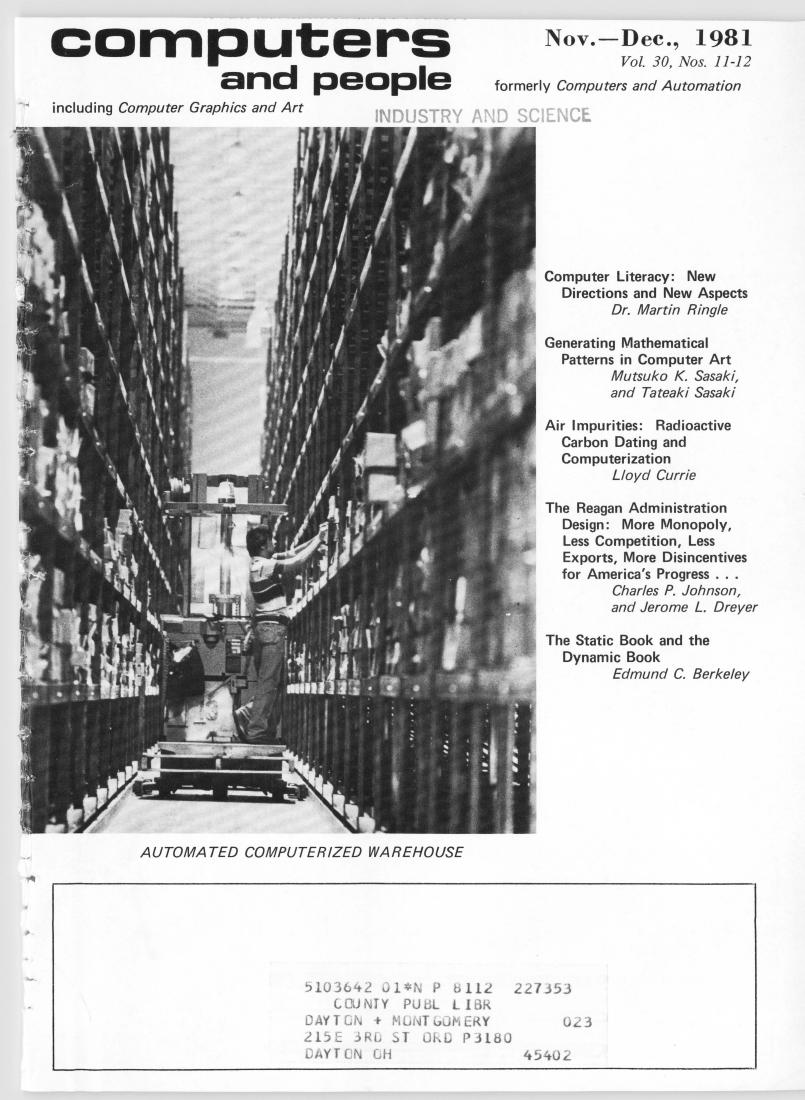
Computers and People, Vol. 30 Nos. 11–12 (November–December 1981) — Sasaki, 'Generating Mathematical Patterns in Computer Art', Part I
- Author
- Edmund C. Berkeley (ed.)
- Year
- 1981
- Published in
- Computers and People
- Publisher
- Berkeley Enterprises
- Subject
- Mutsuko K. Sasaki
- Tags
- magazine · computer art history · computers and people · digital-scan
Notes
Berkeley Enterprises, Newtonville MA, November–December 1981. 28 pp., OCR'd scan (text-searchable). Edited by Edmund C. Berkeley, with Grace C. Hertlein as Art Editor. This is the issue in which Computer Graphics and Art was folded into Computers and People: a page-3 announcement says the magazine "with this issue is being combined with Computers and People", that subscriptions carry over, that submissions now go to Hertlein as Art Editor, and that at least four computer-graphics-and-art articles a year will follow. The masthead already reads "including Computer Graphics and Art". The computer-art content is "Generating Mathematical Patterns in Computer Art, Part I" by Mutsuko K. Sasaki and Tateaki Sasaki of the Institute of Physical and Chemical Research (RIKEN), Wako, Saitama (pp. 7–11, continued on the back cover). "Mathematical patterns are manifestations of beauty which is mathematical." The method, implemented in their ART-3 system and tested over four years: start from an orthogonal x–y canvas of LX × LY lattice squares, bring in a vertical coordinate z and a function z = f(x, y) built as a sum of terms in constants, multiples of angles, distance from the origin, sines, cosines and arctangents; at each lattice point ART-3's two brushes draw a pattern element (+, *, dot) if and only if f is positive. Periodic functions give wavy patterns, translations shift them, arctan(y/x) gives spirals, changes of constants give contour patterns, the exponential gives flower patterns, and modulus functions give the most complicated ones; the formulas behind the figures were offered on request. Figure 1 is a 3-D surface plot of such a function (undulating hills varying with distance from centre and angle of rotation); Figure 2 a spiral and Figures 3–7 radiating and interference-like fields, all printed as character patterns; Figure 8, "Butterfly Dance" by Mutsuko Sasaki, fills the back cover: a flight of hand-outlined butterflies over a diagonal function-brushed field, signed M. Sasaki. The contents page calls the piece "a splendid and logical introduction and display of mathematical, two and three dimensional, computer art". Its one reference is their "Computer Art System ART-3", Computer Graphics and Art, August 1978, pp. 4–11, in this library as Vol. 3 No. 3. Sasaki's 1992 IPSJ paper Generating Beautiful Pictures by Computers is also here. Rest of the issue: Martin Ringle (Vassar), "Computer Literacy: New Directions and New Aspects"; Charles P. Johnson and Jerome L. Dreyer against the Reagan administration's industrial policy; Lloyd Currie (National Bureau of Standards) on radiocarbon dating of air impurities; Berkeley's editorials "The Static Book and the Dynamic Book" (on Christopher Evans's forecasts for books on a chip) and "Antidote to Executive Fear of Data Processing"; the Computer Almanac lists; Neil Macdonald's puzzles; and the newsletter (Levi Strauss's automated warehouse at Waco, which is the front cover, geothermal well control, NASA winglets). The magazine's other Annual Computer Art Contest / Exposition issues, August 1963 to 1973, August 1975 and September–October 1980 (plus the July–August 1980 rules and the July–August 1981 announcement ending the series), are also in this library.