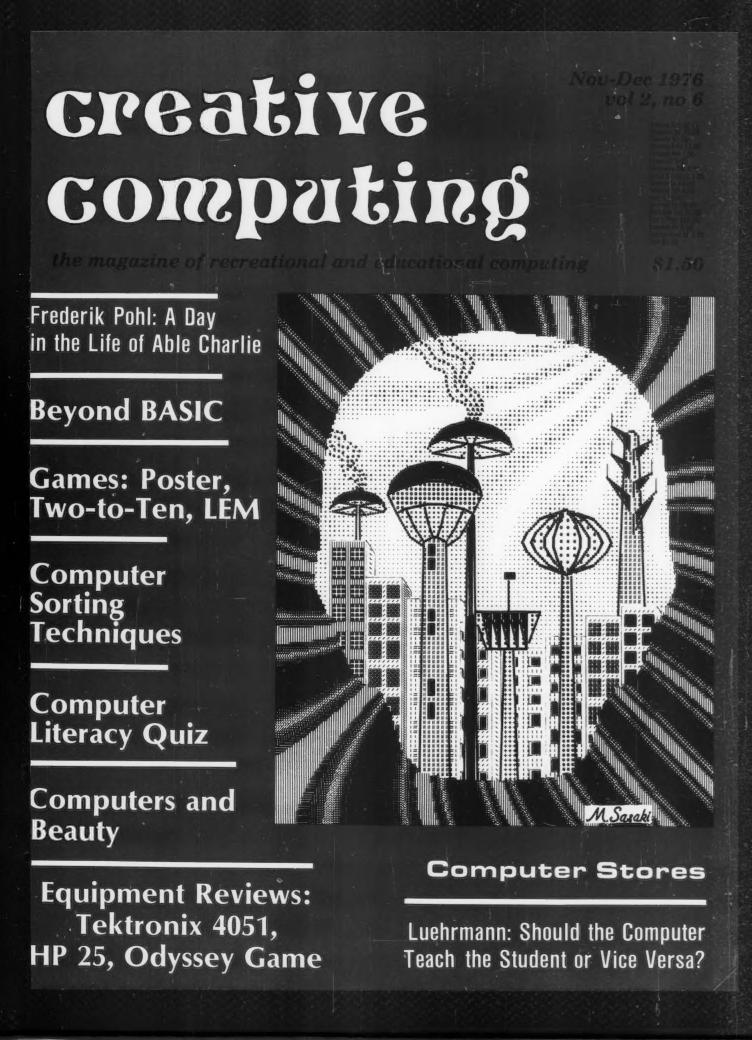
Computers and Beauty
- Author
- Mutsuko K. Sasaki, Tateaki Sasaki
- Year
- 1976
- Published in
- Creative Computing
- Publisher
- Creative Computing Press
- Subject
- Mutsuko K. Sasaki
- Tags
- computer art history · journal article · creative computing · japan · pioneers
Notes
Creative Computing, Vol. 2 No. 6 (November–December 1976), pp. 48–51; Fig. 6 of the article is the issue's cover illustration. This PDF is the cover plus the four article pages, extracted from the Internet Archive scan of the issue held in this library, OCR text layer intact. The article was reprinted in The Best of Creative Computing, Volume 2 (1977), p. 112, also here, and that reprint is online at atariarchives.org (the source link). The authors give a Suginami, Tokyo address, with RIKEN (the Institute of Physical and Chemical Research, Wako) as their present affiliation. The Sasakis' earliest statement of the ideas behind ART-3, and their fullest in English. They look for a definition of artistic beauty that a program can use and settle on two conditions, harmony and variety: the golden section is beautiful because it is near 1:1 but not exactly 1:1; a melody with its notes in a bad order is ugly; cooking must be nourishing but must also taste good; a picture made only from random numbers has variety but no harmony. They divide pictorial beauty into three kinds. (i) Mathematical beauty, found in figures expressible by functions, which are "harmonic" through their continuity and gain variety from their parameters and from random numbers; most computer art of the day relied on it. (ii) Natural beauty, the harmony of flowers, butterflies, fishes and mountains shaped by the laws of physics and biology, which a program can borrow by imitating natural objects, provided the drawing does not become too complicated and each object stays identifiable; Figs. 1–4 show three flowers as raw outlines, overlapped, with the hidden parts eliminated, and finally with their insides painted with assigned patterns. (iii) Creative beauty, the artist's emphasis, colour, distortion and imagination, which they read as ways of recovering harmony from an excess of variety and have not yet attempted: "Perhaps we will have to educate and train the computer so that it can appreciate beauty." ART-3 does three things, transformation of the input figures, elimination of invisible parts, and painting of surfaces with patterns, and holds more than fifty mathematical functions for transformation and pattern generation. Three works are reproduced, all signed M. Sasaki and run on a FACOM 230-75: Hellow Sunflowers!, II (24 × 34 cm, 48 seconds of computer time), the cover picture of mushroom-topped towers in a city (Fig. 6), and Surmurine walk, II as printed (fish and weed, 24 × 50 cm, 83 seconds). The three-flower sequence is the same nemophila that appeared as Nemophila in the Computers and People exposition issue of August 1976, also here.