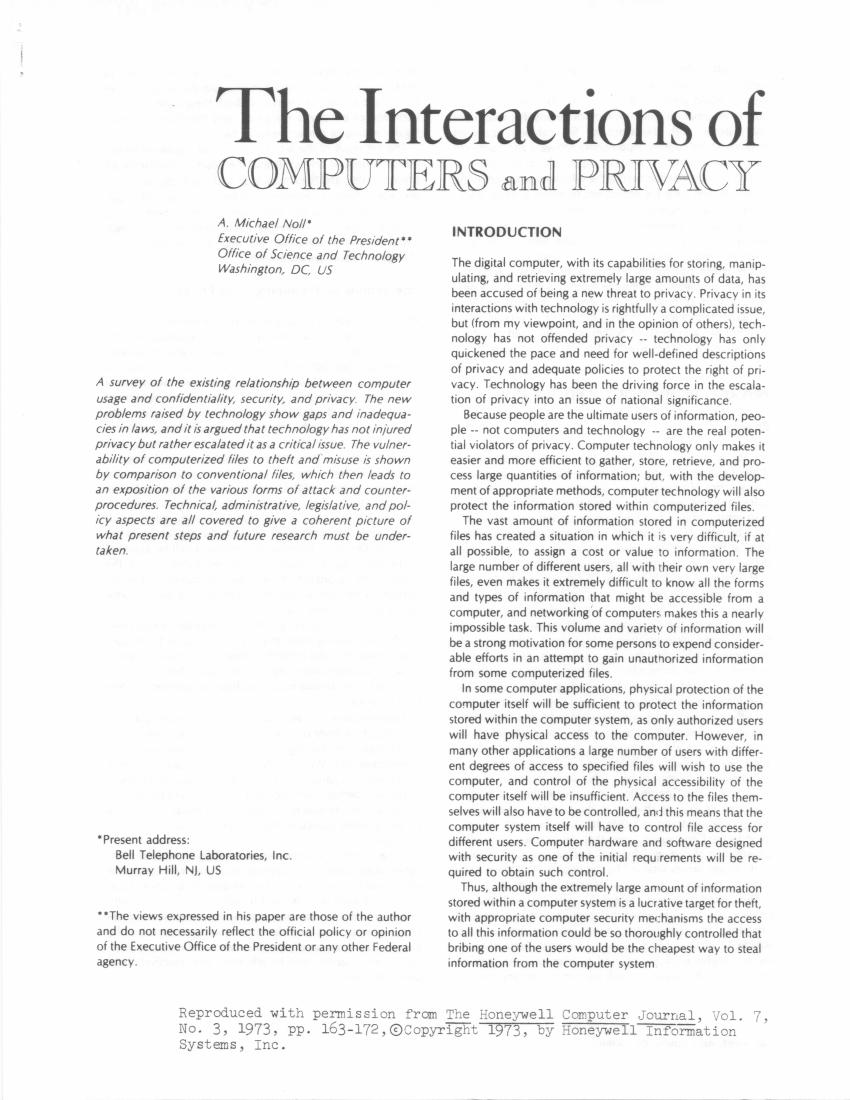
The Interactions of Computers and Privacy
- Author
- A. Michael Noll
- Year
- 1973
- Published in
- A permission line printed on the first page reads: "Reproduced with permission from The Honeywell Computer Journal, Vol. 7, No. 3, 1973, pp. 163-172, © Copyright 1973, by Honeywell Information Systems, Inc." Running footers read HONEYWELL COMPUTER JOURNAL with page numbers 164 to 172. Author affiliation printed as Executive Office of the President, Office of Science and Technology, Washington, DC, with present address given as Bell Telephone Laboratories, Inc., Murray Hill, NJ, and a disclaimer that the views are the author's own.
- Subject
- A. Michael Noll
- Tags
- pioneers · Bell Labs · journal article · research
Notes
A permission line printed on the first page reads: "Reproduced with permission from The Honeywell Computer Journal, Vol. 7, No. 3, 1973, pp. 163-172, © Copyright 1973, by Honeywell Information Systems, Inc." Running footers read HONEYWELL COMPUTER JOURNAL with page numbers 164 to 172. Author affiliation printed as Executive Office of the President, Office of Science and Technology, Washington, DC, with present address given as Bell Telephone Laboratories, Inc., Murray Hill, NJ, and a disclaimer that the views are the author's own.. Self-archived by the author at http://noll.uscannenberg.org/PDFpapers/ComputersPrivacy1973.pdf — Noll posts his own papers on his site at noll.uscannenberg.org, which is where this copy comes from. Hosting here is with his agreement, given to Bre Pettis directly on 6 October 2026. Written while Noll was on the staff of the President's Office of Science and Technology, this survey argues the opposite of the then-popular view: technology has not injured privacy, it has only escalated privacy into an issue of national significance. People, not computers, are the potential violators; the computer merely makes gathering and retrieval cheap, and with the right design it will also do the protecting. He sets out the legal vacuum first. The word privacy does not appear in the US Constitution, so the right rests on the Ninth Amendment and an accumulating body of court decisions. He traces the escalation through polygraphs and wiretaps, the hearings of Representative Cornelius Gallagher and Senator Sam Ervin, and the mid-1960s Bureau of the Budget proposal for a national data bank that collapsed under public protest. The technical core compares computerised and conventional files. A locked cabinet makes theft costly and forced entry visible, and nobody can steal many cabinets at once; a computer file is copied in place with nothing removed, and the method that opens one file usually opens all, so sheer bulk becomes a liability. Because no realistic value can be assigned to the contents, the rule of making theft cost more than the information is worth breaks down; Noll proposes instead that a system is secure when bribing an authorised user is cheaper than penetrating it. Four requirements follow: physical security including shielding of emissions, authentication of every user including other computers, cryptographic protection of remote links, and a secure supervisory program. He is blunt that none then existed, since security was patched in rather than designed in. He suggests a privacy impact statement on the model of environmental ones, audit trails, and laws written with technologists. Points of record: Core thesis: technology has not injured privacy but has escalated it as a national issue; people, not computers, are the violators; The word "privacy" does not appear in the US Constitution, so the right rests on the Ninth Amendment and on accumulated court decisions; Computerised files invert the protection of conventional ones: copying leaves the original in place, and one break-in method opens every file, so bulk becomes a liability; Because the value of computerised information cannot be assessed, Noll proposes a system be judged secure when bribing an authorised user is cheaper than penetrating it; He states that no supervisory system of the day could resist penetration by a remote user for more than a few weeks, because security was patched in rather than designed in; He proposes a privacy impact statement for agencies, on the model of environmental impact statements, plus computerised audit trails. People named: A. Michael Noll (author; Office of Science and Technology, Executive Office of the President; present address Bell Telephone Laboratories), Representative Cornelius Gallagher (cited; congressional hearings on threats to privacy), Senator Sam Ervin (cited; congressional hearings on threats to privacy), Alan F. Westin (cited; Privacy and Freedom, and with M. A. Baker, Databanks in a Free Society), George Orwell (referred to; the fantasies of 1984), A. R. Miller, J. M. Rosenberg, M. Warner and M. Stone (suggested further reading on privacy), J. P. Anderson, L. J. Hoffman, W. H. Ware (suggested further reading on computer security), R. E. Anderson, E. Fagerlund, J. C. Bergart, M. Denicoff and D. K. Hsiao (cited bibliographies). Noted: The permission line gives "Vol. 7, No. 3, 1973" without the season; the supplied citation's "Fall 1973" is not printed on the document. The first printed page number visible in the scan is 164; p. 163 is the title page, whose footer is not reproduced.