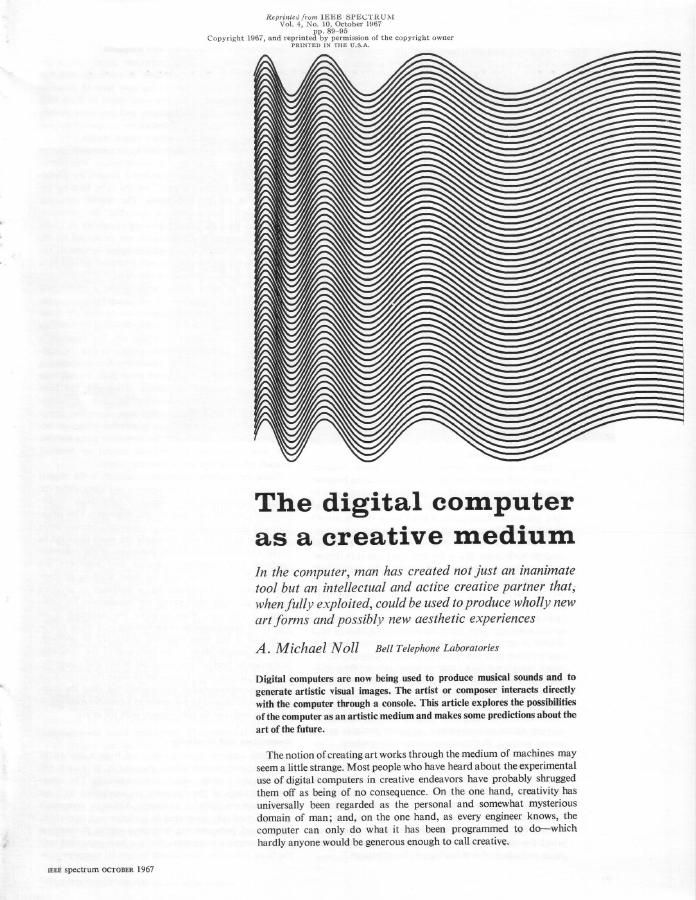
The digital computer as a creative medium
- Author
- A. Michael Noll
- Year
- 1967
- Published in
- IEEE Spectrum, Vol. 4, No. 10, October 1967, pp. 89-95, printed on the reprint's head: “Reprinted from IEEE SPECTRUM, Vol. 4, No. 10, October 1967, pp. 89-95. Copyright 1967, and reprinted by permission of the copyright owner.” Byline: A. Michael Noll, Bell Telephone Laboratories. The supplied citation is confirmed in every detail.
- Subject
- A. Michael Noll
- Tags
- computer art history · citation-mined · pioneers · Bell Labs · essay
Notes
IEEE Spectrum, Vol. 4, No. 10, October 1967, pp. 89-95, printed on the reprint's head: “Reprinted from IEEE SPECTRUM, Vol. 4, No. 10, October 1967, pp. 89-95. Copyright 1967, and reprinted by permission of the copyright owner.” Byline: A. Michael Noll, Bell Telephone Laboratories. The supplied citation is confirmed in every detail.. Self-archived by the author at http://noll.uscannenberg.org/Art%20Papers/Creative%20Medium.pdf — Noll posts his own papers on his site at noll.uscannenberg.org, which is where this copy comes from. Hosting here is with his agreement, given to Bre Pettis directly on 6 October 2026. His most reprinted essay — later in Cybernetics, Art and Ideas (ed. Jasia Reichardt, 1971), which is also in this library. The essay's standfirst states that in the computer man has created not just an inanimate tool but an intellectual and active creative partner that, fully exploited, could produce wholly new art forms and possibly new aesthetic experiences. Noll opens with an anecdote attributed to Henri Matisse about painting a bright red disk on a blank canvas and then waiting for an idea as exciting as the disk. He uses it to argue that the artistic process already involves a kind of program, comparable to a hill-climbing technique optimising the parameter excitement, and that even a passive medium feeds ideas back to the artist. He describes the automatic plotter, a cathode-ray tube photographed by a camera under program control, and identifies the real problem as special-purpose languages that let artists speak in their own terms, citing a music compiler and Ken Knowlton's animation language Beflix, both suffering hours of delay before output. Examples follow: Stan VanDerBeek's dissolves and stretches, John Whitney's use of equations with artist-controlled variables, and op art, with the ninety parallel sinusoids of linearly increasing period printed across the opening page. The Mondrian experiment is restated as a crude approximation of Turing's 1950 proposal: 59 per cent preferred the computer picture, only 28 per cent identified Mondrian's correctly, the observers associating randomness with human creativity. He then reports a graphic console on which amplitude, frequency and duration functions were drawn with a light pen and synthesised almost immediately, and his own proposal for choreography with steerable stick figures. He imagines a computer reading the artist's pulse and brain activity and changing sound, colour and visual patterns to steer his emotional state, an interaction that could be recorded and replayed by the public on their own computers; he calls this, half-jokingly, a psychedelic computer. He predicts an aesthetic experience open to artist and non-artist alike, a citizen-artist after Allon Schoener, and ideas rather than technical skill determining merit; photography drove painting away from representation without driving it out. Its standfirst is the paragraph Noll quotes back at himself in the SIGGRAPH '82 catalogue. Points of record: Argues the computer is not merely a tool but an active creative partner and a wholly new artistic medium; Restates the Mondrian experiment as a crude approximation of A. M. Turing's 1950 proposed test: 59 per cent of 100 subjects preferred the computer picture, only 28 per cent identified Mondrian's correctly; Names Stan VanDerBeek, working with Ken Knowlton's animation language Beflix, and John Whitney as artists using computers; Proposes a feedback art in which the computer senses the artist's physical and electrical signals - pulse rate, electrical activity of the brain - and changes his environment to optimise or steer his emotional state; Predicts a form of citizen-artist, crediting Allon Schoener, and argues the artist's ideas rather than technical skill will determine artistic merit; Argues that photography did not drive out painting, and the computer will not drive out traditional media; Opens with the Matisse red-disk anecdote and likens the artistic process to a computational hill-climbing technique optimising excitement. Illustrated: Ninety parallel sinusoids with linearly increasing period, printed across the opening page as a counterpart to Bridget Riley's painting; A frame from a movie by Stan VanDerBeek made with Ken Knowlton's animation programming language, each frame a fine mosaic of dots; Composition With Lines, Piet Mondrian, (c) Rijksmuseum Kroller-Muller, printed beside the computer-generated picture made with pseudorandom numbers, (c) A. Michael Noll 1965; Frames from the computer-generated movie of stick figures on a stage, captioned as the choreographer of the future at a computer console; Left and right images of a 3-D pair from a computer-generated three-dimensional movie of a randomly changing object, described as a form of kinetic sculpture, with instructions for free-fusing. People named: A. Michael Noll - author, Bell Telephone Laboratories, Henri Matisse - the red-disk anecdote about beginning a painting, Stan VanDerBeek (spelled Vanderbeek in the captions) - animator whose film frame is reproduced, Ken Knowlton - devised the animation programming language Beflix used for VanDerBeek's film; also cited in the references, John Whitney - animator using mathematical equations with artist-controlled variables, Bridget Riley - painter, named for the work printed here as Currents, Piet Mondrian - Composition With Lines (1917), A. M. Turing - cited for the 1950 Mind paper and the imitation-game experiment, M. V. Mathews - cited for the digital computer as a musical instrument and for a graphical language for composing and playing sounds, Marvin L. Minsky - cited on artificial intelligence (Scientific American, 1966), Edward E. Zajac - cited on computer animation as a scientific and educational tool, Allon Schoener - cited for “2066 and all that”, Art in America (1966), source of the citizen-artist idea, Arnold Rockman and Leslie Mezei - cited for “The electronic computer as an artist”, Canadian Art (1964). Noted: Riley's painting is printed here as Currents; in Noll's Design Quarterly article and his 1994 memoir it is Current, which is the painting's usual title. Knowlton's language is printed Beflix (confirmed on the page image); text extraction misreads it as Bellix. The scan's OCR garbles several phrases - for example “an active medium” appears as “an claire medium” and “different media” as “different meila”; these were checked against the page images where they mattered. The figure caption gives the Mondrian result as counts (“preferred by 59 of them. Only 28 subjects identified the Mondrian painting”) where the body text gives percentages and says 28 per cent identified the computer picture correctly; the caption's wording differs from the Psychological Record paper's. Allon Schoener is printed in the body as “Mon Schoener” in the scan; reference 11 gives the correct name. The supplied note that the essay was reprinted in Jasia Reichardt's “Cybernetics, Art and Ideas” (1971) is not stated on this document.