The Death of Computer Art
- Author
- Lev Manovich
- Year
- 1996
- Published in
- Rhizome
- Tags
- computer art history · essay · online resource
Notes
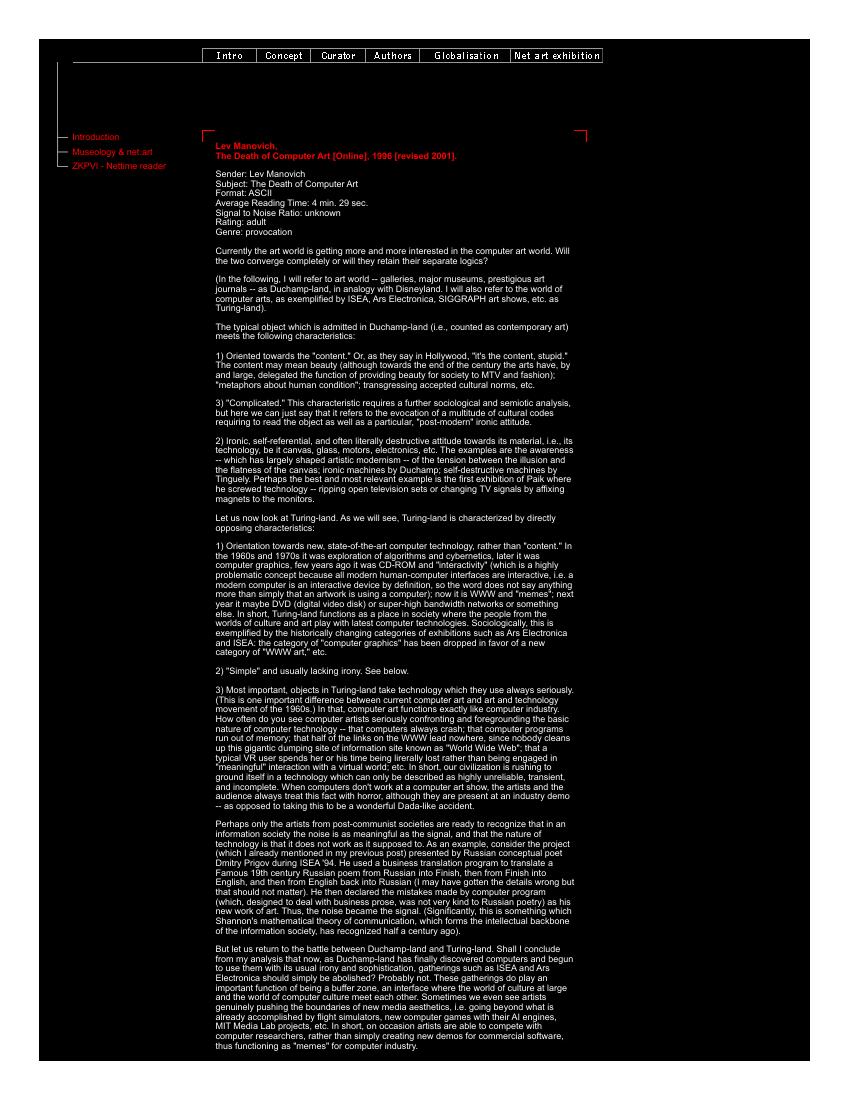
Posted to the Rhizome mailing list on 22 October 1996 (the Rhizome archive is the source link, but it sits behind a bot check). This PDF is a headless-browser print, made 4 October 2026, of the open mirror at absoluteone.ljudmila.org (ZKP VI Nettime reader), which carries the text as revised in 2001; 2 pp. No PDF exists on manovich.net. A four-minute "provocation" in mailing-list format. Manovich names the art world of galleries, major museums and journals Duchamp-land (on the model of Disneyland) and the world of the computer arts, ISEA, Ars Electronica and the SIGGRAPH art shows, Turing-land, and asks whether they will converge. Duchamp-land admits objects oriented towards content, ironic and self-referential and often destructive towards their own material (Duchamp's machines, Tinguely, Paik ripping open television sets), and "complicated" in the cultural codes they invoke. Turing-land objects are oriented towards the newest technology rather than content (algorithms and cybernetics in the 1960s and 70s, then computer graphics, then CD-ROM and "interactivity", now the Web and "memes"), are simple and unironic, and above all take their technology seriously, exactly as the computer industry does, never confronting the fact that computers crash, run out of memory and lose their links; a machine failing at a computer-art show is met with horror rather than welcomed as a Dada accident. Only artists from post-communist societies, he suggests, grasp that in an information society the noise is as meaningful as the signal (Dmitry Prigov's machine-translated poem at ISEA '94). Conclusion: the festivals should not be abolished, since they are a buffer zone where culture at large meets computer culture and artists occasionally push beyond flight simulators, games and the Media Lab, but "Duchamp-land wants art, not research into new aesthetic possibilities of new media. The convergence will not happen."