Tactile Man-Machine Communication System
- Author
- A. Michael Noll
- Year
- 1975
- Published in
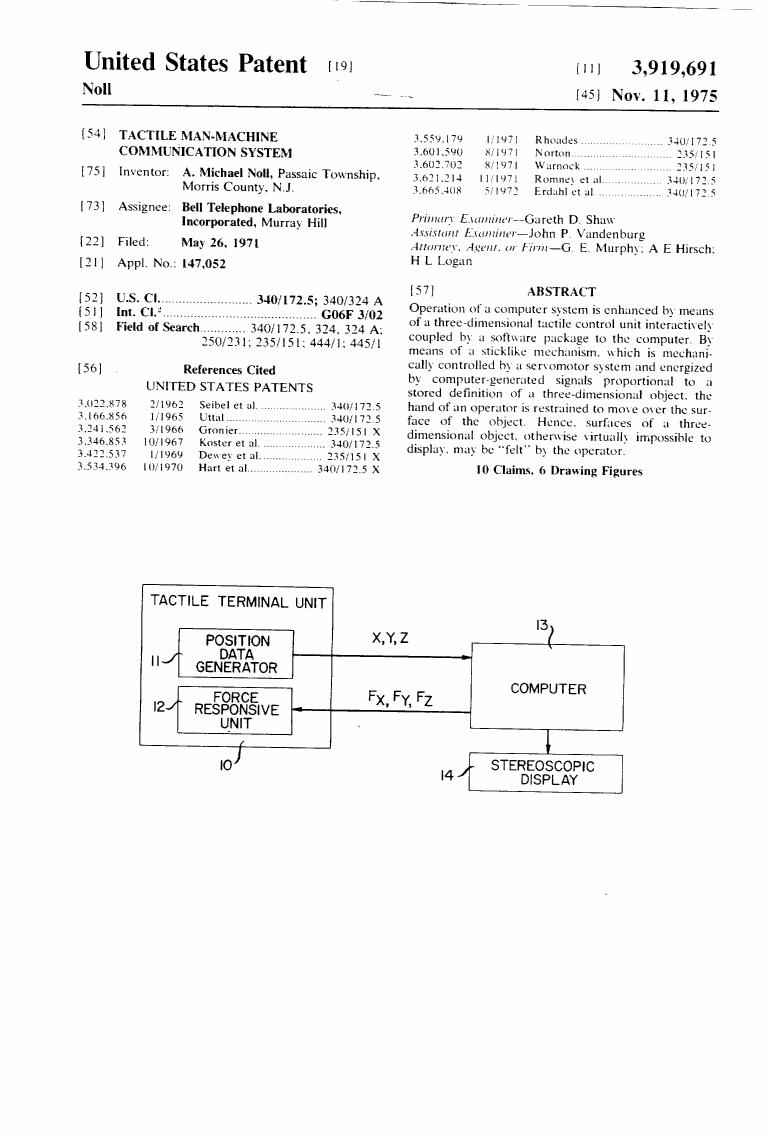
- United States Patent 3,919,691. Inventor: A. Michael Noll, Passaic Township, Morris County, N.J. Assignee: Bell Telephone Laboratories, Incorporated, Murray Hill. Appl. No. 147,052. Filed May 26, 1971. Issued November 11, 1975. 10 Claims, 6 Drawing Figures. U.S. Cl. 340/172.5; 340/324 A; Int. Cl.2 G06F 3/02; Field of Search 340/172.5, 324, 324 A, 250/231, 235/151, 444/1, 445/1. Primary Examiner Gareth D. Shaw; Assistant Examiner John P. Vandenburg; Attorney, Agent or Firm G. E. Murphy, A. E. Hirsch, H. L. Logan.
- Subject
- A. Michael Noll
- Tags
- pioneers · patent · Bell Labs
Notes
United States Patent 3,919,691. Inventor: A. Michael Noll, Passaic Township, Morris County, N.J. Assignee: Bell Telephone Laboratories, Incorporated, Murray Hill. Appl. No. 147,052. Filed May 26, 1971. Issued November 11, 1975. 10 Claims, 6 Drawing Figures. U.S. Cl. 340/172.5; 340/324 A; Int. Cl.2 G06F 3/02; Field of Search 340/172.5, 324, 324 A, 250/231, 235/151, 444/1, 445/1. Primary Examiner Gareth D. Shaw; Assistant Examiner John P. Vandenburg; Attorney, Agent or Firm G. E. Murphy, A. E. Hirsch, H. L. Logan.. Self-archived by the author at http://noll.uscannenberg.org/Patents/US3919691.pdf — Noll posts his own papers on his site at noll.uscannenberg.org, which is where this copy comes from. Hosting here is with his agreement, given to Bre Pettis directly on 6 October 2026. His site also records an unissued patent, “Raster Scan Computer Graphics System”, filed 5 February 1970 and abandoned at the Supreme Court in 1977. This is the patent corresponding to the force-feedback apparatus of Noll's 1972 SID paper, and it claims the loop rather than the mechanism. A three-dimensional tactile terminal unit has two halves: a position data generator and a force-responsive unit. The position generator is an orthogonally movable arm or control stick on platforms running in X and Y on gear, chain-and-sprocket or belt-and-pulley mechanisms, with a third for Z; three potentiometers each control a voltage from minus ten to plus ten volts, digitised for the computer. The force-responsive unit is three electrically reversible motors on the same mechanisms, driven by three eight-bit numbers converted back to analogue. Twelve pounds is stated as sufficient to simulate bumping a rigid object. The claimed invention is the comparison step. The computer holds a definition of a surface, compares the arm's momentary position against it, and generates forces accordingly: zero when the probe is off the surface, so the stick moves freely, and forces normal to the surface when it is on, so the operator feels contact. Two refinements belong to the loop: movement-assist forces computed independently of the comparison — from first differences of position for velocity, second differences or an accelerometer for inertia, or strain gauges on the arm — to cancel the mechanism's own friction; and a knob split into insulated halves containing a microswitch, so the unit is live only while held. Two embodiments of the computer are given: a software one in Fortran, and a hardware one needing no programming at all, in which the reachable cube is divided by a grid, the concatenated coordinates form a memory address, and read-only memories store a bit per point saying whether it lies inside the solid, the force magnitude and direction, and the shift producing the stereoscopic image for each depth. Claim 10 covers two such units at two locations compared against each other, so one operator feels a shape another defines. Points of record: Claims a tactile terminal whose data generator is driven back by the computer, so the operator's hand is restrained to move over the surface of an object stored only in memory; Position is read by three potentiometers spanning minus ten to plus ten volts; force comes from three electrically reversible motors driven by three eight-bit values converted back to analogue; Movement-assist forces, derived from first differences of position, second differences or an accelerometer, or strain gauges on the arm, cancel the mechanism's own friction and inertia; The grasping knob is split into insulated halves with a microswitch, so the motors are live only while held — a dead-man arrangement; A hardware embodiment needs no programming at all: read-only memories addressed by the concatenated coordinates hold the surface bit, the force fields and the stereo shift; Claim 10 covers two tactile units at separate locations compared against each other — a man-to-man tactile link; the example given is a cloth purchaser in New York feeling cloth offered by a seller in Chicago. Illustrated: FIG. 1: block schematic of the interactive system — tactile terminal unit 10 containing position data generator 11 and force responsive unit 12, computer 13, and stereoscopic display 14; FIG. 2: pictorial of the tactile terminal unit — arm 21 with grasping knob 29, platform 22, belt-and-pulley mechanisms 23, 24, 25, motors 18, 19, 20 and potentiometers 26, 27, 28; FIG. 3: flow chart of the computation — input position, calculate position relative to the selected surface, compare with stored surface data, decide ON or OFF, output zero or normal forces through the D/A converter, and in parallel calculate and plot the stereoscopic pair; FIG. 4: the example sphere with its spongy outer shell of depth D; FIG. 5: the square-law force diagram showing force rising to FMAX; FIG. 6: the all-hardware embodiment of computer 13 — A/D converters, address register, memories 300, 310 and 39, AND gates, multiplexer 40 and the D/A converter; Table 1: the memory addresses holding a 1 for a solid cube in the worked example. People named: A. Michael Noll (inventor; Passaic Township, Morris County, N.J.), Gareth D. Shaw (primary examiner), John P. Vandenburg (assistant examiner), G. E. Murphy, A. E. Hirsch and H. L. Logan (attorneys, agents or firm), Cited prior-art inventors on the front page: Seibel et al., Uttal, Gronier, Koster et al., Dewey et al., Hart et al., Rhoades, Norton, Warnock, Romney et al., Erdahl et al.. Noted: The scanned OCR of the front page is noisy; the bibliographic details above were read from a rendered image of the page header rather than the text layer. The prior-art citation list on the front page gives surnames and numbers only; several of the numbers are illegible in the scan.