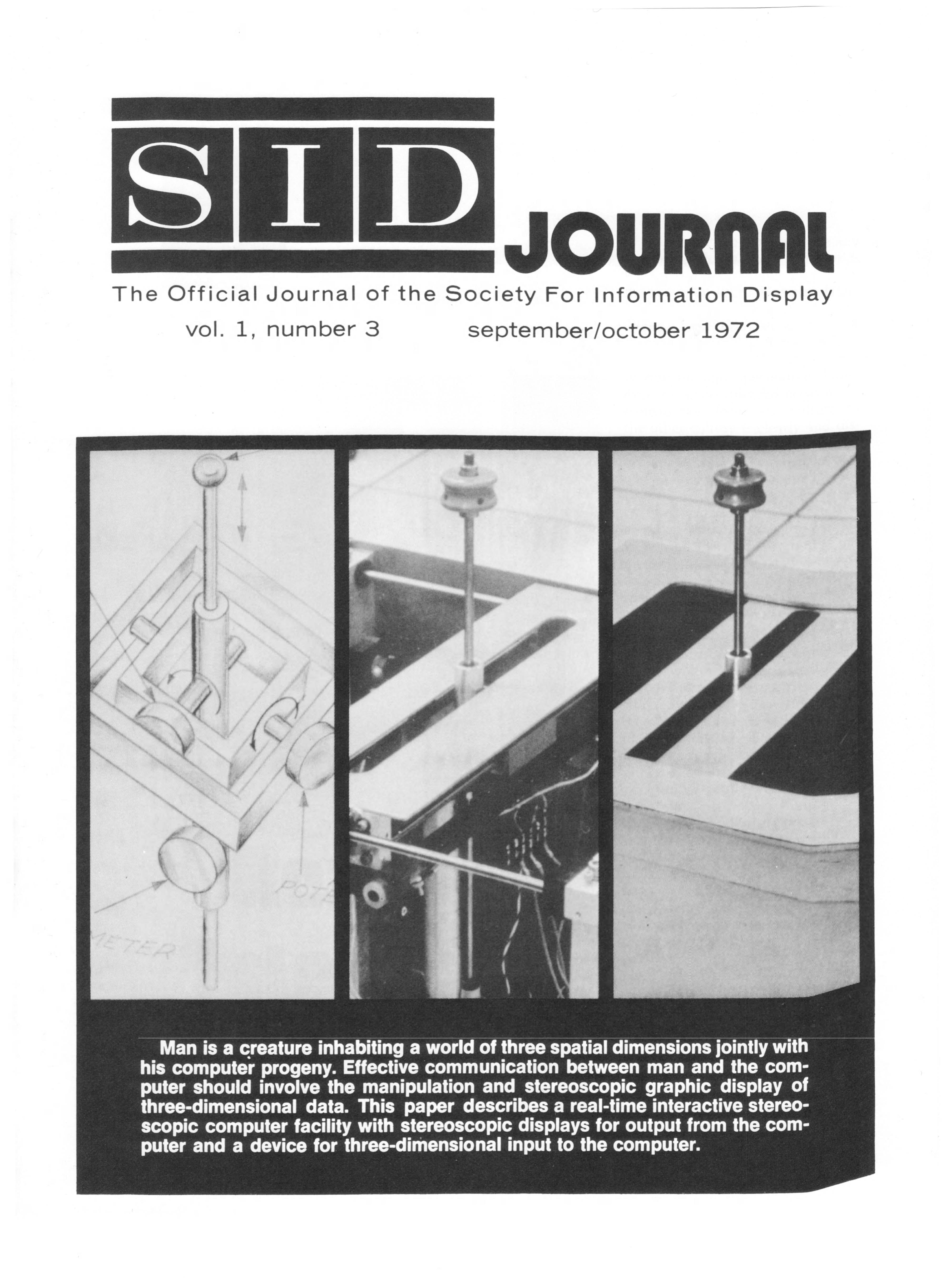
Real-Time Interactive Stereoscopy
- Author
- A. Michael Noll
- Year
- 1972
- Published in
- SID Journal, The Official Journal of the Society For Information Display, vol. 1, number 3, september/october 1972. Printed page footers in this scan run from "Page 14 / SID Journal" to "September-October / Page 21". A note states: "This paper is submitted in partial fulfillment of the requirements for the Doctor of Philosophy degree at the Polytechnic Institute of Brooklyn." Author affiliation printed as Bell Telephone Laboratories, Incorporated, Murray Hill, New Jersey.
- Subject
- A. Michael Noll
- Tags
- pioneers · Bell Labs · journal article · research
Notes
SID Journal, The Official Journal of the Society For Information Display, vol. 1, number 3, september/october 1972. Printed page footers in this scan run from "Page 14 / SID Journal" to "September-October / Page 21". A note states: "This paper is submitted in partial fulfillment of the requirements for the Doctor of Philosophy degree at the Polytechnic Institute of Brooklyn." Author affiliation printed as Bell Telephone Laboratories, Incorporated, Murray Hill, New Jersey.. Self-archived by the author at http://noll.uscannenberg.org/PDFpapers/SID%20Stereoscopy.pdf — Noll posts his own papers on his site at noll.uscannenberg.org, which is where this copy comes from. Hosting here is with his agreement, given to Bre Pettis directly on 6 October 2026. The companion to Noll's tactile paper describes the real-time stereoscopic graphics facility he built at Bell Labs. He opens with Alberti's della Pittura as the earliest known geometrical scheme for depicting objects in a unified space, and argues the mathematical statement of perspective was a precondition for machine plotting; stereoscopy follows from calculating two projections from viewpoints an interpupillary distance apart. The hardware survey is concrete. A dual cathode-ray-tube stereoscope was built from a modified hand-held stereoscope fitted with two one-inch Thomas Electronics tubes, with a blanking signal turning one off so each eye sees only its own image. Alternatively both images are plotted side by side on one large tube and viewed through a prism attachment slipped over the screen, a bulkier mirror stereoscope, or cross-eyed. For input he rejects three knobs as the worst scheme and a spherical gimbal as requiring costly coordinate conversion, settling on a cartesian wand using three mutually orthogonal linear potentiometers, built in aluminium on Thomson linear bearings and in use about three years. Everything ran on a Honeywell DDP-224 with 32,000 words of core, 24-bit words, floating-point hardware and a 1.9 microsecond cycle time; the graphics package occupied about 600 decimal locations and the stereo package about 180. Applications are reported candidly. Stereoscopic speech spectra with rotation worked but yielded no new insight, as did rotating a four-dimensional hypercube. The facility earned its keep on a three-dimensional drawing program where lines and curves could be drawn, latched onto, translated and rotated in real time. Noll concludes monocular perspective cues are usually strong enough that stereoscopy adds little, so its prime areas of use are design and the visual arts, and he frames the whole project as a subpart of the tactile work. Points of record: The whole facility ran on a Honeywell DDP-224: 32,000 words of core, 24-bit words, floating-point hardware, 1.9 microsecond cycle time; A dual-CRT stereoscope was built at Bell Labs from a modified hand-held stereoscope fitted with two one-inch Thomas Electronics tubes and driven with blanking signals; The three-dimensional input device used three mutually orthogonal linear potentiometers on Thomson linear bearings and had been in service about three years; The graphics package occupied about 600 decimal locations and the stereoscopic package about 180; data had to lie in a cube of edge 4095 centred on the origin; Stereoscopic displays of speech spectra and of a rotating four-dimensional hypercube worked but produced no new insight; the real payoff was a real-time three-dimensional drawing program; Noll concludes monocular perspective cues usually suffice, so stereoscopy's prime areas of use are design and the visual arts. Illustrated: Fig. 1: stereoscopic viewing system using two miniature cathode ray tubes with blanking signals; Fig. 2: photograph of the dual cathode-ray-tube stereoscope — a conventional hand-held stereoscope fitted with two Thomas Electronics one-inch tubes; Fig. 3: the three viewing geometries — mirror stereoscope, prism stereoscope, cross-eyed viewing; Fig. 4: photographs of the mirror and prism stereoscopic attachments; Fig. 5: sketch of a spherical-coordinate wand in a gimbal, two angular potentiometers plus one radial; Fig. 6: sketch of the cartesian three-dimensional input device using three mutually perpendicular linear potentiometers; Fig. 7: photographs of the cartesian input device with and without its external covers; Fig. 8: photograph of the complete interactive stereoscopic man-machine communication system; Figs. A1 and A2: geometry of stereoscopic projection viewed perpendicular to the XZ and YZ planes. People named: A. Michael Noll (author, Bell Telephone Laboratories, Murray Hill), John J. Dubnowski (designed the circuitry for the dual cathode-ray-tube stereoscope), Martha J. Southern (wrote the character-display subroutines), Charles F. Mattke (mechanical design of the stereoscopes and the 3-D input device), O. J. Jensen (constructed the DDP-224 computer facility with its hardware interfaces and software), Barbara E. Caspers (programmed the DDP-224 facility), Peter B. Denes (supervision and guidance of the facility; also cited for laboratory computers and real-time speech research), Leone Battista Alberti (cited; della Pittura, earliest known geometrical scheme for a unified space), Bela Julesz (cited; computer-generated stereoscopic patterns for depth-perception research, with Joan E. Miller), Ivan E. Sutherland (cited; Sketchpad and the head-mounted three-dimensional display), L. G. Roberts (cited; the Lincoln Wand), Hubert W. Upton (cited; head-mounted displays in helicopter operations, Bell Helicopter Company), Edward E. Zajac (cited; computer-made perspective movies), M. V. Mathews (cited with Denes on laboratory computers), William H. Ninke (cited; GRAPHIC-I remote display console), Michael C. King and Daniel H. Berry (cited with Noll on computer-generated holography), Gary A. McCue, H. R. Puckett, Thomas G. Hagan, Richard J. Nixon, Luis J. Schaefer, Carl Christensen, Elliot N. Pinson (cited in the reference list), Conrad H. Waddington and William M. Ivins, Jr. (cited on art and science, art and geometry). Noted: Printed page footers visible in the scan run 14 to 21; the supplied citation's closing page 22 could not be confirmed from the document. Several in-text cross-references in the scan are garbled by OCR (for example reference 21, Noll's "Scanned-Display Computer Graphics", is printed with placeholder volume and page numbers: "Vol. xx, No. xx, xxxx").