Real Time Cepstrum Analyzer
- Author
- A. Michael Noll, Manfred R. Schroeder
- Year
- 1971
- Published in
- United States Patent 3,566,035. Inventors: A. Michael Noll, Newark, N.J., and Manfred R. Schroeder, Gillette, N.J. Appl. No. 863,398. Filed July 17, 1969. Patented February 23, 1971. Assignee: Bell Telephone Laboratories, Incorporated, New York, N.Y. Continuation of application Ser. No. 420,362, December 22, 1964, now abandoned. 8 Claims, 8 Drawing Figures. U.S. Cl. 179/1, 324/77; Int. Cl. G10l 1/04. Primary Examiner Kathleen H. Claffy; Assistant Examiner Jon Bradford Leaheey; Attorneys R. J. Guenther and William L. Keefauver.
- Subject
- A. Michael Noll
- Tags
- pioneers · patent · Bell Labs
Notes
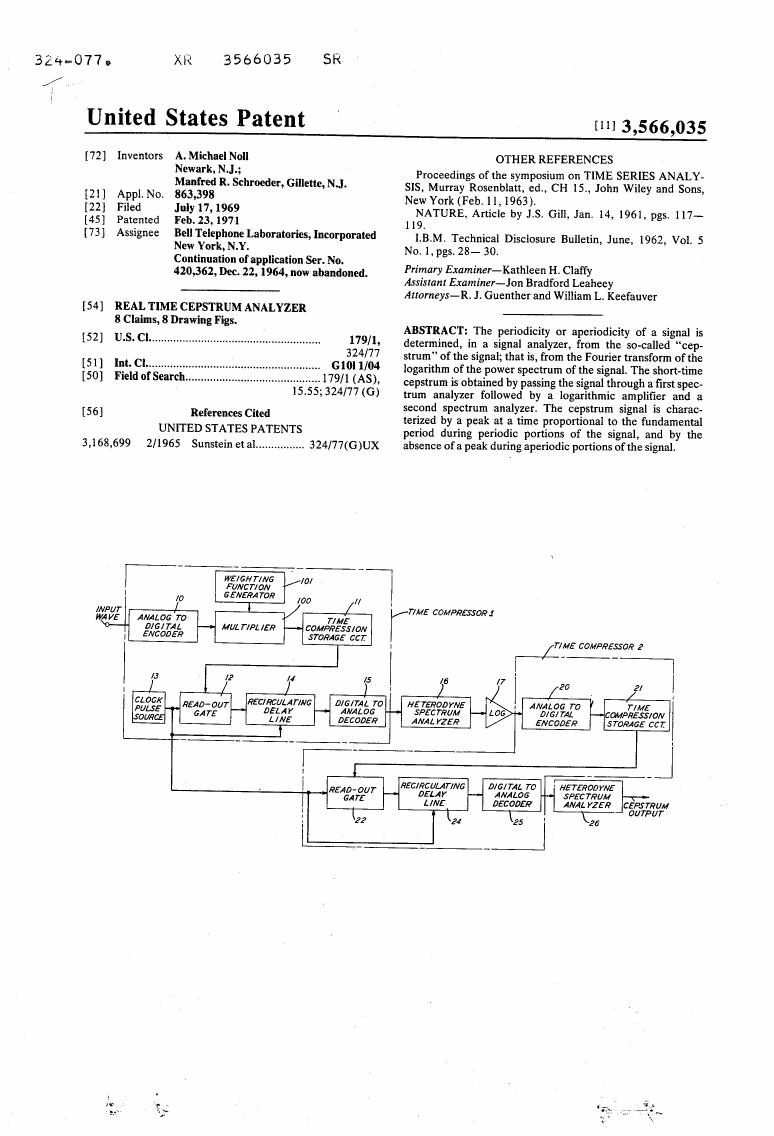
United States Patent 3,566,035. Inventors: A. Michael Noll, Newark, N.J., and Manfred R. Schroeder, Gillette, N.J. Appl. No. 863,398. Filed July 17, 1969. Patented February 23, 1971. Assignee: Bell Telephone Laboratories, Incorporated, New York, N.Y. Continuation of application Ser. No. 420,362, December 22, 1964, now abandoned. 8 Claims, 8 Drawing Figures. U.S. Cl. 179/1, 324/77; Int. Cl. G10l 1/04. Primary Examiner Kathleen H. Claffy; Assistant Examiner Jon Bradford Leaheey; Attorneys R. J. Guenther and William L. Keefauver.. Self-archived by the author at http://noll.uscannenberg.org/Patents/US3566035.pdf — Noll posts his own papers on his site at noll.uscannenberg.org, which is where this copy comes from. Hosting here is with his agreement, given to Bre Pettis directly on 6 October 2026. This patent claims apparatus for deciding, continuously and in real time, whether a speech wave is periodic or aperiodic, and if periodic how long its period is. The method is the cepstrum: take the short-time power spectrum of a wave segment, take its logarithm, and take a second short-time Fourier transform of that logarithm. The second transform is not the inverse of the first: the log spectrum is treated as an independent function on which spectral analysis is performed, and the result's horizontal axis is called “quefrency”. During voiced speech the log spectrum carries a periodic fine ripple on a coarse formant structure and the cepstrum shows a single large peak at a quefrency equal to the pitch period; during unvoiced speech no such peak appears. The peak at the origin, from the DC component, is always ignored. The simplest embodiments are an analyser, a logarithmic amplifier and a second analyser, or a single analyser reused with a gate and a switch. The real-time embodiment is the substance: two time compressors in series, each built from an analogue-to-digital encoder, a digital multiplier fed by a weighting-function generator, a time-compression storage circuit recirculating code groups through a delay element shorter than the sample interval, a clocked readout gate, a recirculating delay line, a decoder and a heterodyne spectrum analyser. The worked numerical example is unusually complete. Speech band-limited to 4,000 Hz with pitch periods up to 20 ms is sampled at 10 kc with 4 bits per sample, giving 400 code groups per 40 ms segment with 20 ms overlap; those are compressed into 50 microseconds so they can recirculate 400 times in each 20 ms interval, fixing the storage delay at 99.875 microseconds. Theory says 320 samples suffice to specify each spectrum, but 400 are used. Total latency for a 40 ms segment is 80 milliseconds. Points of record: Claims real-time apparatus for determining periodicity, aperiodicity and pitch from the cepstrum — the Fourier transform of the logarithm of the power spectrum; Insists the second short-time spectrum is not the inverse transform of the first, which is why the coined term cepstrum (and the axis name "quefrency") is used; A single large peak away from the origin marks voiced speech and its position gives the pitch period; the origin peak from the DC component is always ignored; Real time is achieved by two time compressors built from A/D encoders, weighted digital multipliers, recirculating time-compression storage, delay lines, D/A decoders and heterodyne analysers; Numerical example: 4 kHz speech, 10 kc sampling, 4 bits per sample, 400 code groups per 40 ms segment compressed into 50 microseconds, storage delay 99.875 microseconds, total latency 80 milliseconds; Filed as a continuation of Ser. No. 420,362 of December 22, 1964, which was abandoned — the 1964 priority for the cepstrum apparatus. Illustrated: FIG. 1A: real-time apparatus — two time compressors in series, each with weighting function generator, A/D encoder, digital multiplier, time compression storage, readout gate, clock pulse source, recirculating delay line, D/A decoder and heterodyne spectrum analyzer, with a logarithmic amplifier between them; FIG. 1B: alternative in which the clock pulse source is eliminated and time-compressed segments pass continuously to the first analyser; FIGS. 2A, 2B, 2C: the incoming complex wave with period T, the logarithm of its short-time power spectrum showing fine ripple on coarse formant structure, and the cepstrum Ck(q) with its peak at the period; FIG. 3: vocoder communication system using the analyser as the pitch analyser, with peak detector coder, transmission channel, peak detector decoder, excitation generator, vocoder synthesizer and loudspeaker; FIGS. 4A and 4B: the two simplest embodiments — analyser, log amplifier, second analyser; and a single analyser reused via a transmission gate and switch. People named: A. Michael Noll (co-inventor; also cited for his own JASA paper on short-time spectrum and cepstrum techniques for vocal-pitch detection), Manfred R. Schroeder (co-inventor, Gillette, N.J.), H. W. Dudley (cited, US 2,151,091, the channel vocoder), H. S. McDonald (cited for the peak detector coder and decoder), K. Koenig, H. K. Dunn and L. Y. Lacy (cited for the sound spectrograph used as the heterodyne analyser), R. B. Blackman and J. W. Tukey (cited for the weighting functions; the name is printed "Tulrey" in this copy), V. C. Anderson, J. P. Hesier and W. Peil (cited patents for time compression storage), J. Millman and H. Taub, and A. H. Meitzler (cited on recirculating delay lines), H. G. Cooper, M. H. Crowell and C. Maggs (cited for the high-speed PCM coding tube used as the encoder), Murray Rosenblatt (editor, Time Series Analysis, cited as other reference), J. S. Gill (cited, Nature, 14 January 1961), Kathleen H. Claffy (primary examiner), Jon Bradford Leaheey (assistant examiner), R. J. Guenther and William L. Keefauver (attorneys). Noted: The printed filing date is July 17, 1969; the supplied citation gives July 19, 1969. The assignee address is printed as New York, N.Y. on this patent, not Murray Hill as on Noll's other two patents. Several cited names are degraded in the scan (Blackman and "Tulrey" for Tukey; "K. Koenig"; "J. P. Hesier"), and the McDonald patent number here (3,109,142) disagrees with the number given in US 3,555,191 (3,190,142). Equations and some figures are reproduced as images without a text layer, so the formulae themselves were not read.