Pitch Detector
- Author
- A. Michael Noll
- Year
- 1971
- Published in
- United States Patent 3,555,191. Inventor: A. Michael Noll, Newark, N.J. Appl. No. 744,931. Filed July 15, 1968. Patented January 12, 1971. Assignee: Bell Telephone Laboratories, Incorporated, Murray Hill, Berkeley Heights, N.J., a corporation of New York. 7 Claims, 9 Drawing Figures. U.S. Cl. 179/1; Int. Cl. G10l 1/00, G10l 1/04; Field of Search 179/1 AS, 15.55, 324/77A, 77B. Primary Examiner Kathleen H. Claffy; Assistant Examiner Jon Bradford Leaheey; Attorneys R. J. Guenther and William L. Keefauver.
- Subject
- A. Michael Noll
- Tags
- pioneers · patent · Bell Labs
Notes
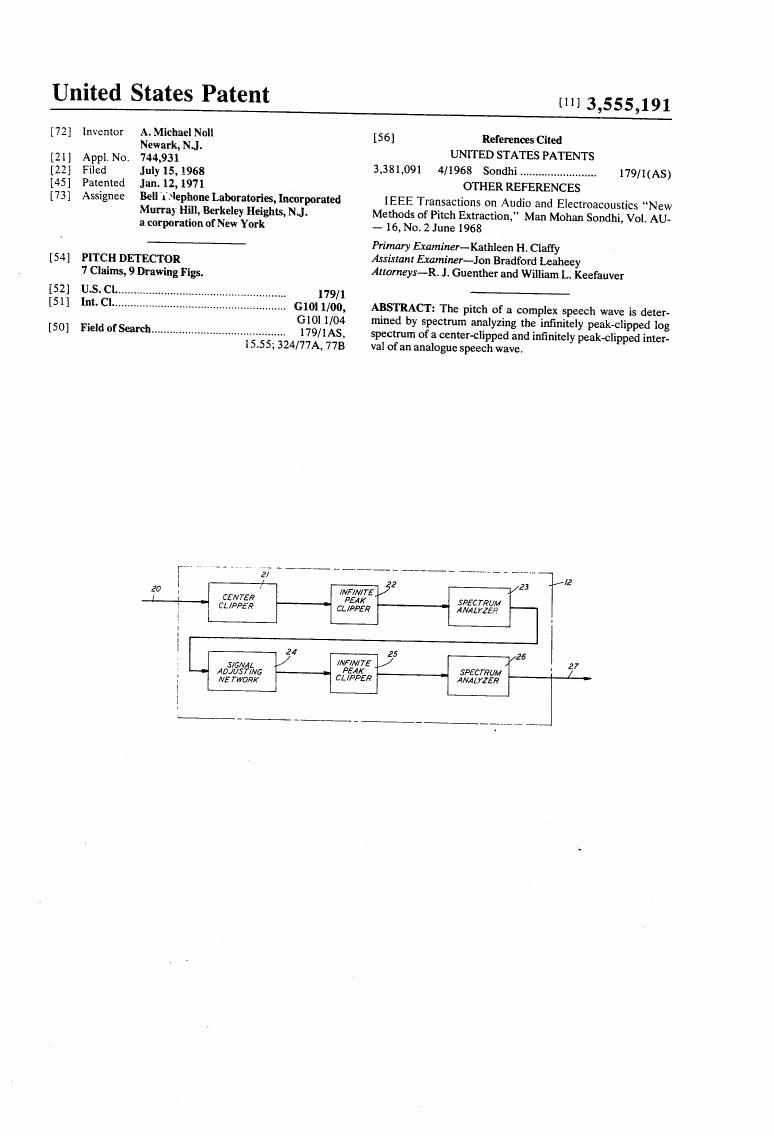
United States Patent 3,555,191. Inventor: A. Michael Noll, Newark, N.J. Appl. No. 744,931. Filed July 15, 1968. Patented January 12, 1971. Assignee: Bell Telephone Laboratories, Incorporated, Murray Hill, Berkeley Heights, N.J., a corporation of New York. 7 Claims, 9 Drawing Figures. U.S. Cl. 179/1; Int. Cl. G10l 1/00, G10l 1/04; Field of Search 179/1 AS, 15.55, 324/77A, 77B. Primary Examiner Kathleen H. Claffy; Assistant Examiner Jon Bradford Leaheey; Attorneys R. J. Guenther and William L. Keefauver.. Self-archived by the author at http://noll.uscannenberg.org/Patents/US3555191.pdf — Noll posts his own papers on his site at noll.uscannenberg.org, which is where this copy comes from. Hosting here is with his agreement, given to Bre Pettis directly on 6 October 2026. The invention is a simplified pitch detector for vocoder speech transmission, and it turns on replacing multiplication with clipping. The background recites the cepstrum method of Noll's earlier application: compute the Fourier cosine transform of the logarithm of the power spectrum of a speech segment and look for a peak at an interval proportional to the fundamental pitch period during voiced speech, with no peak during unvoiced speech. That works, but requires repeated multiplications, which in digital form demands elaborate and expensive computing equipment. The object is the same accuracy with much simpler processing. The claimed chain runs as follows. A segment of speech is centre-clipped, removing a band of amplitude symmetrically about the zero axis — about 70 per cent of the absolute maximum in each interval is said to work best. The result is infinitely peak-clipped, which strips everything but the zero-crossing information and leaves a square wave. The logarithm of that square wave's power spectrum is computed; its coarse structure carries the formants and its fine ripple the fundamental. That log spectrum is treated as a time-varying signal, passed through an adjusting network removing DC and slow variations, and infinitely peak-clipped again. The power spectrum of the resulting second square wave is what Noll names the “clipstrum”: a spike appears at a time proportional to the fundamental period when voiced speech is present, and no spike at all when the input is aperiodic. The practical payoff is that both spectrum analysers are fed square waves, which greatly simplifies digital processing; either analogue heterodyne or digital Fourier transform analysers are allowed. The embodiment sits inside a channel vocoder, driving a pitch encoder at the transmitter and a pitch decoder and excitation generator at the receiver. Points of record: Claims a pitch detector that determines pitch from the infinitely peak-clipped log spectrum of a centre-clipped and infinitely peak-clipped speech interval; Noll names the resulting function the "clipstrum" — a clipping-based substitute for his earlier cepstrum method; The claimed novelty is eliminating the repeated digital multiplications that cepstrum analysis requires, since both spectrum analysers receive square waves; Centre-clipping on the order of 70 percent of the absolute maximum of each interval is stated to be most effective for speech; A spike in the clipstrum signals voiced speech and its position gives the fundamental period; no spike means unvoiced; The embodiment is a channel vocoder transmitter with pitch encoder, and a receiver with pitch decoder, excitation generator and vocoder synthesiser. Illustrated: FIG. 1: block diagram of a vocoder transmission system with the pitch analyser in place; FIG. 2: block schematic of the pitch analyser — centre-clipper, infinite peak-clipper, log spectrum analyzer, signal adjusting network, second infinite peak-clipper, second spectrum analyzer; FIGS. 3A–G: a typical speech waveform, the centre-clipped waveform, the centre-clipped and infinitely peak-clipped waveform, the frequency spectrum, the spectrum after low-frequency and DC removal, that waveform after infinite peak-clipping, and the resulting "clipstrum". People named: A. Michael Noll (inventor; also cited for his own prior application Ser. No. 420,362 of December 22, 1964, his JASA paper on cepstrum pitch determination, and US Patent 3,420,955 on peak detection), M. M. Sondhi (cited prior art, US 3,381,091, for centre-clipping circuits; also cited for "New Methods of Pitch Extraction"), H. W. Dudley (cited, US 2,151,091, the channel vocoder analyser and synthesiser), H. S. McDonald (cited for the pitch coder, pitch decoder and excitation generator), M. R. Schroeder (cited, US 3,321,582, as an alternative spectrum analyser), Kathleen H. Claffy (primary examiner), Jon Bradford Leaheey (assistant examiner), R. J. Guenther and William L. Keefauver (attorneys). Noted: The McDonald patent is cited here as US 3,190,142 issued Oct. 29, 1963, but as US 3,109,142 with the same issue date in Noll and Schroeder's US 3,566,035 — the two documents disagree. The patent's own text once refers to "the spectrum method" where "the cepstrum method" is evidently meant, and once calls the earlier method "cepstrum" and once "spectrum" in the same paragraph.