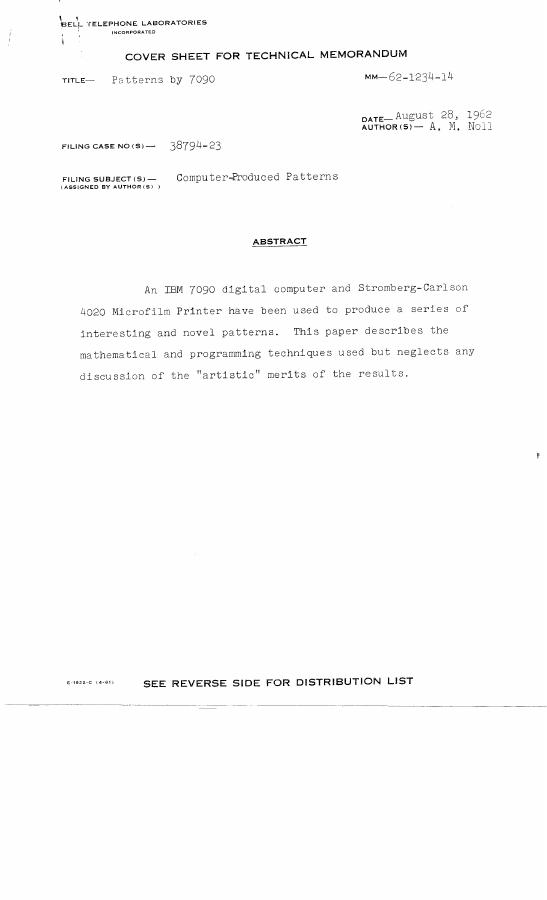
Patterns by 7090
- Author
- A. Michael Noll
- Year
- 1962
- Published in
- Bell Telephone Laboratories, Incorporated, internal memorandum. Cover sheet headed “Cover Sheet for Technical Memorandum”, title “Patterns by 7090”, number MM-62-1234-14, dated August 28, 1962, author A. M. Noll, filing case 38794-23, filing subject “Computer-Produced Patterns”. The document proper is headed “Memorandum for File”, subject “Patterns by 7090 - Case 38794-23”. Fifteen leaves: cover sheet, text, an appendix with a FORTRAN listing, and eight plates.
- Subject
- A. Michael Noll
- Tags
- computer art history · Bell Labs · pioneers
Notes
Bell Telephone Laboratories, Incorporated, internal memorandum. Cover sheet headed “Cover Sheet for Technical Memorandum”, title “Patterns by 7090”, number MM-62-1234-14, dated August 28, 1962, author A. M. Noll, filing case 38794-23, filing subject “Computer-Produced Patterns”. The document proper is headed “Memorandum for File”, subject “Patterns by 7090 - Case 38794-23”. Fifteen leaves: cover sheet, text, an appendix with a FORTRAN listing, and eight plates.. Self-archived by the author at http://noll.uscannenberg.org/Art%20Papers/BTL%201962%20Memo.pdf — Noll posts his own papers on his site at noll.uscannenberg.org, which is where this copy comes from. Hosting here is with his agreement, given to Bre Pettis directly on 6 October 2026. Rights line printed on his site: “[Courtesy of Alcatel-Lucent © 1962 Alcatel-Lucent]”. Already in the library as patterns-by-7090 with empty notes — this summary is to enrich it. The earliest written record of Noll's computer art, written at the end of the summer he spent as an intern in the Bell Labs research division. The abstract states that an IBM 7090 digital computer and a Stromberg-Carlson 4020 Microfilm Printer were used to make a series of patterns, and that the paper covers the mathematics and programming while leaving aside the artistic merits. Noll points at the new musical sounds already being made with computers and argues that microfilm printing opens a similar excursion into visual art. Rather than start an argument about whether machine-made designs are art, he calls the results simply Patterns. Everything is built from two SC-4020 subroutines, one that draws straight lines through successive points of a stored array and one that plots dots, so the medium is confined to lines and dots. Randomness comes from a subroutine named WNG (White Noise Generator), which returns numbers of any specified standard deviation; points landing outside the frame are reduced modulo the plot size. Pattern One joins points whose horizontal coordinates are random, standard deviation 1200, and whose vertical coordinates come from a quadratic in consecutive integers, with faint dots about the point (200, 300). Two and Three keep those lines untouched and only add, darken or recentre the dots. Four and Five build connected vertical and horizontal runs; Six leaves both coordinates random; Seven was meant to be randomly placed prolate cycloids but, in Noll's words, “something went amiss”; Eight uses random horizontal coordinates and a cubic for the vertical. The discussion notes that the identical line structure of the first three plates reads differently depending on where the dots sit, as if the dots steer the eye. Noll concedes the schemes were devised without forethought about artistic merit, then sketches the research programme he actually carried out over the next five years: survey what the 7090 and its microfilm equipment can draw, run subjective experiments on what makes a picture pleasing, and let the programmer-artist aim higher. An appendix annotates the FORTRAN listing for Pattern Two, with the plotter calls ROLL, REFPT, WNG, DVR2, TSP1 called four times to darken 299 dots, CLEAN and SYSTEM. Pattern One is the ancestor of Gaussian-Quadratic. Points of record: Dated 28 August 1962, numbered MM-62-1234-14, case 38794-23 - the earliest documentation of Noll's computer art; Names the machines: an IBM 7090 digital computer and a Stromberg-Carlson 4020 Microfilm Printer, programmed in FORTRAN; Randomness is supplied by a subroutine called WNG (White Noise Generator) at specified standard deviations; out-of-range points are wrapped modulo the frame size; Eight plates, Pattern One through Pattern Eight; One, Two and Three share identical line work and differ only in the number, position and darkness of the dots; Pattern Seven is reported as a failure: intended as randomly placed prolate cycloids that did not come out; Noll declines to call the output art, naming the results Patterns, and proposes subjective experiments on what makes a picture pleasing so a programmer-artist might later make true art; An appendix reproduces and explains the complete FORTRAN listing for Pattern Two, including the SC-4020 calls ROLL, REFPT (1024-unit frame), WNG, DVR2, TSP1, CLEAN and SYSTEM. Illustrated: Pattern One (1962) - straight lines through random horizontal and quadratic vertical coordinates, with a faint scatter of dots at lower left; Pattern Two (1962) - the same lines with more and darker dots; Pattern Three (1962) - the same lines with the dots moved to the exact centre, standard deviation 30; Pattern Four (1962) - connected vertical and horizontal line segments from random arrays (standard deviations 3200 and 2000); Pattern Five (1962) - as Four, with more lines and standard deviations 2500 and 4000; Pattern Six (1962) - straight lines joining points random in both coordinates; Pattern Seven (1962) - intended randomly placed prolate cycloids; a dense failed plot; Pattern Eight (1962) - straight lines with random horizontal and cubic vertical coordinates; Appendix plate: the FORTRAN program listing used to produce Pattern Two. People named: A. M. Noll (A. Michael Noll) - author, Bell Telephone Laboratories; the memorandum is signed A. M. NOLL, No other individual is named in the document; the typing credit line reads MH-1234-AMN-bam. Noted: The supplied citation is confirmed by the document: title, number MM-62-1234-14 and date 28 August 1962 all appear on the cover sheet and in the memorandum header. The internal header reads “Memorandum for File”; “Technical Memorandum” appears only on the cover sheet. The cover sheet says “See reverse side for distribution list”; that reverse is not reproduced in this PDF, so the circulation is unknown. Text extraction renders FORTRAN as “FOTRAN”; the page image shows it typed with a slashed O, so this is a scanning artefact rather than a typo in the original. The running text gives a standard deviation of 5 for the array FY2 while the program listing reads 75 for both FX2 and FY2; the running-text digit could not be read with certainty. The plates are untitled apart from their numbers. Pattern One strongly resembles the work later titled Gaussian-Quadratic, but that title appears nowhere in this memorandum. The rights line printed on Noll's website (“Courtesy of Alcatel-Lucent, (c) 1962 Alcatel-Lucent”) does not appear on the document itself.