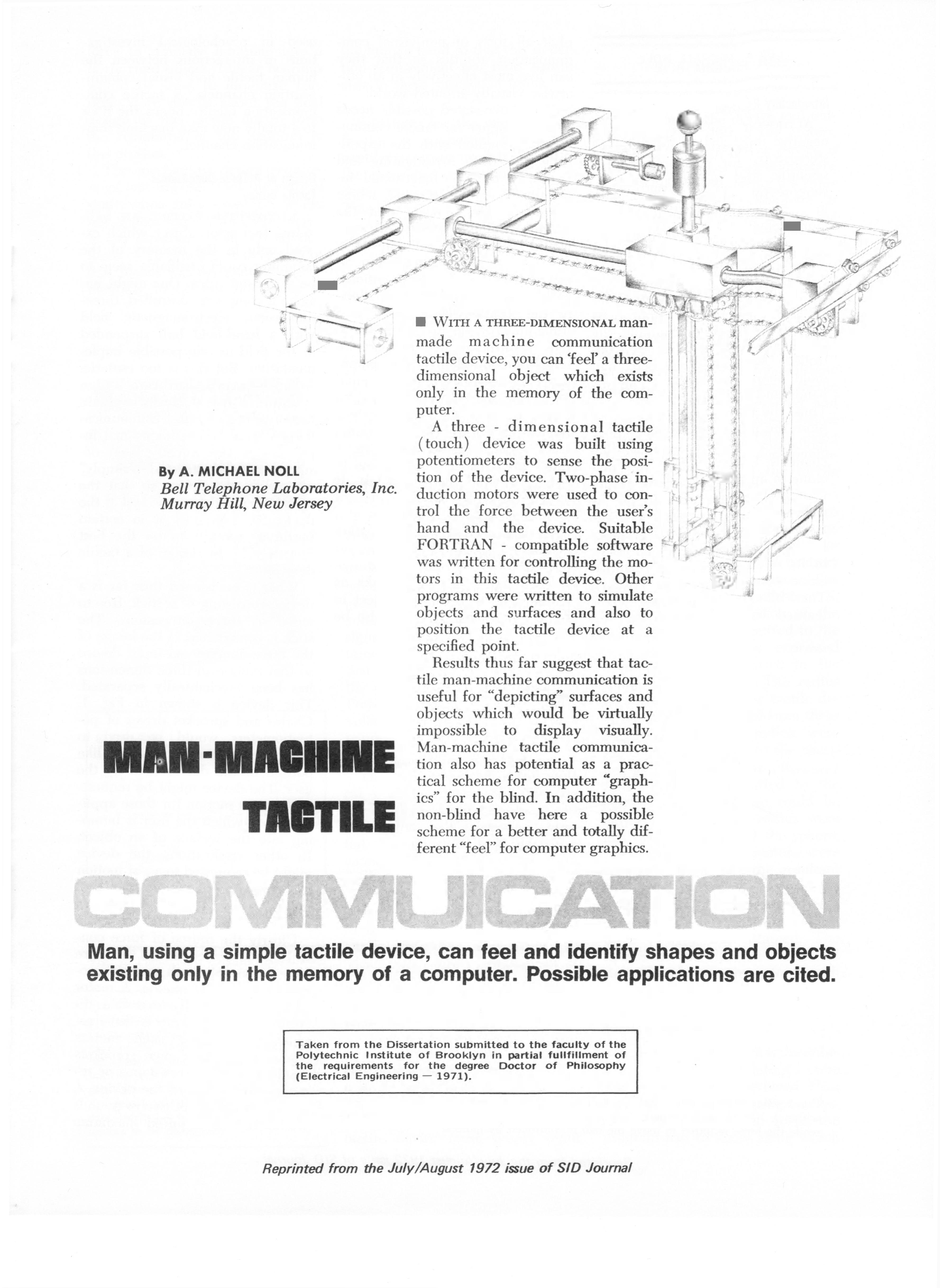
Man-Machine Tactile Communication
- Author
- A. Michael Noll
- Year
- 1972
- Published in
- Offprint stamped on every page "Reprinted from the July/August 1972 issue of SID Journal" (SID = Society for Information Display). The reprint's jump line reads "continued from page 11", and Noll's own later citation of this paper (in his 1976 IEEE Transactions correspondence) gives SID Journal, Vol. 1, No. 2, pp. 5–11, July/August 1972, which agrees with the supplied citation. A box on the first page states the material is taken from the dissertation submitted to the faculty of the Polytechnic Institute of Brooklyn for the degree Doctor of Philosophy (Electrical Engineering — 1971). Author affiliation printed as Bell Telephone Laboratories, Inc., Murray Hill, New Jersey; the contributor note describes him as then on the staff of the Office of Science and Technology, Executive Office of the President.
- Subject
- A. Michael Noll
- Tags
- pioneers · Bell Labs · journal article · research
Notes
Offprint stamped on every page "Reprinted from the July/August 1972 issue of SID Journal" (SID = Society for Information Display). The reprint's jump line reads "continued from page 11", and Noll's own later citation of this paper (in his 1976 IEEE Transactions correspondence) gives SID Journal, Vol. 1, No. 2, pp. 5–11, July/August 1972, which agrees with the supplied citation. A box on the first page states the material is taken from the dissertation submitted to the faculty of the Polytechnic Institute of Brooklyn for the degree Doctor of Philosophy (Electrical Engineering — 1971). Author affiliation printed as Bell Telephone Laboratories, Inc., Murray Hill, New Jersey; the contributor note describes him as then on the staff of the Office of Science and Technology, Executive Office of the President.. Self-archived by the author at http://noll.uscannenberg.org/PDFpapers/SID%20Tactile.pdf — Noll posts his own papers on his site at noll.uscannenberg.org, which is where this copy comes from. Hosting here is with his agreement, given to Bre Pettis directly on 6 October 2026. Reprinted in Creative Computing Vol. 4 No. 4 (July–August 1978). Related to his patent 3,919,691. Noll's published account of the force-feedback device he built at Bell Labs, drawn from his 1971 Brooklyn Poly doctorate. He argues that computer graphics has been overweighted as the channel between people and machines, and that touch deserves to be a channel in its own right. The apparatus is a stick free to move in three mechanically separated directions, carrying a ball on a vertical shaft movable anywhere within a ten-inch cube. Chain-and-sprocket drives couple the motion to three potentiometers reporting position; three reversible two-phase 60 Hz 10-watt induction motors resist or assist it, twelve pounds being taken as the force needed to simulate bumping a rigid object. The ball is split into two insulated halves, so the motors are live only while the user's fingers bridge the gap: a dead-man interlock. Software was plain FORTRAN-callable subroutines, one reading a potentiometer three times, one writing three numbers to the D/A converters. Programs simulated a spongy sphere (force rising with the square of penetration), a cube whose square-law region width set its sponginess, and a cube containing a sphere joined by one-way holes. Users identified the cube quickly but slid off the convex sphere; the concave interior was easier. Standing friction of about half a pound was cancelled by using first differences of position as a velocity estimate to drive assist forces, and a control law combining bang-bang and linear terms let the computer hold the stick at a commanded point without chatter. A stereoscopic display of the cube's edges plus a dot for the probe tested whether seeing strengthened feeling; users looked briefly, then abandoned it. Noll reads this as evidence that tactile communication stands alone rather than supplementing graphics, and is cheaper besides, since the computer need only decide whether one point touches a surface. Proposed uses include graphics for the blind and two linked devices letting a cloth buyer in New York feel fabric in Tokyo. Points of record: Describes a working three-dimensional force-feedback stick built at Bell Telephone Laboratories, derived from Noll's 1971 Ph.D. dissertation at the Polytechnic Institute of Brooklyn; Position is sensed by three potentiometers on chain-and-sprocket drives; force is applied by three reversible two-phase 60 Hz 10-watt induction motors, up to about twelve pounds; The ball handle is split into two insulated halves so motors energise only while the user grips it — a dead-man safety interlock; Users identified the cube by feel readily but slid off the convex sphere; the concave interior was easier to recognise; An added stereoscopic display was abandoned by users, which Noll takes as showing tactile feedback is a channel in its own right, not an adjunct to graphics; Proposed applications include computer graphics for the blind, design evaluation by feel, and two linked devices for remote tactile communication (a cloth buyer in New York feeling fabric in Tokyo). Illustrated: Fig. 1: sketch of the tactile device — ball on a vertical shaft movable within a 10-inch cubical space, position sensed by potentiometers, force controlled by motors; Fig. 2: photograph of the interior of the three-dimensional tactile device; Fig. 3: block diagram of the motor control electronics — relay control, phase shifters, multipliers, power amplifiers and the two-phase servo motor per axis; Cover drawing of the full chain-and-sprocket mechanism with the ball-topped vertical shaft. People named: A. Michael Noll (author; Bell Telephone Laboratories, Murray Hill; by publication, staff of the Office of Science and Technology, Executive Office of the President), Ivan E. Sutherland (cited for the head-mounted three-dimensional display), James J. Batter and Frederick P. Brooks, Jr. (cited for the University of North Carolina two-dimensional force display, GROPE-1), Charles S. Harris (cited for perceptual adaptation to distorted vision), Aldous Huxley (cited; the "feelies" of Brave New World, 1932), Irmgard Flügge-Lotz (cited on discontinuous and optimal control), L. S. Pontryagin, V. G. Boltyanskii, R. V. Gamkrelidze and E. F. Mishchenko (cited on optimal processes), Erik Oberg and Franklin D. Jones (cited, Machinery's Handbook), S. Timoshenko and Gleason H. MacCullough (cited on strength of materials, used for the deflection calculation). Noted: The display headline on the first page is printed "MAN-MACHINE TACTILE COMMUICATION" — an apparent typesetting error for COMMUNICATION; the running jump line reads "Man-Machine Tactile Communication". The offprint carries no page numbers, so pp. 5–11 could not be read directly; it is supported by the "continued from page 11" jump line and by Noll's own citation of the paper in the 1976 teleportation correspondence. The paper does not name the computer used. The companion paper in the next issue (Real-Time Interactive Stereoscopy) states that the facility was built on a Honeywell DDP-224, but that identification is not made in this article. The reference list cites "Real-Time Interactive Stereoscopy" as "to be published" and the Batter and Brooks GROPE-1 paper as "to be published".