EXPLOR: A Generator of Images from Explicit Patterns, Local Operations and Randomness
- Author
- Kenneth C. Knowlton
- Year
- 1970
- Publisher
- Bell Telephone Laboratories
- Subject
- Kenneth Knowlton
- Tags
- computer art history · programming · pioneers
Notes
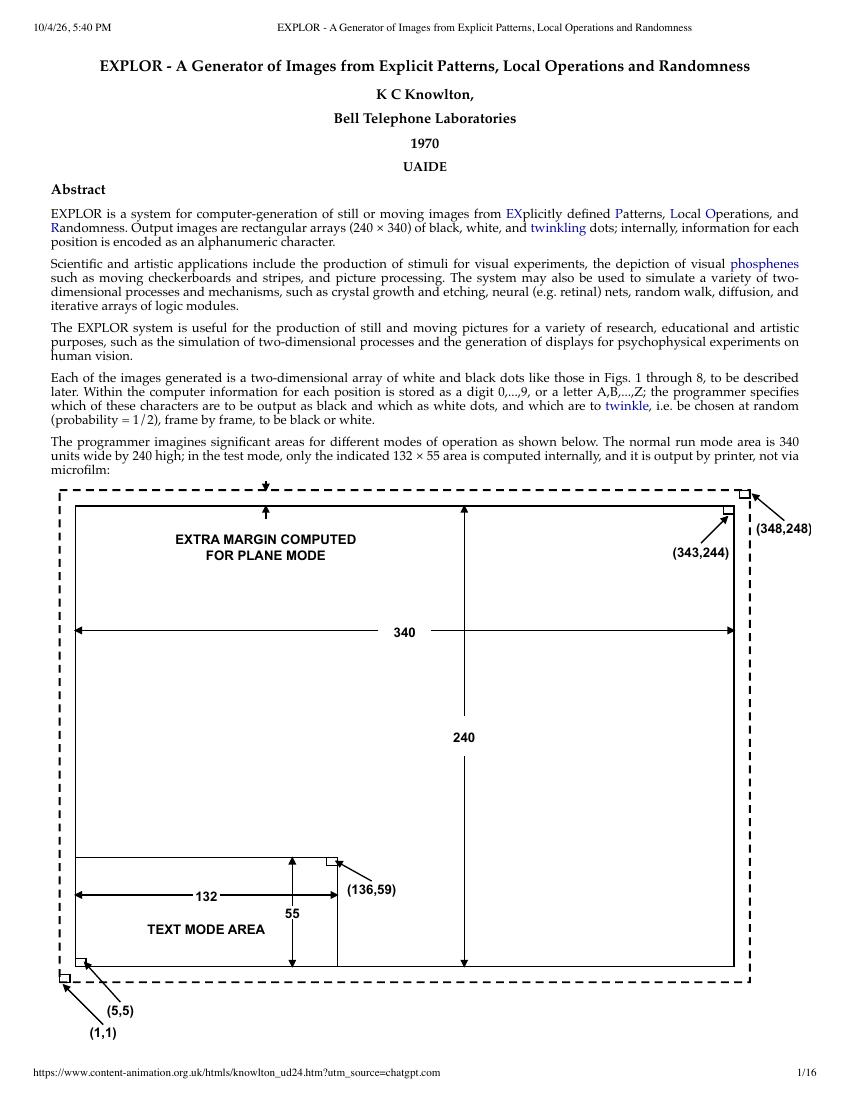
Proceedings of the 9th Annual UAIDE Meeting (Users of Automatic Information Display Equipment), 1970; Knowlton was at Bell Telephone Laboratories, Murray Hill. This copy is the web transcription on Content: Animation (content-animation.org.uk, "More Computer Animation Papers 1964–1976"), printed to PDF on 4 October 2026: 16 pp. with the site's reproductions of Figures 1–8. It is not a scan of the original proceedings. EXPLOR (EXplicit Patterns, Local Operations and Randomness) is Knowlton's picture language of 1970, after BEFLIX (1963): a macro language for generating still or moving images as a 340 × 240 array of black, white and "twinkling" dots, each cell held internally as one of 36 characters (0–9, A–Z) that a WBT instruction maps to white, black or twinkle (chosen at random every frame). The surface can be a torus or a plane, with square or hexagonal neighbourhoods. Pictures are made by transliterations, table look-ups that replace characters with others, applied everywhere (XL), only where a cell's neighbours in named directions belong to a given set (AXL), to specific adjacent pairs (PXL), or inside regular arrays of boxes (BXL, BAXL, BPXL); by explicit patterns coded as octal numbers (PAT) or lifted from the picture (SVP); and by DO/GOTO/IF flow control. Every instruction carries a periodic-and-probabilistic indicator (n, p), "every nth time, with probability 1/p", and instructions can rewrite one another's parameters, patterns and even direction letters at run time (CHV, CHP, XLI), so programs mutate as they run. Eight worked examples with program listings cover crystallisation and etching on a substrate, expanding fringes from random nuclei, overlapping-box designs, line-segment detection after Roberts, designs stamped from the letters BTL, hexagonal snowflake growth, cyclic transliteration of nested squares (akin to scenes in the Schwartz–Knowlton film Pixillation, 1970), and probabilistic collections of rectangles. Technical details: implemented in BE-FAP on an IBM 360/50 emulating a 7094, output on a Stromberg DatagraphiX 4060 microfilm recorder at an effective raster of 1024 × 1366; a full frame of twinkles takes 2.9 seconds. References include Julesz on random-dot patterns and depth perception, Oster on phosphenes, and Roberts's Machine Perception of Three-Dimensional Solids. Cited by Mutsuko K. Sasaki in Generating Beautiful Pictures by Computers (1992), also in this library.