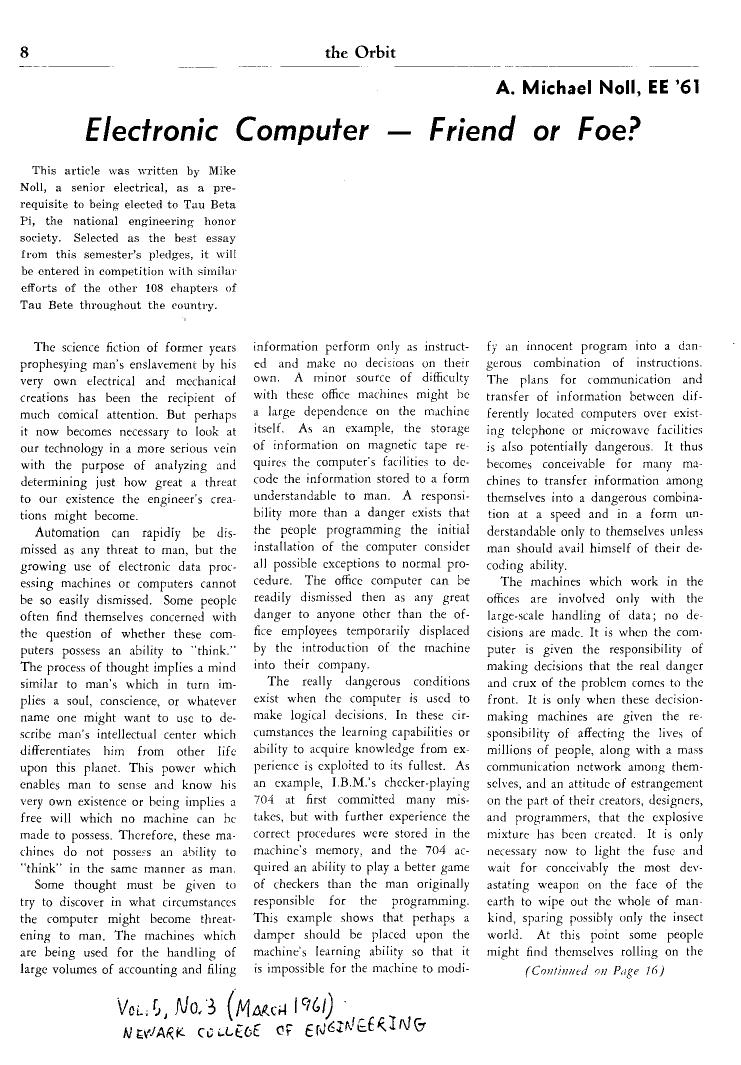
Electronic Computer — Friend or Foe?
- Author
- A. Michael Noll
- Year
- 1961
- Published in
- the Orbit (student magazine, Newark College of Engineering), p. 8, continued on p. 16; byline printed as "A. Michael Noll, EE '61". The scan carries a handwritten annotation reading Vol. 5, No. 3 (March 1961), Newark College of Engineering; that volume, number, date and institution are not printed on the pages themselves. A boxed editorial note states the article was written by Mike Noll, a senior electrical, as a prerequisite to being elected to Tau Beta Pi, that it was selected as the best essay from the semester's pledges, and that it would be entered in competition with the other 108 chapters.
- Subject
- A. Michael Noll
- Tags
- pioneers · essay · research
Notes
the Orbit (student magazine, Newark College of Engineering), p. 8, continued on p. 16; byline printed as "A. Michael Noll, EE '61". The scan carries a handwritten annotation reading Vol. 5, No. 3 (March 1961), Newark College of Engineering; that volume, number, date and institution are not printed on the pages themselves. A boxed editorial note states the article was written by Mike Noll, a senior electrical, as a prerequisite to being elected to Tau Beta Pi, that it was selected as the best essay from the semester's pledges, and that it would be entered in competition with the other 108 chapters.. Self-archived by the author at http://noll.uscannenberg.org/ScannedPapers/1961Orbit.pdf — Noll posts his own papers on his site at noll.uscannenberg.org, which is where this copy comes from. Hosting here is with his agreement, given to Bre Pettis directly on 6 October 2026. His first publication, written as an engineering undergraduate. Noll's earliest publication is a short polemic written while he was a senior electrical engineering student. He argues that the comic treatment of machine takeover in science fiction has made people careless about a real hazard, and proposes a sharp distinction between two classes of machine. Office data-processing machines, which merely file, sort and tabulate, he dismisses as harmless; their worst risks are a dependence on magnetic tape that only the machine can decode, displaced clerical staff, and programmers who fail to anticipate every exception to a routine. The dangerous category, he says, is the machine that is given the responsibility of making logical decisions, because such machines exploit learning ability most fully. His worked example is IBM's checker-playing 704, which made many mistakes at first but, by storing correct procedures in memory, came to play better than the man who programmed it. From this he draws the conclusion that a limit should be placed on machine learning, so that a machine cannot convert an innocent program into a dangerous combination of instructions. He extends the worry to networks: plans to link separately located computers over existing telephone and microwave facilities would let machines exchange information among themselves at a speed and in a form that only they could decode. The argument culminates in a warning about decision-making machines that analyse the world situation and recommend foreign, economic or military policy. Such machines should not be seen as the saviour of mankind, and the readiness to laugh at the danger is itself evidence of a growing estrangement between people, their own thinking powers, and the computer. Noll places responsibility squarely on the engineer who builds the reasoning machine, and notes that the engineer must contend with the ordinary human dislike of having to make decisions. He ends by asking what happens if that estrangement goes uncorrected. Points of record: Noll's first publication, written as an undergraduate; the byline reads "A. Michael Noll, EE '61"; An editorial box states it was written as a prerequisite for election to Tau Beta Pi and chosen as the semester's best pledge essay; He separates harmless office data-processing machines from decision-making machines, and argues only the latter are a real threat; He cites IBM's checker-playing 704 learning to beat its own programmer as evidence that machine learning should be damped; He warns that linking computers over telephone and microwave facilities could let machines exchange information in a form only they can decode; Responsibility, he concludes, rests on the engineer who creates the reasoning and decision-making machine. Noted: The volume, number, month and institution supplied in the citation appear only as a handwritten annotation at the foot of the scanned first page, not in printed form. Page 1 of the PDF has no text layer; its content was read from a rendered image of the page. The title is printed with an em dash ("Electronic Computer — Friend or Foe?").