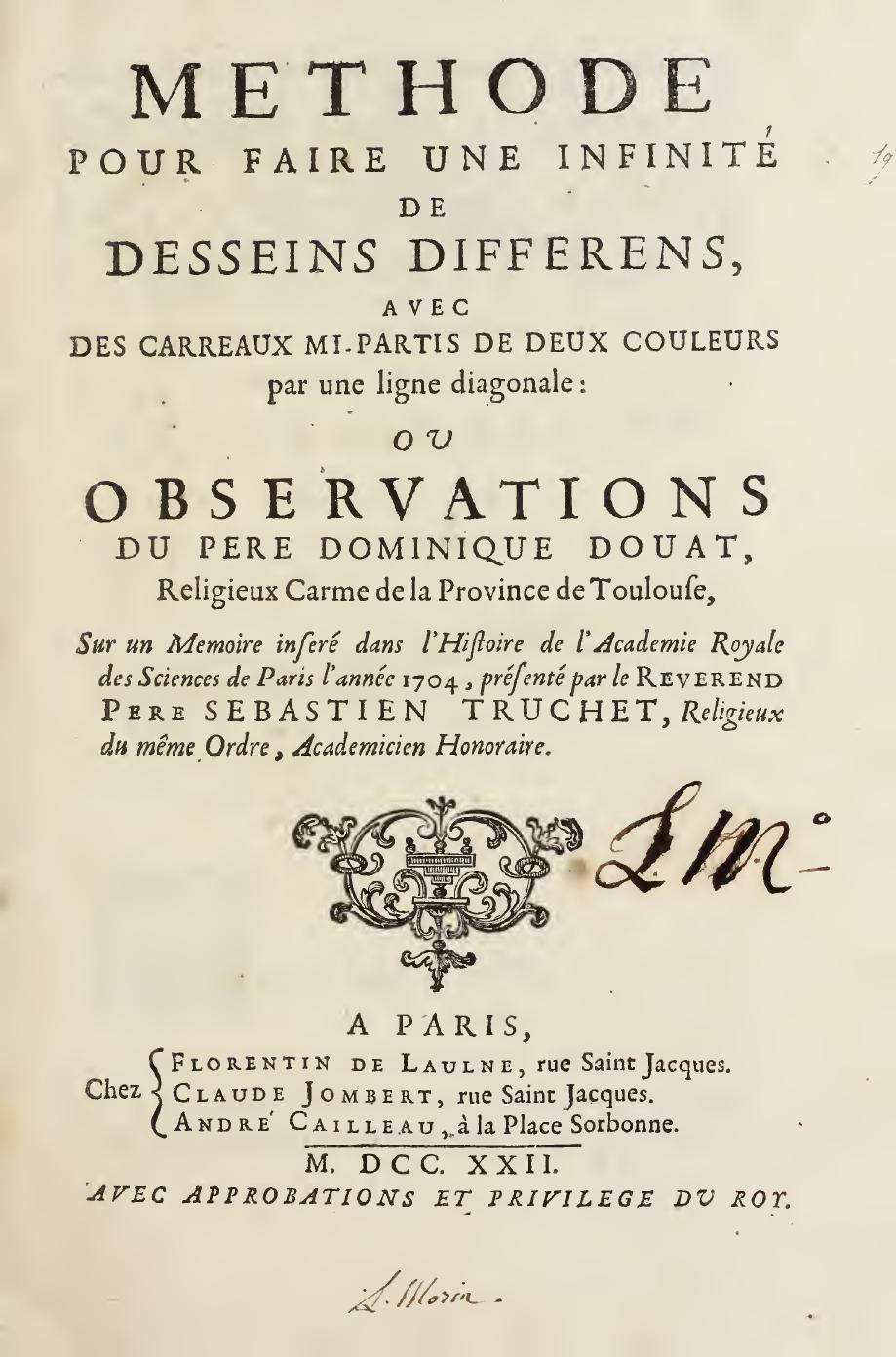
Méthode pour faire une infinité de desseins différens, avec des carreaux mi-partis de deux couleurs par une ligne diagonale
- Author
- Dominique Douat
- Year
- 1722
- Publisher
- Florentin de Laulne, Claude Jombert, André Cailleau
- Tags
- truchet tiles · combinatorics · proto-generative · facsimile
Notes
Facsimile PDF (Internet Archive scan, digitised 2016) of the 1722 Paris edition — Père Dominique Douat, Carmelite of the province of Toulouse, systematically enumerating the permutations of Sébastien Truchet's diagonally halved two-colour tiles, with page after page of printed patterns. E. H. Gombrich called it "the earliest (and perhaps the rarest) treatise on the theory of design." In the library because Mark Wilson's Douat Dump series takes its name from it — see PION.2016.002, Douat Dump A20. Also digitised at Gallica: https://gallica.bnf.fr/ark:/12148/bpt6k5823204r Summary (from a read of the facsimile, 2026-09-02): Douat opens by arguing that all sciences rest on simple principles — mathematics on a single point, arithmetic on nine digits, music on seven notes — and his principle is one square tile halved diagonally into two colours. Seen from one side it has four orientations, which he names A, B, C, D; four letters, repeated and permuted, give 256 four-letter figures and from there designs without end. Part 1 builds the system as numbered Observations, each with a Démonstration: A↔C and B↔D are opposed diagonally (colours swap), A↔D and B↔C horizontally, A↔B and C↔D perpendicularly — so a design's mirror or negative is pure letter substitution. Part 2 is 72 full-page engraved plates of dense, quilt-like pattern fields; Part 3 explains their construction row by row. Part 4 is the remarkable one: 'Pratique pour executer les desseins… sans voir lesdits Desseins' prints each design as a grid of letter strings (BCAD / CBDA / …) beside its horizontal, perpendicular and diagonal opposites, to be executed by laying tiles from the letters alone — never looking at a picture. A closing table gives 256 numbered 4×4 designs as bare letters, 544 designs in all, which Douat suggests trying with cardboard tiles. Source code, its transforms, and sample output, separated — in 1722. Front matter: dedication to François-Xavier Bon of Montpellier; approbations from military engineers, from the Jesuit royal professor of mathematics at Toulouse ('la matière y est entièrement épuisée'), and from the Paris Académie Royale des Sciences — examined by de Lagny and Saurin, certified by Fontenelle, with a further approbation by Varignon. Douat credits Truchet, 'ornament of my Order,' with the 1704 idea throughout. Printed by Jacques Quillau, rue Galande; sold by de Laulne, Jombert and Cailleau; privilège du Roy, 1721.