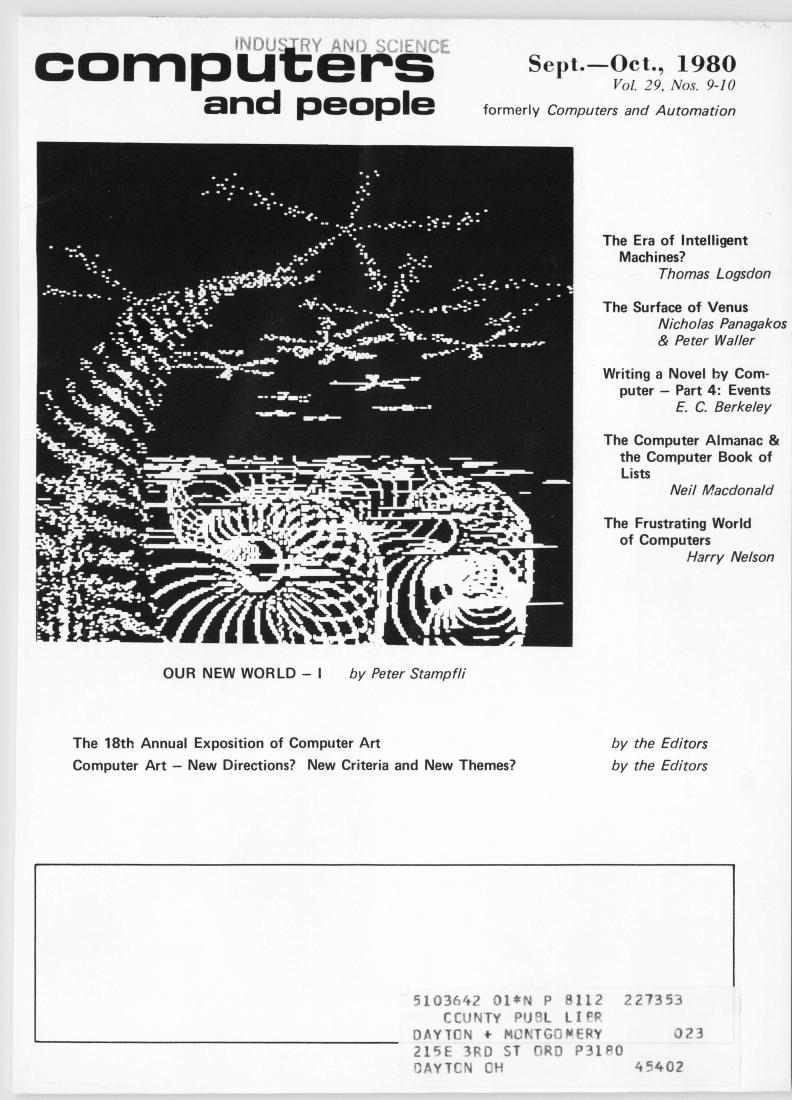
Computers and People, Vol. 29 Nos. 9–10 (September–October 1980) — 18th Annual Exposition of Computer Art (The 1980 Annual Computer Art Exposition)
- Author
- Edmund C. Berkeley (ed.)
- Year
- 1980
- Published in
- Computers and People
- Publisher
- Berkeley Enterprises
- Tags
- magazine · computer art history · digital-scan · computers and people · exhibition catalog
Notes
Berkeley Enterprises, Newtonville MA, September–October 1980. 28 pp., OCR'd scan from bitsavers.org (Computers_And_Automation/Computers_and_People_V29_N09-10_198009.pdf), the source link. 18th Annual Exposition of Computer Art (The 1980 Annual Computer Art Exposition): pp. 8–13. Cover: Our New World – I by Peter Stampfli of Bettlach, Switzerland: a landscape of trees, sun and water waves drawn as dot patterns on an 8080 microcomputer with a 256 × 256 Matrox graphics interface, programmed in Palo Alto Tiny BASIC. The 1980 exposition is the smallest and the most argued-over of the series. Berkeley's editorial, "Computer Art – New Directions?", explains that after discussion over a couple of years the editors imposed four selection criteria: each drawing must be interesting and artistic; must show at least three kinds of forms (crystals, leaves and icicles; trees, animals and the sun); must show them in various sizes, perspectives and orientations; and a form in front must conceal parts of the form behind, as in ordinary drawing. Abstract computer art, he writes, evokes chiefly mathematical, wallpaper and fabric-design ideas, and "after 18 years of publishing computer art (1962 to 1980)" it may be time for computer artists to bring their art to a broader emotional appeal, since "it is human beings and not computers who wish to be stirred by computer art". Five artists met the criteria: Peter Stampfli's microcomputer landscapes ("I'm awfully limited due to the coarse resolution of my graphics, my slow slow processor, and an inadequate programming language"), Richard Helmick's silk-screened Mesas and Canyon, David Dameron's hidden-line Spheres and Network from a home-built Z-80 system, Hertlein's Celtic-derived Lions, Birds, and Pillars, and Bill Kolomyjec's Nike on an Apple II. In the Forum, Hertlein, the magazine's art editor, answers the criteria in "The Criteria of the Computer Art Exposition of 'Computers and People' in 1980 – Some Personal Reactions": her first reaction was that no one should set requirements for artists, but on trying perspective she found the criterion easy and pleasurable, the requirements turning into parameters of her programs. She agrees that much current computer art repeats what was done fifteen and twenty years ago, recalls Cybernetic Serendipity, insists that as an editor she would never set specific requirements, and concludes that the magazine may nevertheless have done computer art a service by focusing on what has not yet been attained; artists should ask "Am I creating for myself? or am I communicating to others?" and should stop treating themselves as high priests. The criteria, she notes, applied to 1980 only. The next July–August issue announced the end of the expositions. Artists and works as credited: Peter Stampfli — Bettlach, Switzerland — Our New World I (cover) and II to V — 8080 microcomputer, Matrox graphics interface (256 × 256), Palo Alto Tiny BASIC · Richard Helmick, Jr. — Dept. of Housing and Interior Design, Univ. of Missouri, Columbia — Mesas; Canyon — black-and-white photographs of coloured silk-screened computer-designed art combining line-printer and plotter graphics, SYMAP and SYMVU software from Harvard · David Dameron — Palo Alto, CA — Spheres; Network — Z-80 system with 48K RAM, Cromemco BASIC, modified Sylvanhills DFT-2 plotter, hidden-segment elimination between spheres · Grace C. Hertlein — Computer Science Dept., Calif. State Univ., Chico — Lions, Birds, and Pillars (from The Celtic Series) — HP 3000, FORTRAN IV, HP raster terminal and flatbed plotter · Bill Kolomyjec — Kolomputer Design, Lansing, MI — A Nike Reaching for a Grape — Apple II driving a Houston Instrument X-Y digital plotter; Nike digitised by hand, hair by linear interpolation between algorithmic curves. Rest of the issue: Thomas Logsdon, "The Era of Intelligent Machines?" (from Computers and Social Controversy); Nicholas Panagakos and Peter Waller, "The Surface of Venus"; E. C. Berkeley, "Writing a Novel by Computer – Part 4: Events"; a Forum letter from Martin Ringle on using the magazine for Vassar's computer-literacy course; Neil Macdonald's Computer Almanac and puzzles; newsletter items on computer crime and the shrinking memory chip; Harry Nelson's "The Frustrating World of Computers".