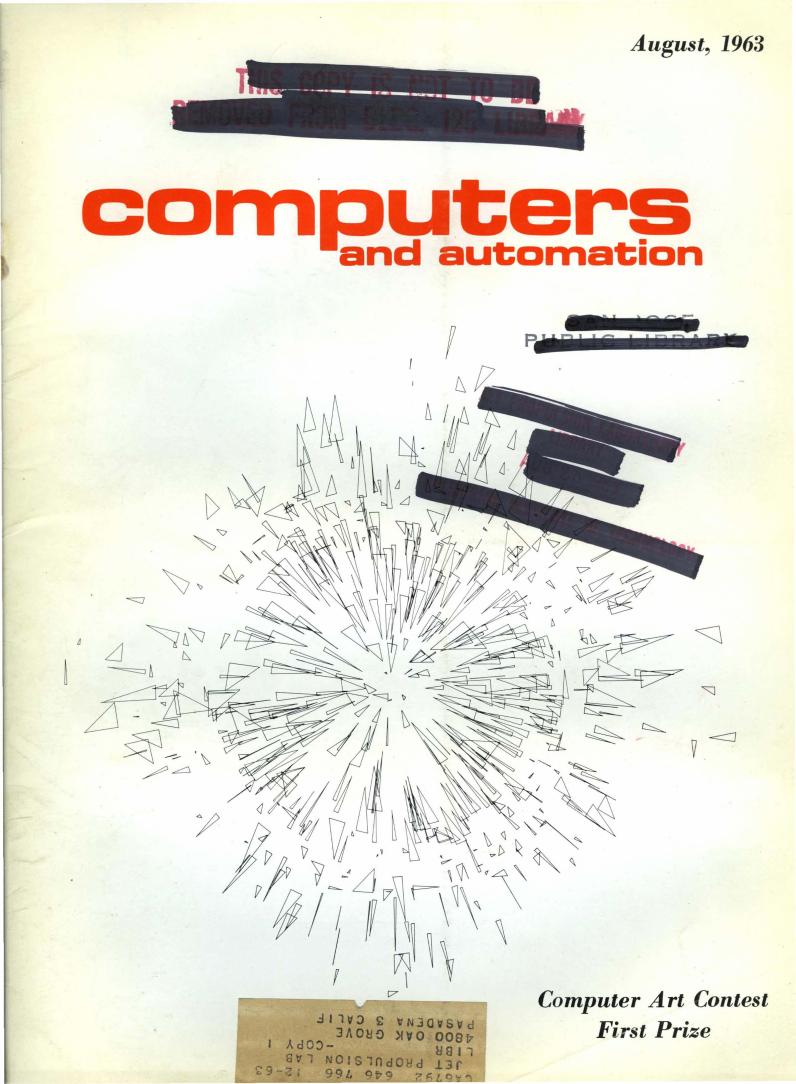
Computers and Automation, Vol. 12 No. 8 (August 1963) — First Computer Art Contest
- Author
- Edmund C. Berkeley (ed.)
- Year
- 1963
- Published in
- Computers and Automation
- Publisher
- Berkeley Enterprises
- Tags
- magazine · computer art history · digital-scan · computers and automation · exhibition catalog
Notes
Berkeley Enterprises, Newtonville MA, August 1963. 48 pp., OCR'd scan from bitsavers.org (Computers_And_Automation/196308.pdf), the source link. Computer Art Contest: pp. front cover and 3 (editorial). Cover: A radial 'splatter' of hundreds of small line-drawn triangles and wedges bursting outward from a centre, labelled 'Computer Art Contest First Prize'; the contents page calls it the 'Splatter Diagram' produced by a computer-directed plotter, and no artist is credited on the cover. The first Computer Art Contest occupies only the front cover and Berkeley's one-page editorial 'The Computer and Art' (p. 3). He explains that the January 1963 cover, 'an artistic design produced by an automatic computer', set the editors thinking, so in February they announced 'an informal contest for examples of visual creativity in which a computer plays a dominant role', with results in August. First prize goes to the cover 'Splatter Pattern' (the contents page calls it a 'Splatter Diagram'), 'a valid plot of an actual computer-found solution' of the radial and tangential distortion of a camera lens, graphed on an Electronic Associates DATA PLOTTER (Long Branch, N.J.). Second prize, 'Stained Glass Window', reproduced large above the editorial, was made on the same plotter by programming a digital computer to solve an area-filling equation, the line widths varied with different ruling pens; it reads as a dense maze-like lattice of right-angled paths. No entrant, programmer or institution is named, and no other entries or entry count are given. Berkeley, admitting the editors are 'without professional qualifications in the field of art', writes that they 'have agreed that these two designs are beautiful, and should be published', announces a further contest and invites readers to 'submit work or ideas which they or their associates have produced in this area of computer art'. The January cover appears as a small inset. This is the seed of the annual series; the 1964 issue later attributes the winning plot to the U.S. Army Ballistic Research Laboratories, Aberdeen, Md. First prize: 'Splatter Pattern' (contents page: 'Splatter Diagram') - a plot of the radial and tangential distortion of a camera lens, graphed automatically by a DATA PLOTTER made by Electronic Associates, Inc., Long Branch, N.J.; the entrant is not named in this issue. Also: Second prize: 'Stained Glass Window' - produced on the same plotter by programming a digital computer to solve an area-filling equation, with line widths varied by using different ruling pens (reproduced at the top of p. 3). Artists and works as credited: (entrant not named) - 'Splatter Pattern' / 'Splatter Diagram' - plot of the radial and tangential distortion of a camera lens - DATA PLOTTER made by Electronic Associates, Inc., Long Branch, N.J. (first prize, front cover) · (entrant not named) - 'Stained Glass Window' - digital computer solving an area-filling equation, line widths varied with different ruling pens - same Electronic Associates plotter (second prize, p. 3). Rest of the issue: Feature articles: 'Deciphering Ancient Maya Writing with Aid from a Computer' by Nicolai Meisak (p. 9); 'Computer in the Bathtub, or Programming Techniques for Processing Clues and Hints' by Peter Kugel (p. 12); 'Electronic Computers and Scientific Research (Part 1)' by Stanislaw M. Ulam (p. 20). Also the editor's scratchpad 'Nuggets of Computerology - UOALPASKB' (p. 7), a readers' forum piece by Mrs. Helen Solem on the IRS allowing a tax deduction for education expense in keeping up with technological change (p. 6), the Computing and Data Processing Newsletter (p. 25), Monthly Computer Census (p. 42), New Patents by Raymond R. Skolnick (p. 47) and Who's Who in the Computer Field (p. 19).