Computer animation and the fourth dimension
- Author
- A. Michael Noll
- Year
- 1968
- Published in
- AFIPS Conference Proceedings, Volume 33, 1968 Fall Joint Computer Conference, pp. 1279-1283. The reprint's head reads “Reprinted from AFIPS - Conference Proceedings, Volume 33, Copyright (c) 1968 by Thompson Book Company, 383 National Press Building, Washington, D. C. 20004”; the running feet read “Fall Joint Computer Conference, 1968”. Byline: Bell Telephone Laboratories, Incorporated, Murray Hill, New Jersey. The supplied citation is confirmed.
- Subject
- A. Michael Noll
- Tags
- computer art history · citation-mined · pioneers · Bell Labs · journal article
Notes
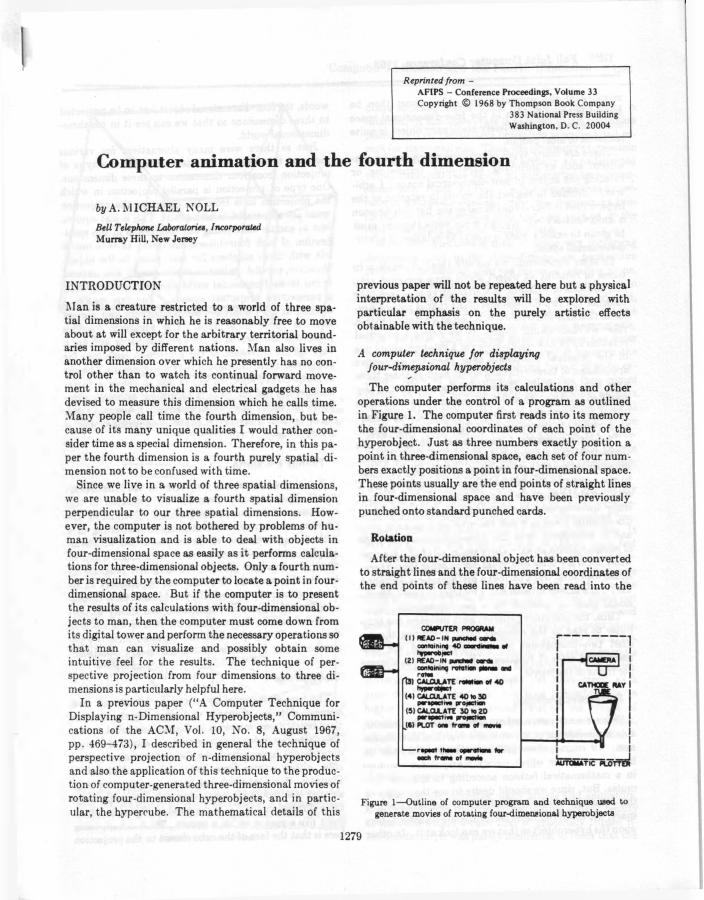
AFIPS Conference Proceedings, Volume 33, 1968 Fall Joint Computer Conference, pp. 1279-1283. The reprint's head reads “Reprinted from AFIPS - Conference Proceedings, Volume 33, Copyright (c) 1968 by Thompson Book Company, 383 National Press Building, Washington, D. C. 20004”; the running feet read “Fall Joint Computer Conference, 1968”. Byline: Bell Telephone Laboratories, Incorporated, Murray Hill, New Jersey. The supplied citation is confirmed.. Self-archived by the author at http://noll.uscannenberg.org/Art%20Papers/Fourth%20Dimension.pdf — Noll posts his own papers on his site at noll.uscannenberg.org, which is where this copy comes from. Hosting here is with his agreement, given to Bre Pettis directly on 6 October 2026. A sequel to Noll's Communications of the ACM paper on displaying n-dimensional hyperobjects (Vol. 10, No. 8, August 1967, pp. 469-473). The mathematics is not repeated; instead he gives a physical interpretation of the results and concentrates on the purely artistic effects. He insists that the fourth dimension here is a fourth purely spatial dimension, not time, which he would rather treat as a special dimension of its own. The computer handles four-dimensional objects as easily as three-dimensional ones, but must transform them so that a three-dimensional creature can see the results. Four-dimensional line endpoints are punched on cards and read into memory. Rotation about an axis is meaningless in four-space, so Noll defines rotation by naming the two-dimensional plane in which it occurs and the rate in degrees per frame. He uses perspective projection, four dimensions to three and then to two, and the coordinates drive a cathode-ray tube photographed frame by frame. The projection of a hypercube with one face parallel to the projection space is a cube within a cube. When the rotation plane is not perpendicular to the viewing axis, the inner cube swells into the outer and the outer shrinks into it, so the object seems to turn inside out. No feel for the rigid four-dimensional object could be obtained; Noll calls the experiment a complete failure at its stated purpose. Because people were awed by the turning cube and did not care that a computer or a hypercube was involved, he explored it for its artistic consequences. The program accepted any four-dimensional points, so he placed the letters A, M and N - his initials - on different planes in four-space, then whole words. That effect made the main title of Incredible Machine, a film about computer graphics produced for the American Telephone and Telegraph Company by Owen-Murphy Productions of New York; the words were plotted on graph paper, placed on two planes in four-space and punched onto cards. The finished title zooms in, rotates, freezes on a frame picked for legibility, and is superimposed over a shot of a man at a display console. He concludes that work should be judged on its own merit whatever the medium, and that computers will be fully exploited artistically only when artists learn them as media. Points of record: Defines four-dimensional rotation by naming the two-dimensional plane of rotation and a rate in degrees per frame, abandoning the three-dimensional idea of an axis of rotation; Reports that the hypercube experiment failed at its stated purpose: no intuitive feel for a rigid four-dimensional object could be obtained from the three-dimensional projection; The cube-within-a-cube appears to turn inside out, an artefact of perspective projection from four dimensions to three rather than a property of the object; Suggests the technique may still serve as a display method for scientific data in more than three dimensions, such as multi-dimensional factor analyses; Noll animated the letters A, M and N - his own initials - placed on different two-dimensional planes in four-dimensional space; The technique produced the computer-animated main title sequence of Incredible Machine, a film about computer graphics made for AT&T by Owen-Murphy Productions, New York; Builds explicitly on his earlier paper, Communications of the ACM, Vol. 10, No. 8, August 1967, pp. 469-473. Illustrated: Figure 1 - outline of the computer program and technique used to generate movies of rotating four-dimensional hyperobjects; Figure 2 - the three-dimensional perspective projection of a four-dimensional hypercube as a cube within a cube; Figure 3 - the perspective projection of a three-dimensional cube with one face parallel to the projection plane, a square within a square; Figure 4 - the cube's faces as distorted squares changing size and shape when the rotation plane is not perpendicular to the viewing axis; Figure 5 - selected frames from computer-generated movies of different configurations of the letters A, M and N on planes in four-dimensional space; Figure 6 - selected frames from the computer-generated main title of the film Incredible Machine, including the freeze frame. People named: A. Michael Noll - author, Bell Telephone Laboratories, Incorporated, Murray Hill, New Jersey; describes himself in the conclusion as an engineer with somewhat conservative artistic ideas, No other individual is named in the paper. Organisations named: the American Telephone and Telegraph Company, which commissioned the film, and Owen-Murphy Productions of New York City, which produced it. Noted: The reprint's cover line names Thompson Book Company as publisher and copyright holder, which the supplied citation omits; otherwise the citation is confirmed exactly, including pages 1279-1283. The paper gives no date for the film Incredible Machine; Noll's 1994 Leonardo memoir dates it 1968 and names Owen-Murphy Productions. No computer model is named in this paper; the plotter is described only as a cathode-ray tube with a camera. The OCR of pages 1282-1283 is poor, with letter-spaced text throughout; readings there were checked against the page images. Figure 5's caption is set as “four-dimen-sional apace” in the scan, i.e. four-dimensional space.