Choreography and Computers
- Author
- A. Michael Noll
- Year
- 1967
- Published in
- Dance Magazine, January 1967. The offprint is footed “Reprinted from DANCE MAGAZINE January 1967” and carries an editor's note; no volume or page numbers are printed on it. Noll's own later bibliographies give Dance Magazine 41, No. 1, pp. 43-45, agreeing with the supplied citation. The editor's note records that the essay was prepared for presentation at the Philadelphia Art Alliance on 9 November 1966 and was sent to England for comment by Ann Hutchinson.
- Subject
- A. Michael Noll
- Tags
- pioneers · computer art history · essay
Notes
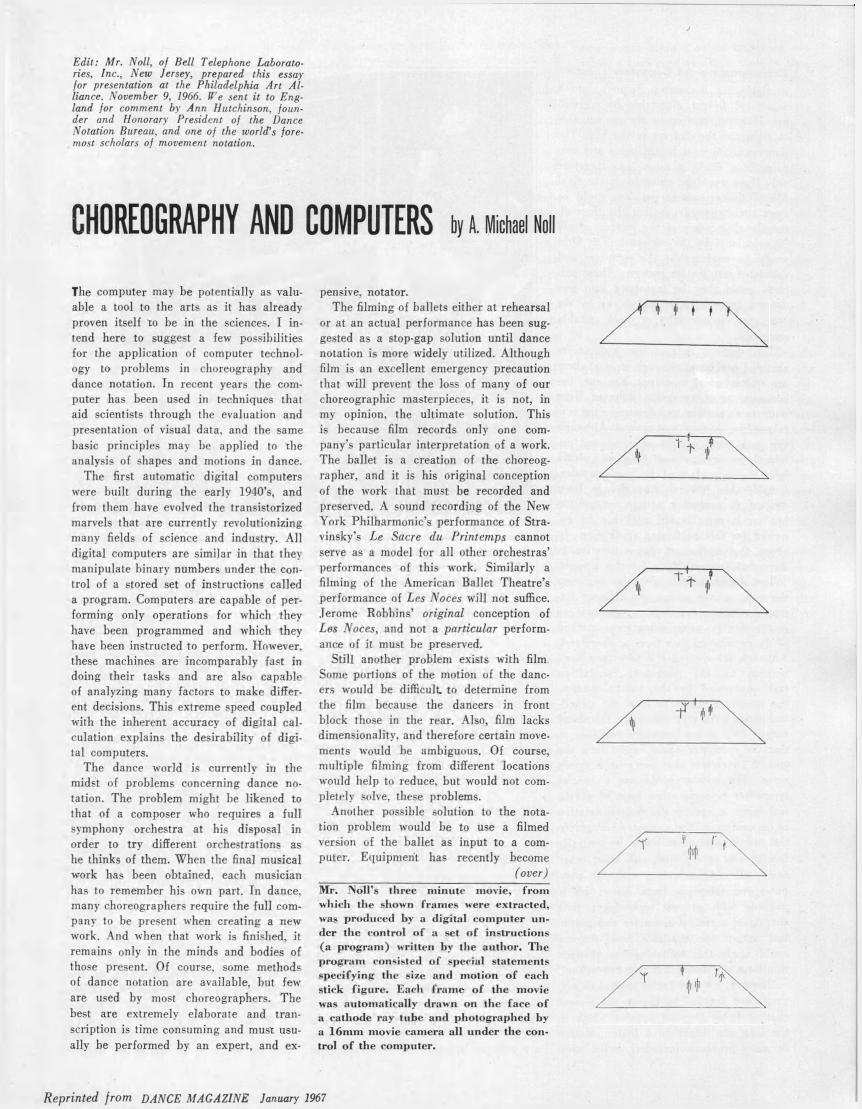
Dance Magazine, January 1967. The offprint is footed “Reprinted from DANCE MAGAZINE January 1967” and carries an editor's note; no volume or page numbers are printed on it. Noll's own later bibliographies give Dance Magazine 41, No. 1, pp. 43-45, agreeing with the supplied citation. The editor's note records that the essay was prepared for presentation at the Philadelphia Art Alliance on 9 November 1966 and was sent to England for comment by Ann Hutchinson.. Self-archived by the author at http://noll.uscannenberg.org/Art%20Papers/Choreography.pdf — Noll posts his own papers on his site at noll.uscannenberg.org, which is where this copy comes from. Hosting here is with his agreement, given to Bre Pettis directly on 6 October 2026. Noll argues that the computer may be as valuable to the arts as it has proved in the sciences, and applies that claim to choreography and dance notation. He sets out the preservation problem: notation systems exist but are elaborate, slow to transcribe and need an expensive expert, so few choreographers use them, and a finished work survives only in the minds and bodies of the dancers present at its making. He likens this to a composer needing a full orchestra to try orchestrations, each player then left to remember his part. Film, he says, is an emergency precaution rather than the answer: it records one company's interpretation, not the choreographer's conception. A recording of the New York Philharmonic playing Le Sacre du Printemps cannot stand for all orchestras, and a film of American Ballet Theatre's Les Noces cannot stand for Jerome Robbins' conception; film also hides dancers behind one another and lacks dimensionality. His first proposal is to film dancers wearing lights in a dim room from several camera positions and let the computer recover their positions and convert the motion into any notation drawn on microfilm, but he judges this too ambitious, the pattern recognition being beyond the state of the art. A graphical dance-notation typewriter on a time-shared computer is possible already. What he really proposes is more radical: the choreographer works with a real-time three-dimensional stick-figure display instead of a corps, storing movements in memory, combining them at will, setting restrictions for individual dancers and letting the machine introduce chance or learn his style. The work then exists in digital form and can be translated automatically into any notation for the dancers, freeing choreographer and dancers from each other. A three-minute computer-generated film illustrates the idea: six stick figures, each a single line for the body, a single-line shoulder and single-line arms, moving at individually specified rates, with random but axis-parallel stage motion and pauses in which three arm-waving figures turn once, an effect he likens to atoms in a gas. He closes by urging that meanwhile every new production be filmed and notated. Points of record: Editor's note: the essay was prepared for presentation at the Philadelphia Art Alliance on 9 November 1966, and Dance Magazine sent it to Ann Hutchinson, founder and Honorary President of the Dance Notation Bureau, for comment; Proposes that the choreographer compose by interacting in real time with a three-dimensional stick-figure display rather than with a live corps; Argues film cannot replace notation because it preserves one company's interpretation, not the choreographer's conception; Describes Noll's own three-minute computer-generated film of six stick figures on a stage, with random but axis-parallel stage motion and programmed arm movement; Proposes automatic translation of the stored digital choreography into any dance notation for issue to the dancers; Suggests the computer could be programmed to learn the choreographer's style and fill in parts of the creative process; Names Balanchine's Apollo, Graham's Appalachian Spring and Robbins' Les Noces as masterpieces at risk, and recommends that all new productions be filmed and notated in the meantime. Illustrated: Six frames from Noll's three-minute computer-generated stick-figure ballet film, each showing a trapezoidal stage in perspective with stick figures at different positions, running down the right-hand column of the first page; A photograph of a demonstrator at a computer display writing numerals with an electronic pencil on an electronically sensitive plate, the computer translating them immediately into stick figures on the screen, with part of the computer cabinet visible at left. People named: A. Michael Noll - author, Bell Telephone Laboratories, Inc., New Jersey, Ann Hutchinson - founder and Honorary President of the Dance Notation Bureau and, per the editor's note, one of the world's foremost scholars of movement notation; the magazine sent her the essay for comment, Jerome Robbins - choreographer of Les Noces, named twice, George Balanchine - choreographer of Apollo, Martha Graham - choreographer of Appalachian Spring, Igor Stravinsky - named through Le Sacre du Printemps, Institutions named: New York Philharmonic, American Ballet Theatre, Dance Notation Bureau, Philadelphia Art Alliance. Noted: No volume, issue or page numbers are printed on the offprint; only “Reprinted from DANCE MAGAZINE January 1967”. Noll's own bibliography gives Dance Magazine 41, No. 1, pp. 43-45, which matches the supplied Vol. XLI, No. 1, pp. 43-45. Ann Hutchinson's commentary, which the editor's note says was solicited, is not included in this three-page PDF. The article headline reads “CHOREOGRAPHY AND COMPUTERS” but the continuation line on the following page reads “Choreographers and Computers”. No computer or plotter model is named in this article; the equipment is described only as a cathode-ray tube with a 16-mm camera under computer control. The film is dated only by implication; Noll's 1994 memoir dates the computer-generated ballet to 1965.